
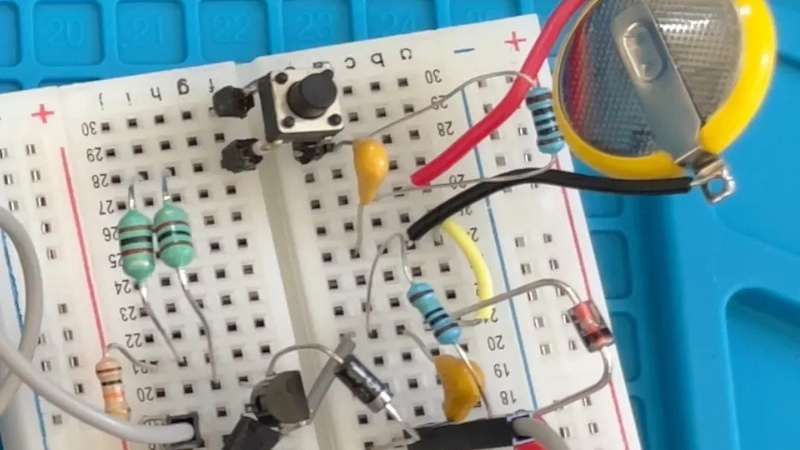
We have all no doubt at some point released the magic smoke from a piece of electronics, it’s part of what we do. But sometimes it’s a piece of electronics we’re not quite ready to let go, and something has to be fixed. [Chris Greening] had a board just like that, a 27 volt generator from an LCD panel, and he crafted a new circuit for it.
The original circuit, which we think he may have drawn incorrectly, uses a small boost converter IC with the expected inductor and diode. His replacement is the tried and tested joule thief, but with a much higher base resistor than its normal application in simply maintaining a battery voltage. It sucks 10 mA from the battery and is regulated with a Zener diode, but there’s still further room for improvement. Adding an extra transistor and using the Zener as a feedback component causes the oscillator to shut off as the voltage increases, something which in this application is fine.
It’s interesting to see a joule thief pushed into a higher voltage application like this, but we sense perhaps it could be made more efficient by seeking out an equivalent to the boost converter chip. Or even a flyback converter.









Could you make it switch the other way around and make it all yellow? Then you could put a black mask over it and create switchable signs.
Did you know that Bigclive actually originally came up with the name ‘joule thief’?
BigClive is an internet legend. Along with Mike’s Electric stuff, Bill Beaty, Jeri Elsworth, Benkrasnow and a half a dozen more I am surely missing. If it weren’t for them I would not have had any fun at all as a teen.
I played around with lighting neon bulbs using a joule thief. Add a third winding with a lot of turns, and you can make an 80V discharge bulb glow from a 1v5 cell.
Now do it with a potato.
Why not use a 555?
The coincell probably won’t, but if you add a bit of electronic circuitry you can get a bunch of kV out of it if that’s your goal.
I’m guessing ultimately the limit in how low and amperage and high a voltage you can achieve is governed by the requirement to get the magnetic field strong enough in a coil to have an effect in the circuit.