

I was looking over the week’s posts on Hackaday – it’s part of my job after all – and this gem caught my eye: a post about how to make your own RP2040 development board from scratch. And I’ll admit that my first thought was “why would you ever want to do that?” (Not a very Hackaday-appropriate question, honestly.) The end result will certainly cost more than just buying a Pi Pico off the shelf!
Then it hit me: this isn’t a project per se, but rather [Kai] was using it as an test run to learn the PCB-production toolchain. And for that, replicating a Pico board is perfect, because the schematics are easily available. While I definitely think that a project like this is a bit complicated for a first PCB project – I’d recommend making something fun like an SAO – the advantage of making something slightly more involved is that you run into all of the accompanying problems learning experiences. What a marvelous post-complete-beginner finger exercise!
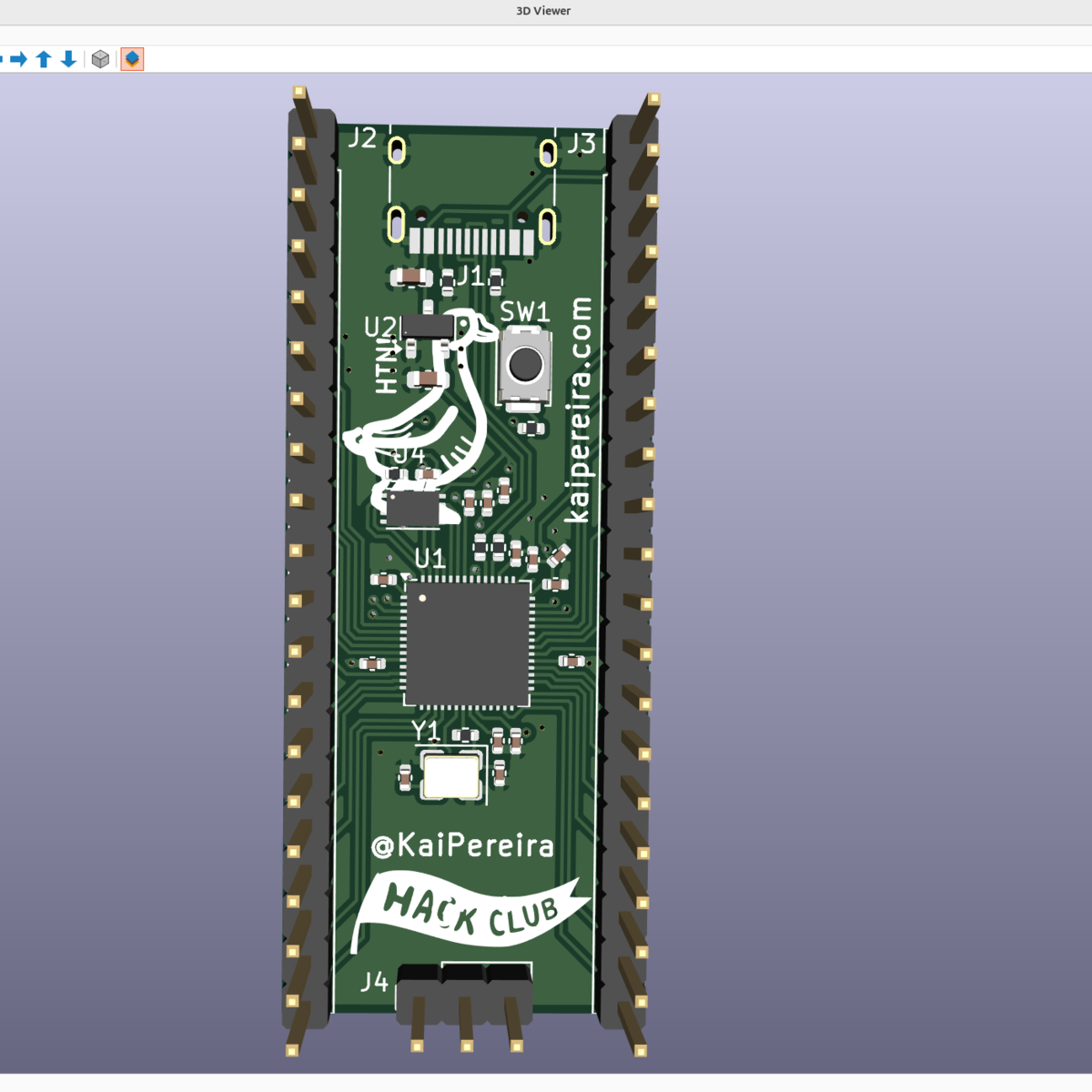 And then it hit me again. [Kai]’s documentation of everything learned during the project was absolutely brilliant. It’s part KiCAD tutorial, part journal about all the hurdles of getting a PCB made, and just chock-full of helpful tips along the way. The quality of the write-up turns it from being just a personal project into something that can help other people who are in exactly the same boat, and I’m guessing that’s a number of you out there.
In the end, this was a perfect Hackaday project. Yes, it was “too simple” for those who have made their 30th PCB design. (Although I’d bet you could still pick up a KiCAD tip or two.) And yes, it doesn’t make economic sense to replicate mass-market devices in one-off. And of course, it doesn’t need that fun art on the board either. But wrap all these up together, and you get a superbly documented guide to a useful project that would walk you through 95% of what you’ll need to make more elaborate projects later on. Superb!
Surely you do “finger exercises” too. Why not write them up, and share the learning? And send them our way – we know just the audience who will want to read it.











That’s what you’re supposed to do if you intend to actually make something out of the RP2040. The development board is nothing but a minimal reference implementation, which you can then expand upon or remove from, depending on your needs. Knowing how to replicate the development board means you know how to adapt the chip into a product.
Unless you’re one of those people who stuff Arduinos and other development boards into products as is, pay the extra cost to the middle man, and live with the fact that it’s a product outside of your control, not built or sold for your purpose in the first place, and may vanish from the market at any time.
Of course the SOC chip may also vanish from the market at any time, though hopefully it’d be rescued as open-source hardware.
That would be true of all components in the end, but that’s a different matter.
Btw. it’s called parasitic design or parasitic engineering: when the host dies, the parasite dies as well.
So you have to be extra careful about what products you latch on to. For example, you might design an electric bicycle to use a bespoke motor for a food mixer, and the only way to obtain those motors is to buy them as spare parts meant for the food mixers. Once the host company EOLs that product and stops producing spare parts for it, you’re screwed.
That’s why parasitic engineering is typical of hit-and-run products, kickstarters, etc. that are only meant to turn a quick buck by shoving something out there and raking the money in while it lasts.
Not all use of off the shelf parts is ‘parasitic’.
Otherwise ‘parasitic’ means nothing.
But you’re right, be extra careful what you use to power your thingie.
Used to be easy, ‘small block chevy’ or ‘bug motor’.
Now many good options.
Recently learned:
The NHRA banned hydrazine from drag racing in 1968.
Pussies.
Digressing again:
E85 (the strain, not the fuel).
When it’s a common industry part, which is available from multiple third parties that can shift to catering to your product instead of whatever they were originally serving, it’s called synergy instead of parasitism. Everyone gets it easier by using the same thing, so the producers shift into making it as a generic product that outlives its original purpose.
Case in point: the Nokia BL-5C battery.
Hold on …
Isn’t that almost literally 90% of these projects?
Doesn’t every project start as:
I want to learn 25 more skills this year and make something with them so I have experience. And this project could cover 4 skills so that’s what I’m doing.
If that’s not how you have been looking at HaD projects, then I don’t actually understand.
Different backgrounds and view points I guess. But I figured our fundamentals would be similar.
This! While I am not fluent in this specific field I feel like you captured a philosophy here that has truly inspired my own tinkering and testing. I get scoffs from some off my coworkers at time for ‘re-inventing the wheel’ but my argument was always that we can ‘trust’ that the wheel can roll or we can ‘know’ how it rolls. I agree that it is not always the most economic in most ways but the value of learning at times can’t be understated.
Such co-workers are accustomed to being “LEGO engineers”. Many companies, especially startups, operate under the minimum viable product principle where they’ll push a prototype directly to production under the motivation that it’s better to make money now to pay for refinements later. They use whatever is available at minimum effort to make something that sells, and the peril is that the management may be more willing to pay their investors and themselves first rather than investing in the future.
That’s not a stable position, especially if there’s a threat of competition later on when the patents and copyrights expire. Others will take the time to go back to the fundamentals and make the same thing better and cheaper. If you don’t “re-invent the wheel”, you’ll be run over by the better wheel.
I bought a “make you’re own Arduino kit” so I could learn about the ATMega328 hardware requirements. It benefited me in a couple of different ways:
I rapidly learned how to break the ATMega328 out of the Arduino and use it in my own circuit designs.
I built a bare chip programmer, using the kit parts, to burn ATMega328s, without the need for the Arduino bootloader and the long boot up delay. ;-)
If you want to learn stuff it is good to break out of the box and projects like this are excellent for that.
I read the HaD article about how to bare-metal program AVR chips, and skipped the Arduino fad entirely. I only started using them later because saving 15 bucks on parts no longer seemed like worth the trouble.