
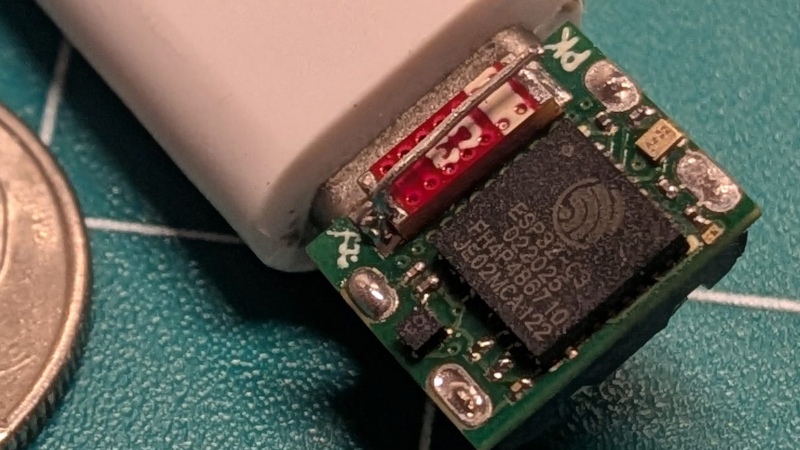
Whenever there’s a superlative involved, you know that degree of optimization has to leave something else on the table. In the case of [PegorK]’s f32, the smallest ESP32 dev board we’ve seen, the cost of miniaturization is GPIO.
There’s only one GPIO pin broken out, and it’s pre-wired to an LED. That’s the bad news, and depending on what you want an ESP32 for, it might not phase you at all. What is impressive here, if not the number of I/O pins, is the size of the board: at 9.85 mm x 8.45 mm barely overhangs the USB-C socket that takes up one side of the board.
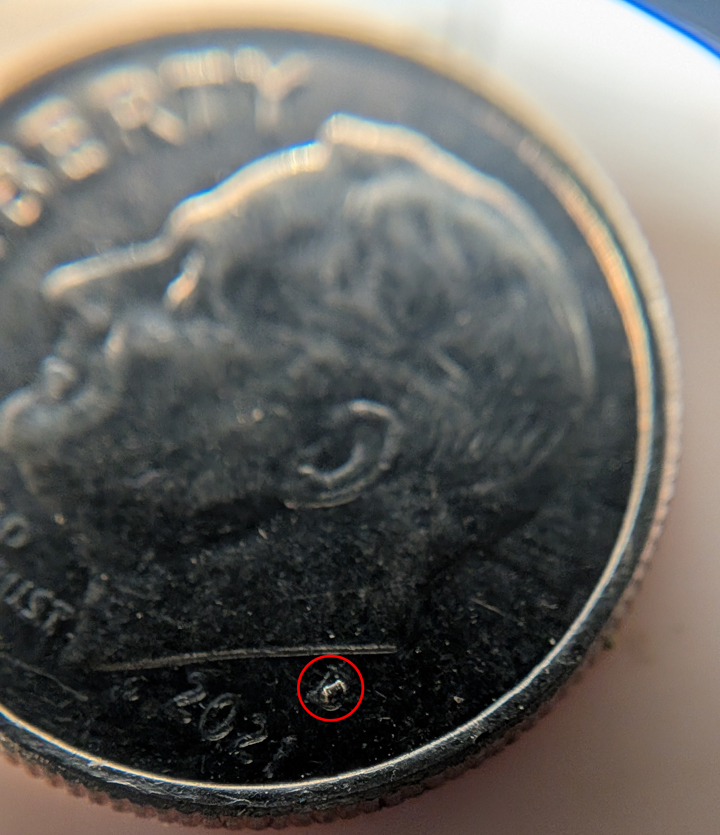
In order to get the ESP32-C3FH4 onto such a tiny board, all of the other support hardware had to be the smallest possible sizes– including resistors in 01005. If you don’t speak SMD, one could read that number code as “oh god too small” — at 0.4 mm x 0.2 mm it’s as minuscule as you’ll find– and [Pegor] hand soldered them.
OK, he did use a hot plate for the final step, but he did tin the pads manually with a soldering iron, which is still impressive. Most of us probably would have taken PCBWay up on their offer of assembly services, but not [Pegor]. Apparently part of the reason for this project was that he was looking for an excuse to use the really small footprint components.
Aside from leaving out GPIO and needing too-small SMD components, [Pegor] admits that pesky little details like antenna matching circuits and decoupling capacitors had to get cut to make the tiny footprint, so this board might be more of a stunt than anything practical. So what can you do with the smallest ESP32 board? Well, [Pegor] put up a basic web interface up to get you started blinking the built-in LED; after that, it’s up to you. Perhaps you might fancy a teeny-tiny minecraft server? If you can stand to increase the volume a little bit, we’ve seen how to hack a C3 for much better wifi performance.
Thanks to [Pegor] for the tip, and remember– submit your projects, big or small, we read ’em all!











You could fit it into the USB-C plug itself by decapping the ESP.
I was thinking the same
Euhm, if 01005 (in Banana units) is 0204 mm, then it’s still quite big. 01005 [mm] also exists. These things almost disappear into the ribs of a fingerprint.
I recently hand soldered some 01005 [mm] diodes. I thought I got an empty cut of tape until I pulled out the microscope. It took a while, and luckily they included 8 extras on the cut tape (on purpose?). My biggest problem was the pads on the bottom of the silicon kept disappearing. I didn’t have a proper hot air station at the time and the board was too big for my hotplate. I also had to sharpen the end of my tweezers with a file to be able to pick them up. I don’t really recommend this method for anyone unless you have no other choice.
You’re an engineering masochistic. Hand soldering things smaller than grain of salt can be extremely painful and agrivating. One sneeze and you lost $0,03 worth of parts that hadn’t been soldered in yet
Back in the late 70s the prevailing comment about miniaturisation was that package sizes were mostly constrained by the elephantine proportions of the human hand. Now we’re seeing that actually demonstrated
Agree
Is it jsut me or is the antenna and the usb -c connector kinda melting into each othe rin the iamge? is it AI or jsut weird perspective?
I think it’s a bodge wire
You could click on the project link and answer your own question in like 2 seconds
It’s weird perspective. Looks like the USB-C port is on the other side of the board.
Welcome to Hell. Here’s your Radio Shack “Baby’s First Soldering Iron” kit and 01005 SMD components.
My first time handling 01005 was at the soldering contest at supercon. And [Pegor] soldered these with even less access.
Same here… I thought I had a chance at winning the soldering contest, then these baby components popped up. They just stuck to the soldering iron!
Wow, I have trouble soldering 0402 (US units)!
All I can think of when I look at those 01005s is the Punisher “no no no no no” meme
Make the unit TALLER. Add another layer so the bottom layer is a bga. We’ve all seen jtag connections that the spring pins push on. Make the solder pads available for the thin wire we used to get from radio shack (wire wrap super thin stuff). Doing this would give you the ability for all io.
Probably definitely small enough to fit a plug, may be good for a Data vampire or exfiltration.
Absolutely seperates all the admired and skilled soldering masters from … me. I am happy to realise my limitations and can say I’d have no chance.
Impressive assembly work.
I have trouble , how run any program from linux
Connected to ESP32-C3 on /dev/ttyACM0:
Chip type: ESP32-C3 (QFN32) (revision v0.4)
Features: Wi-Fi, BT 5 (LE), Single Core, 160MHz, Embedded Flash 4MB (XMC)
Crystal frequency: 40MHz
USB mode: USB-Serial/JTAG
MAC: 10:b4:1d:10:30:2c
Stub flasher running.
Warning: ESP32-C3 has no chip ID. Reading MAC address instead.
MAC: 10:b4:1d:10:30:2c
Hard resetting via RTS pin…