
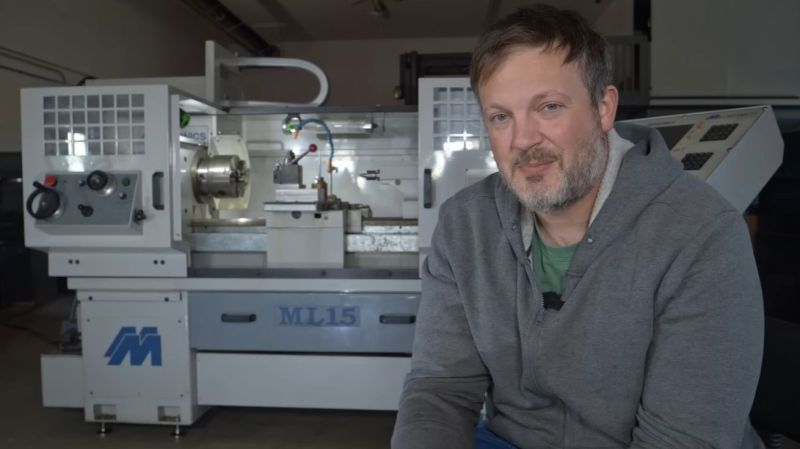
When you’re like [Wes] from Watch Wes Work fame, you don’t have a CNC machine hoarding issue, you just have a healthy interest in going down CNC machine repair rabbit holes. Such too was the case with a recently acquired 2001 Milltronics ML15 lathe, that at first glance appeared to be in pristine condition. Yet despite – or because of – living a cushy life at a college’s workshop, it had a number of serious issues, with a busted Z-axis drive board being the first to be tackled.

The identical servo control board next to it worked fine, so it had to be an issue on the board itself. A quick test showed that the H-bridge IGBTs had suffered the typical fate that IGBTs suffer, violently taking out another IC along with them. Enjoyably, this board by one Glentek Inc. did the rebranding thing of components like said IGBTs, which made tracking down suitable replacements an utter pain that was eased only by the desperate communications on forums which provided some clues. Of course, desoldering and testing one of the good IGBTs on the second board showed the exact type of IGBT to get.
After replacing said IGBTs, as well as an optocoupler and other bits and pieces, the servo board was good as new. Next, the CNC lathe also had a busted optical encoder, an unusable tool post and a number of other smaller and larger issues that required addressing. Along the way the term ‘pin-to-pin compatible’ for a replacement driver IC was also found to mean that you still have to read the full datasheet.
Of the whole ordeal, the Glentek servo board definitely caused the most trouble, with the manufacturer providing incomplete schematics, rebranding parts to make generic replacements very hard to find and overall just going for a design that’s interesting but hard to diagnose and fix. To help out anyone else who got cursed with a Glentek servo board like this, [Wes] has made the board files and related info available in a GitHub repository.












Great work.
Keep preventing nice machines from becoming paperweights or scrap.
Gotta speak up for Milltronic.
I owned a Partner 3 that had been previously upgraded to a 5 (IIRC), it was a good small mill.
The Bridgeport style manually adjustable (in Z) table gave it lots of reach and versatility.
Milltronic provided great support for a far far EOL machine.
I got it on the network (in a DMZ as it needed Lanmanager authorization)!
They were very helpful, even when I revealed I wouldn’t be buying an ISA network card from them, as I’m a packrat.
The servo board is a component Milltronic bought.
Rations of shit for painting out part#s should land on Glentek.
I’ve got a 1995 Partner 1 mill. Had Glentec IGBT failure when I got it but I have a tube of replacement transistors now and extra boards. Had huge problems with the VFD shorting out but replaced it. Now in the process of seeing if I can retrofit a Windows 10 SBC into the card cage to hopefully run DOS as well as W10 when I need it. We’ll see how it goes but you’ve got a great piece of iron that will serve you well with a little maintenance…
Check the brush’s and holders on the Axis motors.
The DC brushed motors on those ran at high voltage when rapiding.
The brushes EDM away the old plastic guides, arcing to the housing.
The drivers either don’t bitch or the error was suppressed by a setting I never found.
It was working OK even with the brushes, closed loop control fixes much.
I was obviously the second person fixing this on mine, the brushes were still worn 40degrees sideways.
Not super hard to fix.
The first guy did it with Epoxy.
I 3d printed new plastic brush guides after drilling out the remaining epoxy and Bakelite.
Such an awesome video
I have supported this model for years . Parts are available, and Miltronics has always been great to me for the mills and lathes
When I saw this video a few days ago, I was a bit surprised by the repair of the servo drive by someone who apparently does not have much electronics experience. And kudos for giving the lathe a new life.
Another thing that surprised me was the USD 1200 price tag for a replacement servo drive. (@ 03:30). The driver board looks like it’s a fairly simple PCB and easy to completely reverse engineer, or make a compatible replacement board. If you’re capable of selling a few of such boards for that price there certainly is plenty of room for some profit.
Wes is quite good at electronics and professionally serviced CNC equipment. In addition to being a great mechanic no less. Learned a lot from his automotive electronics troubleshooting stuff.
“with the manufacturer providing incomplete schematics” I wouldn’t complain too much about this, with so many manufacturers not providing any schematics at all.
Part swapping and perseverance triumph. I bought a Par 5 axis waterjet years ago that had a wiring issue to one axis requiring the previous owner to replace the full cable bundle. They inadvertantly mixed two wires and never could get past the faults. It took a lot perusing of wiring diagrams, swapping axis components and toning wire to find the fix.