
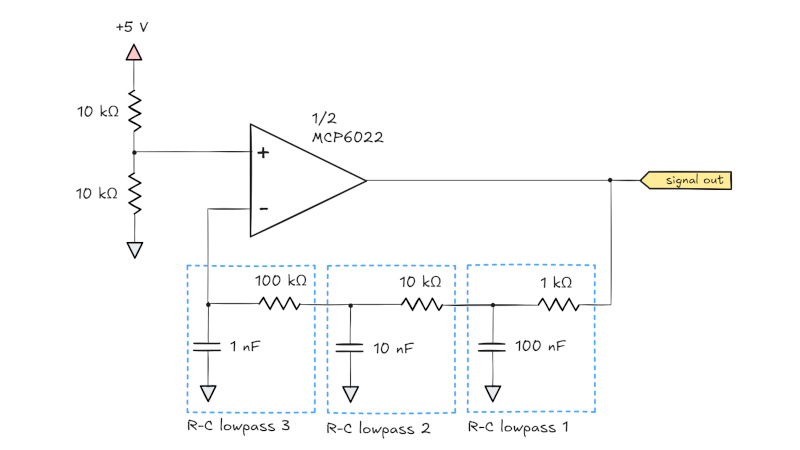
There’s more to making an oscillator than meets the eye, and [lcamtuf] is here with a good primer on the subject. It starts with the old joke that if you need an oscillator it’s best to try to make an amplifier instead, but of course the real point here is to learn how to make not just a mere oscillator, but a good oscillator.
He does this by taking the oscillator back to first principles and explaining positive feedback on an amplifier, before introducing the Schmitt trigger, an RC circuit to induce a delay, and then phase shift. These oscillators are not complex circuits by any means, so understanding their principles should allow you to unlock the secrets of oscillation in a less haphazard way than just plugging in values and hoping.
Oscillation is a subject we’ve taken a deep dive into ourselves here at Hackaday, should you wish to learn any more. Meanshile [lcamtuf] is someone we’ve heard from here before, with a comparative review of inexpensive printed circuit board manufacturers.












Relaxation oscillators, ring oscillators, and the classic multivibrator are all cool and all but what if I need higher frequency oscillator? Its harmonic oscillators all the way. Sadly they are difficult to get right and start up.
Charlie (ZL2CTM) has you covered : 40m CW Transceiver – Part 2a: Oscillator Design.
I guess you can use the square wave from a 555 and have infinite harmonics?
“I’m open to suggestions”
I made a great oscillator for 87MHz to 108MHz. It’s based on the Vackar oscillator. Very flat, stable low distortion, and easy to tune with a varactor. Made with a single transistor. It’s a little finicky to get it to start and only puts out about 50mW, so it requires a buffer. I used a voltage follower which boosts the output to around 100mW and isolates the output from the oscillator.
I once made a great oscillator… too bad the bloody thing was supposed to be an amplifier.
I spent my final year at uni proving mathematically…I could design a microwave amplifier that oscillated and vice versa – because, then, you couldn’t model all the parasitics. You made them work by hacking.
Should have never given away that Model 200A Bill and Dave built.
That was one hell of a good oscillator!
Although HP specified distortion as < 1% over the entire tunable range, distortion at low frequencies could be pretty bad as the light bulb nonlinearity modulated the waveform. My only experience with the 200 series oscillator was with a brand new unit in 1981, which would not have been a 200A. The waveform was so distorted that it was funny.
Once I heard an anecdote about one guy who designed filter for some synth company. But to test it he needed oscillator but things escalated quickly and this is how Access Virus was born. So be careful guys – you may end up as industry leader.
Round-loop gain of 1.
Round-loop phase shift must be a multiple of 360 degrees (2 pi).
https://en.wikipedia.org/wiki/Barkhausen_stability_criterion
Ocillators are a bit of magic. I wanted an old fashioned ESR meter, sensing effective resistance across a capacitor with a 100KHz oscillator as an excitation source. I decided a phase shift oscillator would be the best solution, and I researched online to find the right formulae to work out how to make it work at 100KHz. I didn’t use the technique of increasing the impedance stage by stage, which may have been a mistake ;-)
Using close tolerance components, built using sensible design techniques on a PCB, and danged if the thing doesn’t oscillate at 80KHz. It is a nice sine wave though.
That’s interesting. I’ll speculate that you used a cheap opamp that only had a gain of 10 at 100 kHz. If you used high value resistors / small capacitors, stray capacitance could also lower operating frequency.
TL082 .. but I am running the meter off a relatively low power supply voltage. I wanted it portable, so I used a small LI-Ion followed by boost converters. Maybe I could turn the rail voltages up a bit ..
Old school 1transistor rf oscillators and their PCB layout ! Now theres something to talk about that no-one teaches.
Link?
Will the video where a butterd slice of toast is taped on the back of a cat, then dropped, then since both the cat want to land on its feet and the buttered toast want to land on the buttered side, a perpeetum mobile generator is created (that could be use as an oscillator) would qualify for practical tests?
Definitely a component abuse. Not a typical use of the cat.
Bright LED on the cat, pick it up with an SDR? I’m down.
How do you tune it?
It works the other way too. If you want to build an amplifier try building an oscillator.
it’s easy, bad amplifier are fine oscillators!
I always wondered if you took a Chameleon and placed that lizard on a mirror….
Will it Oscillate as it tries to match the colors in the mirror……
Can you Please suggest Practical Design Guide Book for Opamp and Analog Design
https://www.ti.com/lit/an/sboa092b/sboa092b.pdf
Random thought: is the “Sustain pedal” of an electric guitar, an oscillator – or an amplifier?
Amplifier with a variable gain, possibly. Control the gain as the signal decays to maintain the output as constant as possible until some limit is reached.
If the amplifier clips like mad as well, you could combine fuzz with sustain.
Aaah of course – a Class C amplifier, with the vibrating string forming the tank circuit (typically fou d on output).
According to Prof Budak, all you need to do is move your poles to the imaginary axis, and keep them there. Piece o’ pie.