
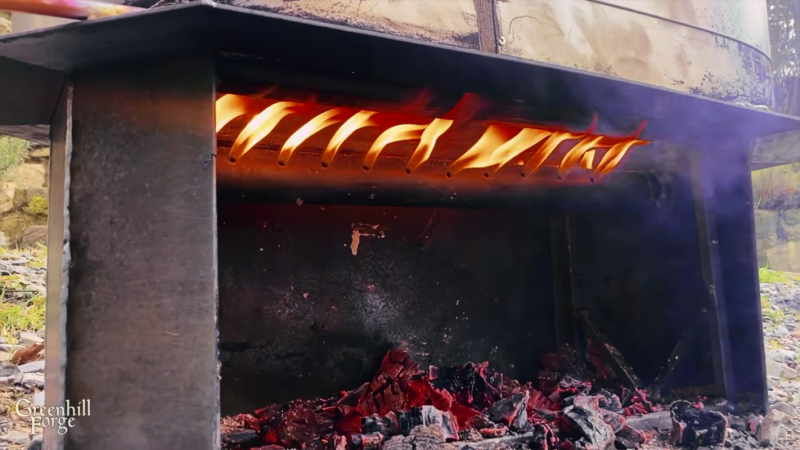
Cooking with charcoal is a fairly common human activity, as much as others have come to prefer fuels like propane and propane accessories for their outdoor, summertime grilling. Although it’s made from wood, it has properties that make it much more useful for cooking — including burning at a higher temperature and with more consistent burn rates. It can also be used as a fuel for generating heat and electricity, but since it’s not typically found lying around in the forest it has to be produced, which [Greenhill Forge] has demonstrated his charcoal production system in one of his latest videos.
The process for creating charcoal is fairly simple. All that needs to happen is for wood to be heated beyond a certain temperature in the absence of oxygen. At this point it will off-gas the water stored in it as well as some of the volatile organic compounds, and what’s left behind is a flammable carbon residue. Those volatile organics are flammable as well, though, so [Greenhill Forge] uses them to heat the wood in a self-sustaining reaction. First, a metal retort is constructed from a metal ammo box, with a pipe extending from the side and then underneath the box. A few holes are drilled in this part, and the apparatus is mounted above a small fire on a metal stand. With the fire lit the wood begins heating, and as it heats these compounds exit the pipe and ignite, adding further fuel to the fire. Eventually the small fire will go out, allowing the retort to heat itself on the gasses released from the wood alone.
To generate the hot water, [Greenhill Forge] has taken an extra step and enclosed the retort in a double walled metal cylinder. Inside the cylinder is a copper tube packed in sand, which harvests the waste heat from the charcoal production for hot water. In his test runs, the water in a large drum was heated to the point that the tubing he used for the test began to melt, so it is certainly working better than he expected.
After the retort cools, [Greenhill Forge] uses the charcoal in another process that generates about a days’ worth of electricity and hot water. It’s part of a complete off-grid system that’s fairly carbon neutral, since trees are an abundant renewable resource compared to fossil fuels. Heating with wood directly is still common in many cold areas around the world, with the one major downside being the labor required to keep the stove running. But we’ve seen at least one project which solves this problem as well.












“It can also be used as a fuel for generating heat and electricity, but since it’s not typically found lying around in the forest it has to be produced…”
I think 7 days to die, burnt biome has this problem licked.
Growing up in a house heated by wood, I learned that heating with wood is very efficient: It warms you three times: Once when you cut it, once when you chop it, and once when you burn it.
My house is still heated (partly) by wood, and it is my secondary backup after gas and electricity.
Don’t forget the fourth time, when you tote it.😁
Burning wood is easy, burning wood efficiency and safely is HARD. There’s no shortage of poorly designed wood burning stoves either. I’ve cut, hauled, split, stacked, stoked, and shoveled the ashes out plenty. Heating with wood is a lifestyle.
There’s a reason why the old WW2 era gasifiers were built in a vertical drum. The air intake is at the bottom and the combustion happens in a funnel with the syngas taken out just above the funnel. The ashes drop down through the funnel onto a grate at the bottom while the fuel is continuously replenished from above. The grate has a shaker which keeps the ashes from getting stuck, and in a moving vehicle there would be a pendulum to move the shaker.
The gases emitted by the fuel as it’s cooking in the hopper are taken out through a vent at the top and directed down to the combustion zone with the intake air, so the system can actually cook the charcoal while it’s running and the volatile gases, tar and steam, are combusted through the fire which breaks them down and gives you more syngas. That’s how they were able to run on wood chips without getting too much tar in the engine.
With that design, approximately 70% of the energy contents of the wood can be converted into syngas versus about 50% for the charcoal burning version.
Correction: the air intake is just above the funnel and the syngas is taken out from the bottom of the funnel. That way the gases given off by the cooking fuel on top of the combustion zone are drawn down through the fire and contribute to the combustion. There is no separate top vent for the gases.
https://www.researchgate.net/figure/Downdraft-gasifier_fig1_289685682
Another advantage of the funnel shape is that you can build a lot of insulation around it and conserve heat.
This is called a downdraft gasifier. It works on charcoal as well, and charcoal was used in the cities because it generates less smoke out of the exhaust and it’s easier to start, but the fuel economy was far worse and reloading the hopper was dirty business. When used in trucks and buses, wood chips were used instead because it goes further on a charge and refueling stations could be set up along the roads without the need to maintain charcoal burning fires. The wood chips could be made into fairly large chunks because they break down through the pyrolysis zone.
Coincidentally, they now sell wood gasifying stoves for heating homes in Europe, for the point that the gasifying process can be slowed down inside a well insulated box and the same load of wood can burn for more than a day, so you don’t need large hot water tanks to moderate the heating. It burns cleaner and more efficiently without a big draft up the chimney. I bet you could tap some of the syngas out of the stove and run the generator on it as well.
Excellent read, thank you for sharing!
Wood might be a renewable resource, but its slow. ‘
One acre of well-managed forest typically produces about 2.5–3 tons of firewood per year on a sustainable basis. Clearcutting an acre typically yields 80–105 tons of timber but is only possible after a 15-80 year growth period depending on species, whereas thinning (removing selected trees) provides roughly 25-40 tons, every 10-15 years after an initial 30-50 year growth period.
A well-managed bamboo plantation can yield between 10 to 20 tons of fresh bamboo per acre every year after an initial growth period of around 5 years.
Forgot to add…
10 tons of fresh bamboo can produce approximately
2 to 3 tons of fuel pellets. So production per acre for fuel purposes falls roughly between equal and double per acre by weight.
Bamboo fuel pellets generally offer better combustion properties—higher heat value and lower emissions compared to pine
Bamboo is a grass so the ash content is greater. Commonly about 2-3 times more.
Yes, compared to pine pellets (around 0.83%), bamboo fuel pellets typically have a higher ash content (around 1.1–1.64%), still relatively low compared to other agricultural residues like rice husk and straw which can exceed 20% ash or corn stalks (and related stover) which typically ranges from 3.6% to 13.2% on a dry matter basis,and can spike higher (up to 23%) depending on soil condition.
From what I can find, Bambusa balcooa is around 0.84% while Bambusa vulgaris is 1.84% while Bambusa tulda is up to 4.5% ash. Pine on the other hand averages closer to 0.5% and tops off at around 0.9% depending on soil conditions.
Another difference is that wood ash is mostly potassium and calcium, while bamboo ash contains a lot of fine silica dust which is a health hazard when inhaled.
Bamboo fuel pellets are almost exclusively produced from Bambusa balcooa as its significantly more productive per acre than B Tulda, or Vulgaris.
Bamboo ash Also contains calcium (Ca), potassium (K), and magnesium (Mg). While the high silica content of stem based wood pellet ash is up to 50%, and that is certainly higher than wood based ash production, its far lower than other agricultural residue. Rice Husk ash is 97-99% silica. Rice straw ash often contains 60-75% silica, wheat straw ash typically ranges around 65-73%, Corn stalk ash often contains around 64–79%
None of this changes the fact that Wood is a SLOW renewable with longer production time, and lower fuel production per acre.
For the information you’ve provided, so is bamboo. If you’re betting for maybe 50% more fuel per year per acre, it’s probably simpler to just buy more land and skip introducing a potentially invasive species to the land. You have to consider that you’re changing the ecosystem and the biodiversity.
For example, in managed forestry, the loggers cut some trees high and leave a dead trunk standing, which dries up and becomes a habitat for insects and birds which normally inhabit old dead trees. What happens if you replace that area with bamboo? Would the native insects and animals survive? If they die, that has a domino effect on other life in and around your bamboo grove. For instance, no birds means you get swarms of mosquitoes, gnats…
What goes for more native species, poplar and willow:
https://biomassmagazine.com/articles/cream-of-the-coppice-5209
Poplar comes with identical heating value to bamboo, and the ash content is reasonably low at 0.46 to 1.29% and being a tree instead of a grass species it contains less silica.
Do you really? – if its your own tiny personal plot of land rather than industrial scale the minor changes to the local ecosystem of your rather intensively managed land on its own is minimal. Now if everyone is doing it…
Indeed, a valid point when you are talking about real managed forestry – but again you are talking probably two orders of magnitude differences in scale.
NB I am very much in favour of using a native tree species that coppices well if it suits all your other needs, or even just a native grass species as in most places there are rather fast growing native large grasses that could be processed for fuel pellets, and may well be more of of co-croping situation providing a useful edible grain etc. But on a tiny scale while actively managing your plot intensively whatever a single individual is doing is bound to pale into insignificance compared to the usual farming and forestry practices of the are in ecological harm – for instance around here there is a huge ‘sustainable forestry’ plantation full of pine, its basically an ecological dead zone as few native plants can actually survive the soil conditions under such a plantation, and being all one species…
If I see my neighbor planting bamboo, I’m going to ask them, nicely, to stop.
If they don’t…Kick him/her, square in the crotch.
Then I’d ninja in and plant a coastal oak on their land, as far from my lot as possible.
They’ll be forbidden from touching land within 50 ft of the damn, protected thing.
Legal problems will keep them too busy to do dumbass shit like planting bamboo (or suing me for kicking them in the crotch until they puked.)
But not a worry, I known my neighbors for years.
If I planted bamboo, they’d kick me.
Coastal oaks are ‘radioactive’, only a complete fool would plant one.
Unintended consequences are a bitch.
@Dude
“For the information you’ve provided, so is bamboo. If you’re betting for maybe 50% more fuel per year per acre,”
Except wood has a 15-80 year delay before meaningful production, then requires either another long waiting period or a less efficient and more labor intensive process of thinning and replanting.
While bamboo has a much shorter waiting period, has a low labor harvest, and requires no labor between harvest, and can be reharvested year after year indefinitely.
As for changing the ecosystem, Agriculture and developed land account for more than half of the US today. Very little of this country is “unspoiled” natural ecosystem. Growing some bamboo isnt going to tip the scales of disaster. And your potentially invasive comment reflects your ignorance in the matter. B Balcooa is a clumping variety (Sympodial). not a runner variety (Monopodial), As such its noninvasive, only spreading outward by a few inches per year. Its easily managed and requires little to contain. Your tilting at windmills.
Clumping bamboo species are classified as low risk, but that is an assessment subject to review. IFAS is updating the assessment every ten years.
https://www.researchgate.net/publication/315720069_Bamboos_and_Invasiveness-_Identifying_which_Bamboo_species_pose_a_risk_to_the_natural_environment_and_what_can_be_done_to_reduce_this_risk
Moral of the story: if you have a stream running through your property or there’s substantial surface drainage, don’t put bamboo on it or it might become your neighbor’s problem.
@Dude Re: invasive bamboo
Your examples cite the spread of bamboo in NON AGRICULTURAL settings. The planting of bamboo for erosion control is dramatically different than the cultivation of fuel/lumber use bamboo. Containing and maintaining clumping species is a trivial concern. The fear of bamboo invasiveness is a paranoia fueled by people with knowledge/experience/anecdote driven by experience with running varieties.
According to what? For what I can find, bamboo averages 18 MJ/kg while pine goes for 21 MJ/kg.
Liu et al. (2016) reported that calorific value of bamboo pellets was 18.5 MJ/kg which was higher than pine wood of 18.3 MJ/kg.
Only high resin pine hits 21Mj/kg, those species/cuts are typically avoided in fuel pellet production due to the fouling deposits it creates during combustion.
I would say 0.2 MJ/kg is not a meaningful difference to call one higher than the other, considering both will have local variation.
So far as generating syngas goes, using bamboo pellets is more costly than coarse chips because the process is more complicated and demands energy in itself. The gas generator doesn’t need fine pellets: a medium size downdraft gasifier can deal with lumps up to the size of your palm. The pellets are needed mainly if you intend to construct a conveyor/auger feed system that would benefit from uniform particle size.
@dude
Youre not wrong. It does take more power to convert bamboo into pellets than to chip wood and Pellets are more efficient to store and feed. But you are not required to pellet bamboo. You can run it through a chipper if you prefer chunks. Most stats for fuel use bamboo is focused on pellets so its easier to use that as a referenced standard.
Industrial electric chippers consuming approximately 11–14 kWh per ton. Wood chips typically produce 3 to 4 kWh of thermal energy per kilogram (kg), One ton of wood chips can typically produce between 500 kWh and 1,000 kWh of electric energy,
It takes ~30kw/ton to process bamboo into fuel pellets. One ton of bamboo fuel pellets typically produces approximately 4,700 to 5,000 kWh of thermal energy. In terms of electricity generation, 1 ton of bamboo biomass can generally produce about 833 kWh of electricity.
Even still. Im not sure you can say its more costly though as bamboos biomass production can be as much as double per acre, and has a much greater production supply stability with significantly lower labor investment.
If renewability is of concern, why not use human fat extracted from corpses before they’re buried? While I find regular burial stupid because today’s cemeteries bring tommorow’s abundance (as new oil/gas fields), cremation is even dumber since it wastes all that potential energy into plain CO². If we could obtain corpses from developing countries with large populations (like India, China or Africa) then we could fuel our economies without relying on Middle East.
Well wouldja look at Mr. Edgy here.
“A Modest Proposal 2.0”. Hey, Egypt used mummies for shingles and locamotive fuel…
Europe used dried and powdered mummies as a cure-all, for centuries.
That’s what ‘took over’ from bleeding, though in truth, they were both cutting edge medicine at the same time.
If we used human fat as fuel, where would we get our soap?
As always Vermin Supreme has the answer…
Whale oil for power, along w the zombie treadmills.
Oil extracted via liposuction.
After introducing McKrills, LAZYwhale recliners, VR headsets for whales, whale fleshlights/sybians etc etc.
And of course switching to a pony based economy…
And processing the social changes the secret dental police will inevitably enable.
Vote Pony Party in the midterms!
Early and often.
Any other vote is simply ‘throwing it away’.
Didn’t James Clerk Maxwell’s dad already think of this toward the end of his life? Thought I read that somewhere :)
“All that needs to happen is for wood to be heated beyond a certain temperature in the absence of oxygen. At this point it will off-gas the water stored in it as well as some of the volatile organic compounds, and what’s left behind is a flammable carbon residue.”
OK, a little off topic but would charcoal production be more efficient if it was done in a vaccum?
I suppose the heat will drive off the remaining oxygen in the chamber real quickly, so the effort to get rid of it in advance is probably not in relation to the gained advantage (if any).
Define which ‘efficiency’ you are thinking about?
% of carbon in wood remaining in charcoal?
% of process input energy in the charcoal?
Value of product vs cost of inputs?
Entertainment value of watching someone attempt to maintain vaccum while the vac pump soots up?
Vac chamber becomes pressure chamber.
Flaming hilarity ensues.
If the requirement is “absence of oxygen” you do not necessarily need to maintain a vacuum during the entire process. Drawing an initial vacuum could be sufficient as there is little likelihood that any of the offgassing will be oxygen.
Additionally, There are numerous measures that can be taken to protect a vacuum pump from “sooting up”. Maybe consider offering constructive insights into potential solutions. Its better to contribute to the discussion than to denigrate it.
No.
It was a dumb question, didn’t even define efficiency.
Much less think through how TF you could maintain any sort of decent vac on hot degassing wood.
I doubt you could prevent a vac pump from sooting pulling on a wood gasifier/charcoal output.
It’s a persistent problem with running an internal combustion engine on wood.
You have to take they heads off and media blast, like it’s a direct injected BMW.
You run the gas through a condensing cooler before the pump to get rid of the tar. Once cooled down enough, the remaining volatiles do not form residues. The reason why engines are having problems with sooting is due to limited cooling and filtering capacity you can fit on a moving vehicle while maintaining enough gas flow to run the engine. With a stationary engine, you can have a wet canvas filter the size of a shed if you want.
Not only more efficient, it also does yield a higher quality product
“Vacuum charcoal production, utilizing vacuum pyrolysis, is an advanced, low-oxygen carbonization process that operates under reduced pressure to produce high-quality charcoal with an open, porous structure. This method yields cleaner, more efficient biochar and activated carbon compared to atmospheric methods, featuring faster reaction times and minimal tar production.”
“It allows for faster carbonization cycles—sometimes as low as 12 hours—and reduces emissions by up to 75% compared to traditional, low-efficiency methods.”
Microwave Vacuum Pyrolysis is an even faster subset of the technology, using microwave energy to raise temperatures, providing a green and efficient way to create biochar with high fixed carbon (over 85%).
You also haven’t defined efficiency, just prattling on, confident.
No.
Burning wood may be renewable, but it isn’t instantly carbon neutral because the CO₂ is released now while the replacement tree may take decades to absorb it.
A production crop that is removed from a field instead of decaying in place stops the land from being a carbon sink, because the organic matter is burned instead of deposited as carbon in the soil. To offset that, you would have to spend some of the fuel as biochar tilled into the soil.
The timescale for CO2 issues is actually significantly longer than the lifecycle of these tree species. It’s “instant” for practical purposes.