
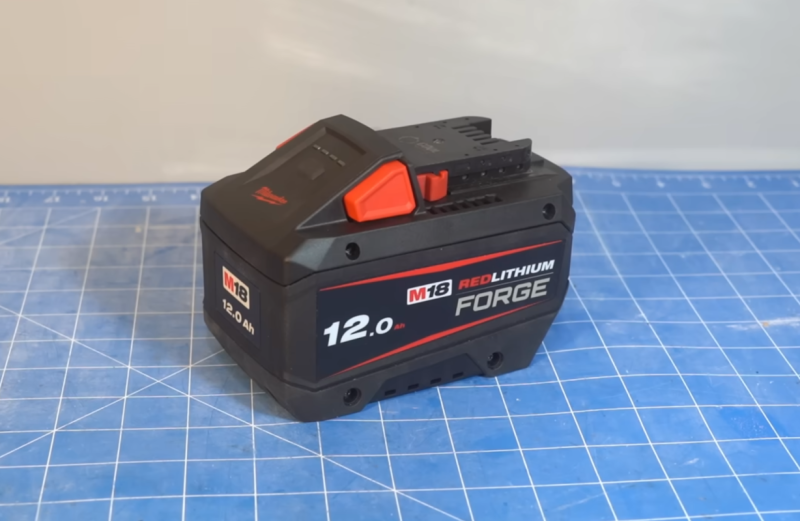
In our modern world full of planned obsolescence helping to fuel cycles of consumerism, the thing that really lets companies dial this up to the max is locked-down electronics and software. We all know the key players in this game whether it’s an automotive manufacturer, video game console producer, smart phone developer, or fruit-based computer company of choice, but there are some lesser known players desperately trying to make names for themselves in this arena too. Many power tool manufacturers like Milwaukee build sub-par battery packs that will wear out prematurely as [Tool Scientist] shows in this video.
Determining that these packs don’t actually balance their cells isn’t as straightforward as looking for leads going to the positive terminal of each. The microcontrollers running the electronics in these packs are hooked up, but it seems like it’s only to communicate status information about the batteries and not perform any balancing. [Tool Scientist] tested this hypothesis through a number of tests after purposefully adding an imbalance to a battery pack, first by monitoring i2c communications, measuring across a resistor expected to show a voltage drop during balancing, let a battery sit 21 days on a charger, and then performing a number of charge and discharge cycles. After all of that the imbalance was still there, leading to a conclusion that Milwaukee still doesn’t balance their battery packs.
Giving them the benefit of the doubt, it could be that most packs will be just fine after years without balancing, so the added cost of this feature isn’t worth it. This video was put out nearly a year ago, so it’s possible Milwaukee has made improvements since then. But a more realistic take, especially in a world dominated by subscription services and other methods of value extraction, is that Milwaukee is doing this so that users will end up having to buy more batteries. They already make user serviceability fairly difficult, so this would be in line with other actions they’ve taken. Or it could be chalked up to laziness, similar to the Nissan Leaf and its lack of active thermal management in its battery systems.
Thanks to [Polykit] for the tip!












I love capitalism where every tool has its own “””ecosystem””” of garbage that breaks itself whenever it wants. So much better than having a mandatory tool battery standard; that would violate my Freedom!
Let’s put E.U parliament to the task :D
I don’t know if its a realistic wish but it’d be so nice !
That’s exactly what we need: the EU to mandate that every tool runs on the same (inevitably new) battery. Then we all have to replace all our tools.
And we’ll be stuck on 12v batteries forever, because a standard enshrined in law will quickly become obsolete.
The problem is that Ali is allowed to ship dangerously – often illegally – bad batteries and other kit at absurdly low prices, so manufacturers are cutting corners to compete.
The EU should focus on enforcing the laws they already have, against every fly-by-night keyboard-mash “brand” that is currently allowed to ignore the EU rules.
Some of the cheapest brands have got this right, Aldi and Lidl both offer tools which can use 12V or 24V battery packs and with the same, standard connector so it’s not rocket surgery so connector and protocol standardisation aint a bad or difficult thing.
They only need to mandate that new power tools have a standard connector type which can support multiple voltages on different pins.
Even if they did that there’s no reason you’d have to junk your old tools, it just needs the manufacturer to continue to make new batteries, hell, going forward if the connector is standardised on new tools then it actually works in your favour and extends the life of your tools because you could buy and use any battery of suitable voltage on it.
And I would be amazed if some enterprising people out there didn’t create adapters to allow the use of new batteries on old tools, just like they already have for Makita LiIon packs on old NiMH tools
Whatever standard connector type is chose, there is still the potential for it to stifle innovation. But even if it doesn’t, standardizing the connector doesn’t solve the issues discussed in this article.
@Jace I was only addressing the issues raised by Dan and positing that a standard connector could be a benefit for consumers.
The argument ‘stifle innovation’ is an argument used by manufacturers to justify proprietary technology, they’ll all claim their technology is necessary but in reality, it’s only there to protect their revenues by locking in customers, it’s almost never there for the consumer’s benefit.
If it weren’t to lock you in then an open standard should be fine yeah??
The standard is set by ETSI, which is the manufacturers. If EU mandates tech, it just forces industry to sit in a room and agree.
Lets call it USB-C PTSD (Power Tool Standard Delivery)
I don’t think they sell Milwaukee in the EU.
They sell Makita though, and I would not be surprised if the export versions of those are also into this game. I don’t think the Japanese have much respect for foreigners actually. But I’m no expert on the Japanese.
Milwaukee is sold in EU.
Of course we have Milwaukee stuff over here. Joined the hype 4 years ago. Burnt several Impact guns, drills, angle grinders and a ridiculus amount of genuine Milwaukee Batteries.
So its back to Bosch and Makita, maybe not as Powerful, but built to last.
This makes me think, there were no phones with those new higher power batteries in the EU, and I am told that was because the rules don’t allow transport of phones with more than a certain amount of amperage per cell.
Recently the larger capacity ones are starting to enter the EU market though, using the trick of putting in two cells to bypass that regulations.
So in fact we now have a risk that the EU created a situation where you get phones with unbalanced cells…
I hope the phone manufacturers don’t start with fake balancing shenanigans.
You have a choice not to buy it. Be thankful for it. When companies do things like this, consumers will find out and will stop buying it and go to a different brand, causing the brand to hurt themselves. Every time an alternative is tried, millions die. Capitalism is the answer and the west needs to go back to it.
Have we considered the possibility that there is, in fact, something between Milton Friedman and cocainized hyper-Stalin?
You make it sound like they had to convert most of Flanders into a gulag to meet the requirements of the USB-PD blood purges of the consumer electronics market.
problem is when the company buy everything up so there are no alternatives look at the shit show with gpus with ai and cuda that nvidia has no alternative so nvidia can abuse their customers as much as they want
GPUs are fine for googoogaga baby companies in AI space. Now-forever-dominant Google doesn’t even sell their TPUs :(
Except this never happens. Consumers buy what the advertisements tell them to, which is why advertising is a billion dollar industry. They wouldn’t do it if it didn’t work. Same as politicians; you can just tell people who to vote for and they’ll do it. I have seen no evidence of a rational consumer. We don’t have free choice, we have a command economy run by the rich.
Oh yes they would. Ever heard of the story of a crocodile whistle?
Both can be true at the same time: some companies pay billions to “carpet bomb” the public with adverts, in order to eclipse their competition who can’t afford to pay as much, and others pay because they dare not try what happens if they don’t. The only people who really make any money out of it is the brokers like Google who get to dictate the prices.
Basically, the takeaway for consumers is that the one product you see being marketed the most is likely to be the worse option, because they’re spending money on advertising instead of product quality and rely on saturation marketing to make it seem like the only option.
Cheap knockoff batteries are available for all of these tool brands, but quality and safety may vary.. actually, all the third party batteries I’ve used have been complete dog doo doo and cracking some open, they did not inspire confidence they would never go “poof” when charging.
I have an old Black and Decker electric lawn mower. As is the case with all battery operated tools the original batteries started to lose charge. I bought knock-off batteries on Amazon but I also did a bit of homework first. The batteries I bought all out-performed the original batteries in life span. This is just one data point but I think it can be applied to tool batteries in general. You don’t always get what you pay for. Alas, my 7yo lawnmower has now bit the dust. Perhaps it can be repaired but may not be worth the investment. I have replaced it with a newer, more powerful and (hopefully) better model. I may try and get it repaired to use as a trim mower at our cabin.
“So much better than having a mandatory tool battery standard; that would violate my Freedom!”
While that would be nice in that situation, the problem with it is that it can go overboard. Plus, at least in the US, regulations are often written to benefit the larger corporations who can afford to comply with them and to present financial obstacles to smaller competition.
purchasing groups are the answer to this crux of a problem under capitalism. they’re not well known but when you have a few thousand purchases at once you have a lot of sway over customisation. they have been sued by irelands competition authority though.
I just want to say I think the diversity of political opinions in the Hackaday comments is pretty refreshing. The conversation about government regulation is not dominated by either Government Interventionists nor Anarcho-capitalists. Many social media outlets are becoming increasingly insular with respect to the political viewpoints of its users, and I think it’s pretty great that Hackaday is full of a broad spectrum of perspectives.
Gotta say I agree with you here – it’s a very welcome thing to see :)
Anonymous may be too young to remember the Floppy Format Wars.
Before the dominance of the IBM PC, home computers with floppy systems all used incompatible formats. There was a lot of noise in the computer press about why they couldn’t all just get along, but in fact the technology was moving much faster than any standards body could act.
Is tool battery technology still moving faster than standards bodies or legislatures? Probably.
However, a simple rule that battery chargers either have a balancing feature or prominently display a warning might help. Or not.
Another example: the modem format wars. by the time the standards body settled on v.90, DSL was on the horizon along with the very first rev of DOCSIS.
(the two competing groups (US Robotics/TI and Motorola/Lucent) at least made their hardware upgradable via software, so there was some foresight there.)
Let’s not forget that capitalism gives us a culture where we can actually tear products apart and evaluate them ourselves. Try that in other economic systems.
I’m pretty sure people take apart tools all around the world, Greg.
The primary cause of cell imbalance in the first place is when you have mismatched cells in your pack – the different internal resistances mean that cells charge at different rates when in series. Balancing such a pack actually requires discharging the higher-charged cells, which ends up adding effective cycles to those cells and aging them faster.
It’s far better if you can nearly perfectly match the cells at manufacturing time, and this is what is actually happening. It’s possible to make a pack that barely exhibits any charge imbalance across it’s expected lifetime, while reducing the cost of the management electronics and eliminating the extra wear that explicit balancing causes.
Of course, the manufacturing and matching processes aren’t perfect, so you’ll have bad packs that fail early, but you’ll always have those. And tool manufacturers tend to have generous warranty replacement policies (just swap the pack if the logs show it failed and wasn’t abused by the user.)
We are talking about packs which fail and lock out because of cell imbalance here, something which a few extra cents of hardware would fix, instead they’re cost engineered into early failure.
Plus, carefully selecting and perfectly matching cells costs time and money which a budget tool company with an overhyped reputation just doesn’t do.
No, all products have a non-zero percentage failure rate. It is simply too expensive (by orders of magnitude) to force the replacement rate completely down to zero. Tradies routinely get the failed packs swapped for warranty replacement without argument, and if that was a significant proportion of all the packs out there then it would bankrupt the tool companies.
We’ve had HaD articles fairly recently that have reverse engineered these packs, and simply “getting imbalanced” isn’t the primary reason for packs getting locked out.
Also, if you have to pretend that Milwaukee is a “budget tool company” to make your argument…
I misspoke, you’re right, Milwaukee isn’t a budget tool company, I should have said Milwaukee is junk, deliberately unrepairable junk that’s cost engineered to the bone but sold with premium prices and promises.
Check out Dean Doherty on youtube if you want an opinion from a professional tool repairer.
Plus, your other point, I didn’t say ZERO defect, I said cost engineered into early failure and not balancing cells is a great way to do that.
Implementing cell balancing could be implemented to extend the life of the packs but Milwaukee have made a conscious decision to limit the life of their packs.
One thing to keep in mind is that TTI, the owner of the Milwaukee brand, also owns Ryobi, which started life as Home Depot’s in-house budget brand. The two brands occasionally share core tool designs for some of the more esoteric devices, with only the spot where the battery plugs in and the color of the plastic being the difference.
I will admit to being something of a fan of Ryobi tools- they haven’t changed the battery interconnect design on the 18 volt One+ system since it came on the market, and even their oldest tools with work on the current generation batteries. To a certain extent, if you are insane enough to have functional ni-cad packs, it’ll still sort-of work with a good chunk of the tool system. (anything requiring the “HP” labeled tools have additional connectors the Ni-cad packs lack- you won’t have a good time with those.)
Also, to finish playing Devil’s advocate: the battery packs are consumables, which is the corporate reason why they don’t care too much about inbalanced and occasional locked out packs.
The argument I’ve heard is that if they still get unbalanced after their careful matching process, the battery could be dangerous
Bosch also does this, there’s no balancing, at least not in the smaller packs.
Funnily, Lidl’s cheap house brand Parkside announces that they use balancing.
Also the cheap Chinese Makita knockoffs, as bad as they are, do in fact have balancing.
And I do agree to the anonymous poster, it’s a shame that we still don’t have standardized battery packs.
The all look the same, only having a slightly different connector, and you can already buy converters from everything to everything.
There’s a bunch of knockoff tools, lamps, USB power banks, etc., that use power tool batteries as a power source, so it’s long overdue to make them universal.
there is no room for socialism in capitalism.
That’s not a very real-“alism” opinion.
Well, according to internet poster “ONV”. Good thing you aren’t in charge!
If only Lidl in the US sold more than just food…
If only I could get access to a LIDL in the US of A. Big cities, yuppa, medium cities , no. Small cities no pro donde Jose
Aldi in the midwest and I’ve bought 3 drills but all had different slots and different plugs for the chargers! Cheap and reliable, till one refused to charge and once inside I charged each call one at a time on an automatic charger. No problem since. Balancing issue?
New packs stay perfectly in balance, but there is no guarantee the cells wear out at exactly the same rate. After all, they’ll see different temperatures based on location in the pack. As soon as one cell gets slightly higher self-discharge, a pack without balancer will quickly become unusable.
So sure, it will last fine for the “expected lifetime” the manufacturer wants, but not as long as it could with a balancer.
You need hard numbers to know what the magnitude of the mismatch is and how long it takes to become significant. If you don’t have them, you’re just assuming that it must be enough to compromise all packs made that way.
The guarantee doesn’t come from physics. It’s economic – any competent manufacturer will spend cents in production to avoid dollars spent handling warranty returns.
It’s notable that the market segment which produces cheap, unreliable crap is also the one that can’t easily be held to a warranty claim (i.e., imported stuff from China.)
Warranty claims only happen during the warranty period. I certainly hope for a battery pack to last more than 3 years.
I once owned a watch with a 2 year warranty, that came with a note which went to explicitly list every part that wasn’t covered by the warranty, which included every part of the watch.
Nope. They charge at the same rate as dictated by the current in series. Each cell in series gets the same number of Coulombs. The voltage during charging for the higher resistance cells will be higher, but the resting voltage will not, which means the charger will see that the whole pack is getting full earlier. That does not mean some cells will become full and others not – it means none of the cells get fully charged.
You get imbalance when the capacity of the cells differ. Internal resistance has some effect on this, but is not the primary cause – varying internal resistance is a symptom of aging and coincides with capacity loss.
Of course if you put in completely different cells from different manufacturers and production lots, you get varying internal resistances as well. That’s just asking for trouble – like your typical content creator type, “I built a powerwall out of discarded vape batteries, oh no why is my house on fire!?”.
It’s more like this in various ecosystems that not only make cheaper off brand accessories desirable to save money, but also because some off brand parts compete on features the original ecosystem manufacturers don’t. We need generic ecosystems where companies must compete on cost, quality and features.
It always annoys me that they chose to take that word and use it wrongly.
The tech industry and journos I mean.
Traditionally the term eco[whatever] is used for living organisms and not hardware, why could they not use a more appropriate word, there are so many words.
ecosystem: noun – Ecology a biological community of interacting organisms and their physical environment.
so whole setup is useless. Solution is to open new pack, add voltage divider on micro pins to emulate battery in perfect condition and when some cell really fail, simply swap problematic cell. Micro will not know, so no lock out.
It is also possible that the chips they are buying in good faith have been cloned and the balancing circuits were omitted. As we have been increasingly made aware, there are lots of fake chips out there.
In case you think that a reputable manufacturer would not do this, Vauxhall once had sub-standard brake components in their supply chain.
Also: Some years ago the buyer for the company where I worked chose to buy capacitors from a once-reputable manufacturer, with types ranging from ceramic to electrolytic, and they were mostly rubbish with sub-standard values, leakage and construction. We noticed when our test failures across the whole range of items suddenly went through the roof.
Sh*t happens!
I used to work for a EU factory that started a second factory in China. Every product was tested before it left the factory. The EU factory had about a 99.9% success rate on all products. After several years, the factory in China still couldn’t reach 40%. They order nuts with a 10.9 grade. The nuts that come in have a class 10.9 rating, but they aren’t 10.9, they aren’t even 8.8. The nuts fail during testing, so they order new ones from a different supplier. Same thing happens again. The oil they buy that goes into the equipment has the same problems, the steel tubes used have the same problems.
It might not be a problem that Milwaukee did on purpose. It could be a supplier buying something they assume is correct from a factory, the first batch is ok and then later they secretly change it with cheaper parts and no one notices, resulting in these issues.
If it’s done on purpose, then this news should be brought to light so people stop buying their equipment.
The game is “Play the pig to eat the tiger”.
Western companies contracting production from China get systematically sabotaged while their products get copied by Chinese competitors. The company is lured in by low labor and material costs, their brand reputation gets destroyed by quality issues, and the copy product gets a foothold on the market instead.
One of the better articles seen here.
The ‘closed captioning’ on the Youtube video is an outstanding PLUS.
No surprise here. It’s a US branded tool, and uses US quality control metrics, and US cost cutting control.
Even Ryobi is now owned by the same company , TTI, a Hong Kong company. The difference is Ryobi is licensed, while Milwaukee is wholly owned.
Japanese Tech vs cost cut Chineese tech, with an American Label, and American quality control. which to choose, which to choose.
Sorry, but no, there is no Japanese tech in Ryobi power tools. Only the Ryobi name is licensed by TTI. The tech is all TTI, as you can see in some of their various crossover tools that have come and gone like JobPlus and JobMax
I’ve been using Hoffer(Aldi) 20/40V 5A tool batteries without issue. Costing 12€ per pack. A real bargain. Opened one up, seems well made. 10x 18650 2.5 A cells with pcb balancing (?) . Works well with Makita tools with an adapter. No complaints from me at that price. 90’ charge time.
The methodology seems pretty clever for determining whether the charger / bms will re-balance the pack. But the consumer question is how long do these packs last under typical usage scenarios, and it’s at best a distraction from that question.
Dyson also have no balancing on the battery packs in their vacuum cleaners. The early battety packs even had the footprints for the required parts on the PCB but left unpopulated. So they were originally going to do balancing but deliberately left it out…….
The best bit is the MCU takes its power from one cell, sending it out of balance over time which then trips the battery protection, bricking the battery. Almost by design.
It’s such a bad issue that there is an open-source firmware now to revive the battery pack once you have manually balanced the cells.
https://github.com/tinfever/FW-Dyson-BMS
From the headline I thought costly power sources had Rick Nielsen squirreled away inside. Had to re-read to get “cheap tricks” plural, not Cheap Trick singular. Sigh. Less fun.
Do something about it! Not just blab…
Many smart people just complaining…
Get together and start working against technocracy…
Abolish artificial locking (matching device to its components by introducing a chip with ID and crypto)
If they say they protecting their software make them release the platform to allow other software…
They will say it is unsafe – well this one is a tough one – need to be reviewed case by case (not every single device(that would take forever)… Case to be a family/type of devices)…
I am pretty tired with cartridge ink being one of most expensive fluids (more than blood)
Or to change break pads you need special tool and subscription to software…
At the moment I just do not use locked stuff if I am able to… But is this sustainable for a long term?