
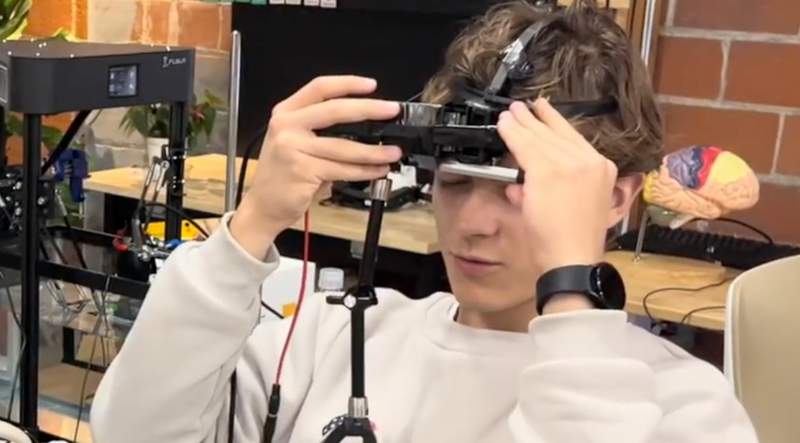
We aren’t sure why, but [Lev Chizhov] and some other researchers have found a way to make you smell things by hitting your head with ultrasound. Apparently, your sense of smell lives in your olfactory bulb, and no one, until now, has thought to try zapping it with ultrasound to see what happens.
The bulb is somewhere behind your nose, as you might expect. This is sub-optimal for ultrasound because your nose isn’t flat, and it is full of air. Packing a subject’s nose with gel wasn’t going to win many fans. The answer was to place the transducer on the person’s forehead and shoot down at the bulb. They made a custom headset that let them precisely target areas of the subject’s bulb guided by an MRI.
So far, they have a sample size of two, but they’ve managed to induce the smell of fresh air, garbage, ozone, and burning wood. What would you do with this? Smell-o-vision? A garbage truck VR game? Let us know in the comments. We don’t think this is exactly how the last VR smell gadget we saw worked, but — honestly — we aren’t completely sure.












Seems like a great device for amateur perfumers. They’ll be able to share scents on the internet with each other.
Or other groups interested in…err…”special scents”.
It would be ideal for the “Smelly cat” videoclip :-D
Heureka… lets build a smelloscope everyone :)
https://m.youtube.com/watch?v=B84O9eRW6O0
Yes, but with BNC terminals for inputs so we can smell our electronics at work. Does a Raspberry Pi smell like it? Can I diagnose a faulty circuit by smell alone? Smells like that hard drive is done!
With this palette of smell, I would vote for an horror VR game.
Even more so if you can mix the odors.
But more generally, any game (or video even) can benefit from odors, it’s just not common yet and for giggles.
So, quick, make an open source API !
People will use OpenOL (Olfactive Layer) and the future will be bright!
OpenOL – The futures bright, the futures stinky.
For those who don’t get it, https://www.youtube.com/watch?v=52M-AYrY708
Oh I ballsed that up, lets try again: https://www.youtube.com/watch?v=52M-AYrY708&t=56s
I was wondering if it’s safe but the article points out it’s weaker than other ultrasound machines used in humans, such machines already being considered safe.
It may be too ‘weak’ to cause actual damage. There should be concern that it cause permanent, non-destructive, rewiring of the cells responsible for smell. What happens if you get permanent phantosmia, and wind up smelling puke-worthy rotten flesh for the rest of your life?
I’d caution against any unfounded presumptions of safety.
Sometimes prolonged, low-level, exposure to something is as hazardous as comparatively brief exposure at higher levels.
The relative proximity of this energetic stimulation to delicate structures like the eyes/retinas is another concern.
Interesting experiments, in any case.
Hmmm I do not think that continuous ultrasound right on your brain for spurious reasons should be assumed safe so easily, and I don’t think the company’s assurance means much, that’s not unbiased medical data (or data at all.)
If there’s a machine that basically simulates that stroke thing where you suddenly smell burnt toast by blasting your brain with vibrational carburetor cleaner I want it to actually go through testing
Those are all smells that people describe right before they have a seizure. Maybe they are not triggering the olfactory bulb itself but instead depolarizing some nervous tissue elsewhere. Like the frontal lobe which is between their transducer and the olfactory apparatus. The brain is a weird thing. You can make someone’s arm or leg move by shocking the scalp over the area of the brain that controls that limb’s movement. Sounds “fun” good luck with that hahha.
If depolarization is a direct result of the ultrasound I would be seriously worried about the intensity. Typically you hit Thermal Index (heating) or Mechanical Index (cavitation) first, which can cause significant tissue damage.
The authors did the homework though, and claim the mechanical index and thermal load were “within safety limits”, but don’t speculate on the actual stimulation mechanism.
Interesting they used the forehead to shoot through. The temporal bone is a far better window: it’s thinner, more transparent and, more importantly, flat on both inner and outer surfaces, so the ultrasound doesn’t get defocussed at the bone:tissue interfaces. They used a quite low frequency though (300 kHz), so the attenuation and defocussing won’t be so bad compared to the usual diagnostic ultrasound frequency of 2-8 MHz.
It’s fun to play with: you can aim an ultrasound beam through your brain to hit the acoustic receptors in the cochlea on the other side of the head. At one watt or so the acoustic pressure is sufficient for you to hear quite clearly an AM modulation on the ultrasound beam carrier. A fetus would hear the pulses in a fetal ultrasound scan quite clearly.
Business opportunity: Speak to your unborn child through the magic of modulated ultrasound!
Ah, hearing voices. Baby’s first religious experience.
Make sure it does not cause damage
Right. Need some test subjects.
What if it induces permanent phantosmia?
Next all we need is touch (hepatics), and we have a sex machine. Hmmmm…. Where are we going with this?
Hey, the TENS system in the previous article falls in that camp. Already widely used. So I’ve heard.
Trapped in the goontrix
I would think that exposing your skull to prolonged ultrasound would be…not great for you?
New torture method that leaves no visible signs just dropped.
I wonder how this works on people with diminished senses of smell
I give it a year before someone with grey-market access to cranial imaging starts providing homebrew stimulator headsets for people with hostile relationships with food in the Bay Area. Considering how liked taste and smell are, it might eventually be possible to eat a dull food like Soylent with part of a good flavor combo in it, and stimulate the rest in order to give the impression of drinking some prestige food like steak or something.
This is interesting and needs more research. Where there prompts for the odours. Being able to make manifest specific scents that do not exist very specifically and consistently would start to make one question the fabric of how we consciously process the world through our senses.