
Remember those brick cellphones in the 1990s? They were comically large by today’s standards. These phones used the 1G network to communicate and, as such, have been unusable for decades now. However [Alan Boris] has resurrected this classic phone to operate today.
Originally costing as much as today’s top-of-the-line phones, but instead of weighing just a few ounces this classic Motorola DynaTAC 8000 Classic 2 tips the scales at a hefty 1.5 lbs. [Alan Boris] decided to not just bring the electronics back to life, but to even stuff a modern cellphone inside it to make it fully functional. Given the size of this phone, finding room for the new innards wasn’t much of a challenge. In fact, after the retrofit there was less in the phone than when it started life.
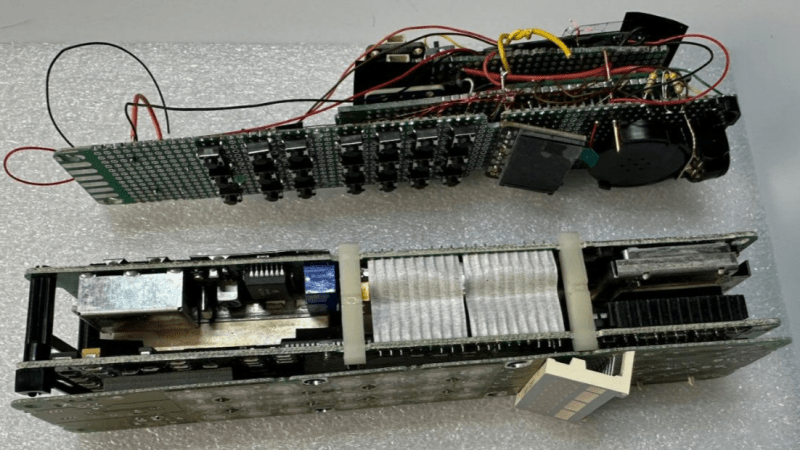
Using a perfboard and some tactile switches he was able to sense the button presses on the phone’s keypad and relay those to a Raspberry Pi Pico 2. The Pico in turn drove a small color LCD to replicate the original screen and controlled a pair of ADG729 boards used to dial the BM10 cellphone within this cellphone. The BM10 is a cellphone about the size of a 9V battery, making it easy to put inside the DynaTAC and bring the handset back to the modern cellular network.
Thanks [Alan Boris] for the tip! Be sure to check out our other cellphone hacks as well as some of our other retrofit hacks.












I wonder what options for the internal phone exist for people in the US? The one used here is 2G only and US carriers phased that out years ago.
You can use the BT10 (and similar) as a BT dialer/handset. I haven’t found any similar phones with 4G or 5G. I suspect he uses it like that too, because he mentioned in the video, that he uses it as a 5G phone.
There is a version of the BM10 that supports 4G.
Really? i gotta find it.
SDR + osmocom-analog + osmo-cc-sip-endpoint will get you there.
There’s a BM80 phone which looks very similar and claims 4G
I’ve wanted to do the same thing to a Mobira Talkman (a luggable phone). Even though that BM10 phone is only 2G, it can work as a bluetooth dialer, so you can link it to a modern phone and dial and speak through it.
I’ve been looking for a BT dialer, either ready made or something like ESP32 project, and those mini phones seem to be the only ones with that capability, meaning i haven’t found any headsets with that feature.
There is a project called “Bakelite to the Future”, which used ESP32 to do exactly that for a rotary phone. I have to look into it more, because i would use an ESP32 instead of Pico anyways.
The only thing i couldn’t quite find out in the project of the topic is how exactly did he connect the speaker and mic to the BM10? Did he just desolder them and connect them with wires? The speaker on the pico 2 is for keyboard beeps only, i would guess, because there is no connection to the BM10 apart from the keyboard signals.
Minus points for butchering a what looked like a quite nice condition original case of the phone.
Essentially a typical HaD hack: Put new components in an old box. Some people like it.
I understand what you mean (I think).
Hacks or mods like this are more about the look&feel.
It’s comparable to making probs for TV shows or sci-fi/phantasy/comic conventions, maybe.
The makers of them usually still care about the underlying technology, but within practical limits.
Reminds me of replicas of, say, futuristic dashboards of famous 80s cars. :)
They usually contain bright modern LEDs and LCD screens,
rather than 70s era LEDs (dim red, green-yellowish, yellow) and glowing halogen lamps and CRTs.
Sound effects are stored on MP3 modules,
rather than era-correct RAM-based “analog” voice recorders (think of early greeting card modules or digital answering machines from 80s/90s).
The whole logic is done via microcontrollers now, rather than electro-mechanical solutions (drum with contacts),
74xxx or 4000 series ICs or discrete logic circuits (relays, capacitors etc).
That will have subtle effects on how things work together.
Older circuits have a certain delay, LEDs will fade out instead of going off instantly etc.
That’s why modern replicas do look a little bit too clean, too sterile.
Seriously, what’s the point other than a vane attempt to get attention from others around you.
“Vain”
With that size of the phone it can be a vane too ;-)
Brickphone or not, what’s missing with my budget cell phone is the ability to plug it into some kind of a 1980s headset, dial buttons and all. Ya know, “landline” office phones kind of headset, the ones that were more-or-less matching the shape of my head, and not the robot’s square head kind head.
I’m not exactly sure what you are looking for, but if this project does not help you, maybe check “Bakelite to the Future” project.
The “correct” hack would be to make a 1G base station and get the phone to connect to it.
hackaday readers seem to fall into two camps on RF applications ‘release all the hertz’ vs ‘I’m a licensed ham and…,’ (Plus no doubt a few ‘I’m a tenured Professor in RF and you kids are all silly’)
So for cred in both former groups the “correct hack” could be do that and aim to stay legal as the cherry on top.
Wonder if there a trimpot like frequency fine tine inside some brick phones for factory calibration, to move it up 100MHz or so from the restricted AMPS frequencies into the ISM band, (for some ITU regions at least). Although 1970s-1980s phones are maybe going to be crystal+divider.
(Prof. RF is shaking his head sadly now)
+1
some old 1G carphones running on 460 MHz band were modified to receive and transmit on 430 MHz and repurposed as 70 cm repeaters, and the modification was somewhat easy. FFirst step was to shift the UHF parts down, and then there was a logic board with a microcontroller, and swapping that with a CPU programmed to behave like a repeater did the trick. If I remember correctly there was also the option to use it as an AX.25 digipeater/TNC.
https://iw1cgw.wordpress.com/2016/03/01/italtel-mb45-diventa-un-ripetitore/
I recently aquired a few Motorola Silverlink 2000 (rebranded in Dutch as Greenhoppers or Kermit phones). These were incredible small phones for their age, though not fully cellular (they were bimode, worked from home and from “base stations” on most train stations, gas stations an highway rest stops.)
I’d love to retrofit them to modern phone usage, but I don’t have the technical skills to even do that!
They sound a lot like the Rabbit phones we had for a while in the UK.
https://en.wikipedia.org/wiki/Rabbit_(telecommunications)