
When you think of ultrasonics, you probably think of a cleaner or maybe a toothbrush. If you are a Star Trek fan, maybe you think of knocking out crew members or showers. But there is another practical use of ultrasonics: cutting. By vibrating a blade at 40 kHz or so, you can get clean, precise cuts in a variety of materials. The problem? Commercial units are quite expensive. So [Electronoobs] decided to roll his own. Check it out in the video below.
There are dreams and then there’s reality. Originally, the plan was for a handheld unit, but this turned out not to be very practical. Coil actuators were too slow. Piezo elements made more sense, but to move the blade significantly, you need a larger element.
Taking apart an ultrasonic cleaner revealed a very large element, but mounting it to a small blade would be a problem. The next stop was an ultrasonic toothbrush. Inside was a dual piezo element with an interesting trick. The elements were mounted in a horn that acts like an ultrasonic megaphone, if you will.
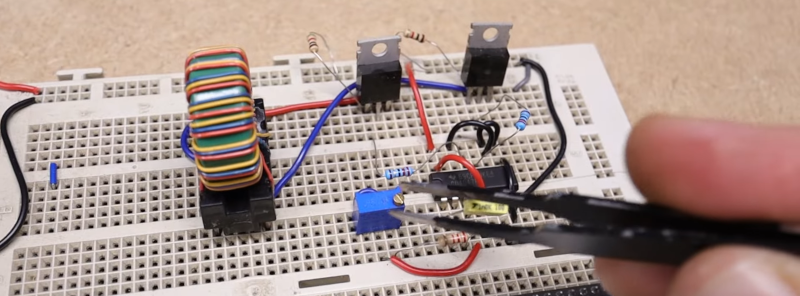
These horns are available, and he found an off-the-shelf solution with four piezos and a large horn that seemed promising. Driving the elements, though, requires a 40 kHz 100 VAC signal. His original board didn’t work — but he’s not giving up. But, for now, he used a simple circuit on a breadboard. However, it didn’t make a strong vibration, even with a larger horn.
Comparison with ultrasonic cleaners showed that his output voltage wasn’t enough. The expedient answer was to buy an ultrasonic cleaner kit (who knew they came as kits?) and use the boards from it to drive the horn and the blade. That worked very well.
His current thinking is that the cleaner driver may be too large, since the blade and horn get hot in use. But he still encased it with a 3D printed case and wound up with a usable tool. His next version should be portable and maybe run a little cooler.
Ultrasonic sensors are, of course, super useful. Or you can always levitate tiny things with it.











This is fantastic. I’m tempted to build my own now but I’d also be happy to buy a kit as long as it is OSHW.
I remember when I was a kid and the first time a “vibroblade” was mentioned in a Star Wars novel. It was described as a fragile, incredibly thin blade oscillating at high frequencies such that the blade itself looked fuzzy around the edges, but it could gently slice through almost anything. The device was described in such detail that I was captivated by the idea that such Star Wars technology could actually exist, only to find out years later that they do, in fact, actually exist.
It’d be a godsend for precisely trimming flashing and sprue, or making precise cuts in models.
Sprue, what’s that? also…eh, I don’t want to spoil your nostalgia, but, it wasn’t like Star Trek communicators, that came true(sortof) later; if I can share my own nostalgia, as a child I observed an “electric knife” (apropos it was Thanksgiving in the ’70s) and I imagined it could be made more powerful, even into a sword, perhaps my friends also proposed it, it was a fairly obvious leap, and popular in the UK at the same time. It’s less exciting than your discovery of it in a Star Wars novel, but it also makes the limitations more obvious. Perhaps I’m less disappointed and probably more skeptical that it can be made “portable” cheaply. That’s how it goes.
Sprue: In my experience of making plastic models of lanes and boats by, for example, Airfix or Revel, the sprue was the plastic I had to twist or cut the parts off. It was a byproduct of the injection moulding. Hope that helps ☺️
Not sure it´s worth building one, look: https://de.aliexpress.com/item/1005009806462605.html
with the promo code it get quite cheap …
I mean, this is Hackaday, not Buyaday.
I’d rather build my own, or support someone putting out OSHW than just buy one off the shelf.
I see your “vibroblade, and raise you the “vibro-saw” from “Farmer in the Sky” by Robert A. Heinlein (published 1950)
I find it amazing that those books were from around 1950. When I found them in the school library around 1960 they were as a fresh and tantalizing as if they were a message from the future. At that time Yuri Gagarin and Alan Shepard’s flights were a year away.
I just drink 4 or 5 cups of coffee and my knife blade vibrates all by itself.
Ah, the Flash.
I wonder if adding ultrasound to a soldering iron would have any useful effects.
It does, in fact. Applied Science did an episode on that. tldw; the solder sticks to everything like magic.
Why DO we think the Philips Sonicare line of toothrushes is ultrasonic??
I certainly was among the rubes who thought so until one day (after several years of neglecting my oral hygine) I required ultrasonic root planing to restore my oral health. No one who has undergone the tortures of that infernal machine could mistake a Sonicare as somehow being ultrasonic, and post facto it’s incredibly obvious that the Sonicare isn’t rising above the range of human perception BECAUSE YOU CAN HEAR IT.
Mine hums along at 250Hz and various overtones.
I’m gonna go out and a limb, here, and postulate that you might have figured out why they didn’t name it the Ultrasonicare.
That name would be considered too long, even if it was ultrasonic.
It took me nearly 6 years of R&D to make a handheld, cordless ultrasonic knife (a chef’s knife, specifically). This guy got pretty close, way faster than I did. Hats-off to him; power ultrasonics is a wildly difficult domain to learn. Driving a piezo stack is full of hidden challenges (they call it a “neurotic load”), and understanding the impact of geometry and material interfaces on resonance is a whole ball of wax. But Electronoobs had some excellent intuitions in his video. I wish a starting point like this existed when I was in blind tinker mode.
How about mounting this now to a cnc drag knive 🤔
+1 Exactly what I was wondering.