
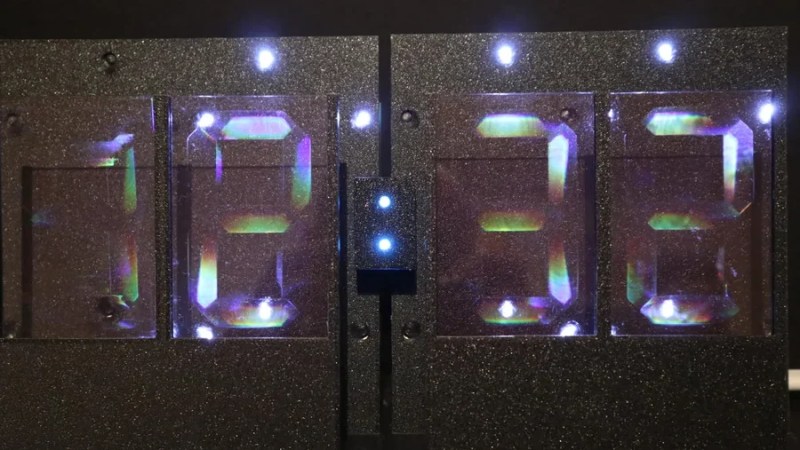
Seven-segment displays are one of the most ho-hum ways to display the time. They were cool for a little bit in the 70s, but by now, they’re a little bit old hat. That is, unless you get weird with it. This holographic seven-segment clock from [mosivers] qualifies neatly in that category.
The first step was to make the holographic segment displays, because they’re not really something you can just buy off the shelf. [mosivers] achieved this by using a kit from LitiHolo, which enables you to create holograms by shooting a laser at special holographic film. Only, a few upgrades were made to use the kit with a nicer red diode laser that [mosivers] had on hand for better performance. The seven-segment layouts were carefully recorded on to the film to form the basic numerals of the clock, such that illuminating the films from different angles would light different segments of the numeral. It’s quite involved, but it’s explained well in the build video.
As for the timekeeping side of things, an ESP32 was used, setup to query a network time server to stay accurate. The microcontroller then commands a series of LEDs to light up as needed to illuminate the relevant segments of the holographic film to show the time.
Ultimately, [mosivers] built a cool clock with a look you won’t find anywhere else. It’s a lot more work than just wiring up some classic seven-segment LEDs, but we think the result is worth it. If you fancy other weird seven-segment builds, though, we’ve got plenty of others in the till.












Yes, seven segment displays were cool in the 1970s. In 1974 I was a freshman at MIT. I knew a guy who built digital clocks to impress the girls in high school. Not sure if he ever had any luck with that but they really were pretty cool! Also sad. Lol.
I built digital clocks in high school, too, at about the same time. I never had any problem with girls (multiple girls had crushes on me at various times), but I don’t think my interest in electronics had anything to do with it. On the other hand, I ended up going to Caltech instead of MIT; that was probably the difference.
Great comeback. Referencing the old school rivalry cracked me up.
I’m surprised there are not more comments! The fact they rolled their own holograms that then can only be viewed when lit by specific angles (each digit segment was processed separately) is a super cool approach
In principle, for a one-minute resolution display, you could have a single-sheet hologram that is capable of displaying all 720 or 1440 configurations directly, and dispense with the segments. Probably well beyond what you can do in a home lab without an optical table, etc.
another throw-back project (to the 70s this time), but with a big difference : this clock seems impossible to read !