

We’ve all been there. You’ve found a beautiful piece of older hardware at the thrift store, and bought it for a song. You rush it home, eager to tinker, but you soon find it’s just not working. You open it up to attempt a repair, but you could really use some information on what you’re looking at and how to enter service mode. Only… a Google search turns up nothing but dodgy websites offering blurry PDFs for entirely the wrong model, and you’re out of luck.
These days, when you buy an appliance, the best documentation you can expect is a Quick Start guide and a warranty card you’ll never use. Manufacturers simply don’t want to give you real information, because they think the average consumer will get scared and confused. I think they can do better. I’m demanding a new two-tier documentation system—the basics for the normies, and real manuals for the tech heads out there.
Give Us The Goods
Once upon a time, appliances came with real manuals and real documentation. You could buy a radio that came with a full list of valves that were used inside, while telephones used to come with printed circuit diagrams right inside the case. But then the world changed, and a new phrase became a common sight on consumer goods—”NO USER SERVICABLE PARTS INSIDE.” No more was the end user considered qualified or able to peek within the case of the hardware they’d bought. They were fools who could barely be trusted to turn the thing on and work it properly, let alone intervene in the event something needed attention.
This attitude has only grown over the years. As our devices have become ever more complex, the documentation delivered with them has shrunk to almost non-existent proportions. Where a Sony television manual from the 1980s contained a complete schematic of the whole set, a modern smartphone might only include a QR code linking to basic setup instructions on a website online. It’s all part of an effort by companies to protect the consumer from themselves, because they surely can’t be trusted with the arcane knowledge of what goes on inside a modern device.
This Sony tv manual from 1985 contained the complete electrical schematics for the set.
byu/a_seventh_knot inmildlyinteresting
This sort of intensely technical documentation was the norm just a few decades ago.

It’s understandable, to a degree. When a non-technical person buys a television, they really just need to know how to plug it in and hook it up to an aerial. With the ongoing decline in literacy rates, it’s perhaps a smart move by companies to not include any further information than that. Long words and technical information would just make it harder for these customers to figure out how to use the TV in the first place, and they might instead choose a brand that offers simpler documentation.
This doesn’t feel fair for the power user set. There are many of us who want to know how to change our television’s color mode, how to tinker with the motion smoothing settings, and how to enter deeper service modes when something seems awry. And yet, that information is kept from us quite intentionally. Often, it’s only accessible in service manuals that are only made available through obscure channels to selected people authorised by OEMs.
Two Tiers, Please
I don’t think it has to be this way. I think it’s perfectly fine for manufacturers to include simple, easy-to-follow instructions with consumer goods. However, I don’t think that should preclude them from also offering detailed technical manuals for those users that want and need them. I think, in fact, that these should be readily available as a matter of course.
Call it a “superuser manual,” and have it only available via a QR code in the back of the basic, regular documentation. Call it an “Advanced Technical Supplement” or a “Calibration And Maintenance Appendix.” Whatever jargon scares off the normies so they don’t accidentally come across it and then complain to tech support that they don’t know why their user interface is now only displaying garbled arcane runes. It can be a little hard to find, but at the end of the day, it should be a simple PDF that can be downloaded without a lot of hurdles or paywalls.
I’m not expecting manufacturers to go back to giving us full schematics for everything. It would be nice, but realistically it’s probably overkill. You can just imagine what that would like for a modern smartphone or even just a garden variety automobile in 2025. However, I think it’s pretty reasonable to expect something better than the bare basics of how to interact with the software and such. The techier manuals should, at a minimum, indicate how to do things like execute a full reset, enter any service modes, and indicate how the device is to be safely assembled and disassembled should one wish to execute repairs.
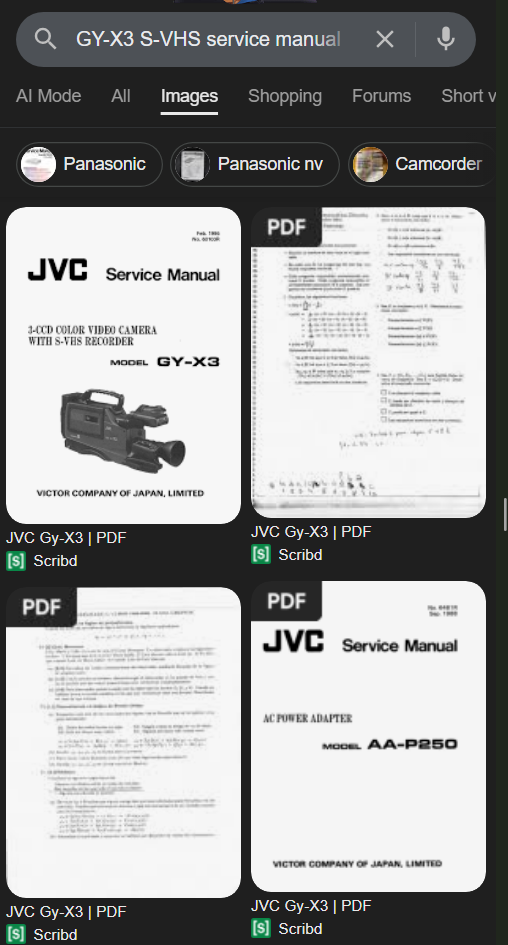
Of course, this won’t help those of us repairing older gear from the 90s and beyond. If you want to fix that old S-VHS camcorder from 1995, you’re still going to have to go to some weird website and risk your credit card details over a $30 charge for a service manual that might cover your problem. But it would be a great help for any new gear moving forward. Forums died years ago, so we can no longer Google for a post from some old retired tech who remembers the secret key combination to enter the service menu. We need that stuff hosted on manufacturer websites so we can get it in five minutes instead of five hours of strenuous research.
Will any manufacturers actually listen to this demand? Probably, no. This sort of change needs to happen at a higher level. Perhaps the right to repair movement and some boisterous EU legislation could make it happen. After all, there is an increasing clamour for users to have more rights over the hardware and appliances they pay for. If and when it happens, I will be cheering when the first manuals for techies become available. Heaven knows we deserve them!












A bit dramatic yes, but a trip through the branch education and asianometry channel should drive home that things are considerably more complex and I don’t see that trend abetting.
That doesn’t mean they can’t include manuals that have more technical detail, enough to mod stuff. You don’t need to know how EVERY part of the car works to work on a car, no?
Modding stuff is very near fixing stuff. And manufacturers don’t want their stuff to be fixed.
And I demand a brand new 2025 4×4 Mercedes Zetros, a blowjob and a GeForce RTX 5090.
Everyone can dream.
The seemingly desperate wish for the first ‘item’ rather precludes the ability to ‘make use’ of the second ‘item’. The demand for the third is just being greedy…
‘blowjob’ is hazardously imprecise specification.
Also water cooled German car, nope nope nope.
Same as the responses to a wide open ‘blowjob’ RFP…yikes.
Then again, you could be from Berlin…
You sound like a Reddit comment. We just want a manual that has more technical detail.
Most Reddit commentators wouldn’t know what a ‘penis substitute’ is…
Chances are the documentation you’re asking for doesn’t exist in the first place. They’re not going to give you their CAD models used in manufacturing or internal development documentation. They’d have to clean it up, see what secrets they can publish, and then roll it up into something they could hand over.
The question is, are you willing to pay for the work?
I’m sure a servicing manual exists for my phone, how could Samsung’s servicemen otherwise know how to replace my broken screen?… But is the manual widely available? The only additional expense they could have in this case is the expense of putting it online, and I’m guessing it’s already accessible to Samsung’s partners through some kind of web portal.
There will be internal documents, and even those internal documents are likely to have errors. Problem is, if there are errors or inconsistencies in the released documentation, that is fodder for lawsuits.
For example: replace that 10K 5% pull-up with a 10K 1% pull-up on the phone? That could be what caused the plane to crash! The jury (civil trials do not need to be unanimous) then assign a non-zero responsibility to the phone manufacturer, and the phone manufacturer has to pay that much of the overall judgement. If you don’t publish it, it can’t be found easily. It is highly unlikely the change of a pull-up would cause such an event. The legal teams can’t simply subpoena every internal document from every company, but if they have a way in…
i think those repair manuals hark back to a day when there were abundant general purpose repair shops. had a rear projection magnivox in the 90’s. i found a full set of schematics hidden inside an access panel to the rear chamber (presumably for alignment calibration purposes). just far enough out of the way to not scare normies, but in a place where the repair technician will find them. eventually all repairs would be handled in house and then not at all. manufacturers just wanted to hump and dump and an entire 3rd party repair industry was killed off in short order. i think what really killed it is when the cost of repair started to exceed replacing the item.
A lot of stuff is made out of modules made by subcontractors or bought off the market, and robots don’t need human-readable documentation, so there may be nobody in the loop who actually looks at any sort of repair or assembly manual at all.
You’d be surprised how many companies DO include CAD models (or, at the very least, usable STEPs) published outright. Many more will provide them if you’re polite and just ask. I recently had to make a antenna bulkhead connector for a Pelican case. I eyeballed the draft angle and got pretty close, but in order to get the bulkhead connector exactly on-axis, I needed some data that I couldn’t measure reliably with mere hand tools. I reached out to Pelican and they gave me exactly what I asked for without even a second glance.
This is especially true with conspicuously trademarked items, stuff you’d get sued for cloning and selling… but if you’re just adapting their product to suit your needs, a lot of companies are way more helpful than people give them credit for.
Noritake did the same thing for me with some replacement VFDs for a repair job. Wasn’t even a bulk order, but they pored over the datasheets and found a pin/logic-compatible VFD for me and even helped me with designing an adapter board (physical, not logical) and provided what looked like internal drawings/specs.
Point is, it’s out there… it’s all in how you approach it.
Yes there are rare contouner examples like these, Yamaha also comes to mind as they can give firmwares (sometimes unreleased ones!) and service manual for electronic musical instrument which are no longer sold nor supported (AX200 and DX200 for example)
The people who make parts for other things usually give you models and specs about the part, so you can actually design around it – but then the company that uses the part to make a thing can’t distribute the same to you because of intellectual property reasons.
So you could get a CAD model for a thing, but it would be missing all the “vitamins” that they aren’t allowed to re-distribute.
It’s oddly endearing to see this being portrayed as being done to somehow protect the consumer. Deep in my cynicism, I cannot fathom any purpose for a denial of access to schematics and service information as anything other than way to bolster future sales.
If I can repair my TV myself, I won’t buy need to buy another.
While I think we’re going to be over represented here, my class of customer who will actually refuse to buy another product from a company that denies them access to service information are the smallest minority, most people don’t care or at most will make some perfunctory comment about how that’s the way things are now, and throw it in the trash and buy another.
Nah, it’s even simpler. It’s anti-competitive practice. And it’s not at all about China or other boogeyman of the day, it’s about you and fellow readers here. If you were to start a business (any kind, support, repairs, add-ons), that would be a risk to the vendor. You are not supposed to produce value independently of large employers. Especially not adjacent to their ecosystems where you could plausibly threaten to take over their business. You are supposed to get employed by them so that they can grab the profits. It’s called capitalism.
Capitalism is when businesses compete.
Modern “capitalists” don’t like capitalism. This is post-capitalist, oligopoly, technofeudalism.
Exists only in your commie fever dreams.
Competition is alive and well.
China, on the other hand, is deep in ‘late stage leftism’.
Ragebait. Your comment achieves nothing. Have you seen how companies are allowed to buy each in America?
Why wouldn’t they be? The state doesn’t own them, so how do you suppose they would be not allowed to buy and sell?
Or do you want to go back to the time when you had to go to the king to be allowed the title to establish a business?
That’s socialism and social democracy as well. Doesn’t matter what sort of value you produce, if you’re not dependent of the system or working for the system, you’re an enemy of the system.
Such societies are really tough on entrepreneurs and small business owners, making it deliberately difficult and expensive to hire and fire people, adding unnecessary expenses and delays by bureaucracy, making the consequences of failed business ventures so dire that you may even end up in prison for debt… etc. which is just designed to discourage people from trying. The risk is too great and everyone’s just spitting on you out of jealousy anyways.
That leaves only the large corporations that grew into huge monopolies through corruption and collusion with the state, without competition and free to exploit their workers any way the state lets them – and believe me they will let them – because it leaves all the people shaking their fists at the “bloody capitalists” and justifying the system in the first place.
Enough documentation and decent service manuals are one of the benefits of retro computing.
It’s sadly a lost art. I love digging into a piece of vintage electronics and finding the original schematic taped to the inside of the case, along with hand-written addendums by the people who serviced it over the decades… Relics of a more civilized age. I leave notes inside most of the machines I mess with, if only to apologize to the next poor schmuck who has to fix my mistakes.
Although there already is a “separate manual for normies.” It’s called the quick-start guide. Then they have the regular manual for more confident normies, and the service manual which you have to actually spend money on (or know how to google for a pdf)
As a member of the manual team for my employer, I appreciate the sentiment but without a big financial incentive, it won’t happen. We spend months developing a manual with the lowest-common-denominator in mind (ad absurdum, sometimes). We don’t even have every aspect documented sufficiently for internal use. The tech debt is all but insurmountable. I’d love to be able to release a technical manual with all the crunchy details, but after 20 years selling basically the same product, we’ve had only 2 inquiries about functionality that wasn’t included in the device. They just want to flip the switch and it works.
I really appreciate your perspective on this. Corporate greed is always a factor, but there is an honest component of waste involved in even the production of a digital manual if it is rarely/never used. Shifting the demand to sustainable levels would require convincing a lot of people that doing more work to maintain functionality is better–a sentiment many of us perusing HaD appreciate but not an easy sell.
It’s arguable that the lack of support materials fuelled a turn from self-repair over the years, but we are where we are and cranking out two documents may represent a lot of futility.
Personally, when I’m spending way too much time repairing old gear, I enjoy the unguided exploratory phase. It opens doors for some hair brained schemes. There’s something satisfying about a ridiculous fix that bypasses the intended pathways.
We got the opposite. We exhaustively documented to cover all use-cases but lazy clients don´t read, even the caveats and no-go practices, delegate the products installation to workshops who just plug and pray (and despite not respecting the manual,they don´t kill the product most of the time) and when they really abuse and manage to kill the product, they complain to customer support and try to hide their mistake. We adapt the documentation to cover every new failure mode discovered by ingenious customers, and prominently push the most nefarious one to raise awareness, and it pays, but there is still an unshrinkable minority for a few countries that persists in abusing our products. Field: transportation.
Look no further than automotive service manuals. The internet is full of people asking what some light means or how to turn on some feature, and the answer is sitting under a pile of fast food napkins, unopened.
Sounds like you’re talking about owner’s manuals. A proper service manual tells you how to do everything. When I started riding motor I always bought a Clymer’s or Haynes manual, again they told you how to do everything.
Everything you said is true, but a service/technical manual is really just reference information. You don’t have to do the hard work of making it intelligible for an average person, because it’s only for people who can understand it in the first place. In fact, having it be impenetrable for anyone other than an already skilled user is a benefit, because you don’t want the unwashed masses to get any funny ideas.
Even if it’s incomplete or inaccurate or out of date in places, just having something to work from that isn’t “reverse engineering everything from scratch” is a huge win for a technical user.
Nope. Historically, humanity has always been largely illiterate. At least half of us are below average.
As for ‘no user-servicable parts’, it’s a risk mitigator. Liability in the U.S. court systems oft rewards the weak and stupid. And by ‘weak’, I mean those have have chosen to be weak and benefactors of state largess.
Around half should always be below average, as with bell curve type distribution “the average” should be in the middle of the curve somewhere! But 300+ years ago the majority of folks could barely read or write if they could at all…
Which doesn’t mean they stupid, but when you spend all your time from a young age working on the farm, press-ganged into the navy, in the mill, or down the mine – half were still below average in literacy but that average proficiency was somewhere in the realms of being able to write your own name, and read a little bit with plenty of folks that couldn’t do that!
Where in the “developed world” 100 to maybe 50 odd years ago the average is reading and writing levels well above can sign your name and maybe puzzle out the written words eventually, and the expected minimum from all that mandatory schooling is well above that too! Still not everyone is going to make that expected literacy level, but the level has raised enough to make things like pulpy fiction novels and children’s books actually find a significant enough market to be worth publishing.
The “bell curve” and all discussions of IQ testing is eugenics and race science pretty much all the way down.
Why would it be?
It’s just observation of reality, no shame in truth.
It doesn’t men that some part of the curve needs to exterminate the other part, silly.
Yes, it’s a fact that some are more intelligent than other.
Heck, it’s even a fact that some group of people are more intelligent than other.
Using IQ to measure intelligence is like BMI for the body’s health: very biased and focused, but also a good general indicator.
It doesn’t mean you have to focus on it.
It also doesn’t mean that a group should be ostracized for their score on it (one way or an other).
Saying disparities doesn’t exist is rejecting reality, so better measure and know/approximate instead of just guessing.
Everyone falls on the bell curves on many different metrics – Its not the data that is the problem, that is simply factual. We are all different and all fall on a bell curves for those metrics for our society/species as a whole somewhere (maybe there are a few things you can measure that are not bell curve across the population, but I don’t know of any).
Just need to stop trying to artificially massage the data to make only the point you wish to make conveniently ignoring all the times those people happen to look better on the bell curves – for instance plenty of tall black and white ethnic groups, not aware of any Asian that trend to tall, so you could use that as an argument one way or the other that a people group is ‘better’. But far as I know massively American level supersized obese folks practically don’t exist in Asia either, etc etc. Once you put all the populations together the bell curves for either measure won’t actually change very much – maybe the the slopes of the curve changed subtly, and the centre line shifts a tiny bit, but its not going to suddenly look like a very different graph.
The point about the bell curve is whether it’s a cause or an effect.
I.e. whether the statistical distribution is a result of the essential properties of individuals, or how they happen to come out by circumstances. Both cases look the same, but turn out with diametrically opposite conclusions about the data.
Dude the Nature vs Nurture argument in effect is still a very different thing to race science. And one that IMO has by now been rather well proven that both have very meaningful impact on the end results. Consider for instance the achievements of black Americans over the last few centuries when compared to their white counterpart – now they are relatively equal in society they are achieving in relatively equal ways, and that change was very very rapid from when everything was active slavery or no blacks allowed! But even during slavery the curve of abilities appears, and the more successful slave owners notice and then document making use of the particular natural talents of specific slaves.
Which one matters most is up for debate still, and probably always will be as to really prove it one way or the other would require some rather unethical experimental setups.
Wishful thinking from commies.
IQ is predictive of success at things like chess (big broad category).
I will grant that life is more poker than chess.
IQ counts in poker too, just not alone.
This is where you pull out bad old IQ test questions to ‘prove’ your beliefs.
You realize the ‘bell curve’ isn’t just a controversial book?
Normal distribution is race science!
You heard it here first.
Data science (aka statistics) must be cancelled!
It keeps telling us things we don’t want to hear!
LA-LA-LA-LA.
Pretty much, but good luck explaining that to commenters here, as there seems to be a higher proportion of people here that just legit believe they are better than everyone else holistically. That is is just “fact”.
Seeing as you correctly point out that literacy and innate intelligence are not related, that literacy is the result of social pressure, the idea that it has anything to do with a normal distribution goes out the window.
A society with a small group controlling most of the resources will result in most people being below the mean.
If you have 100 people in a group, if 99 of them read at a 3rd grade level and 1 of them reads at a college level, 99 of them are below the mean.
The idea that half of the human population is below average at whatever comes from a pretty poor understanding of statistics, half the people are below the median. But the median isn’t what people generally think they’re saying when they say average. Saying half of people are below the median is just a tautological statement with absolutely no information communicated. Saying half the people are below the mean can be somewhat sobering in situations, but it’s only true when you’re on a true bell curve, which for artificial measures you’re usually not.
Very true, though not reflecting societies as a whole and missing the big point history shows us clearly – no matter how much your ‘small group of elites’ is pressured to learn while the serfs are pressured to know nothing and work there is variation in their abilities. You may not be able to get a clean bell curve directly using the compete dataset of the two groups, as their society is so different, but the population within each group has its own bell curve. And quite likely so would the combined data anyway.
I agree with your point on types of average, but as a general rule the mean, mode and median should all be relatively similar with large enough fairly gathered dataset – its only when you are deliberately trying to prove a point with very selective sampling etc that you get your 100 people with only 1 able to read and all the others identically awful – in the real world those 99 serfs would dominate the data creating a bell curve around the level their education targeted with a single outlier from the other group that is possibly very very clear, but probably actually lost in the noise of the over attainers in that 99%.
What you want has a name: “service manual”.
Service manuals are still available for most white goods I believe, and YT or ifixit tear downs for a lot of stuff.
i think a more holistic understanding is warranted. There are a lot of reasons that a lot of products don’t come with service manuals by default, and i think overall the reasons are really practical. Like, some products will be replaced instead of repaired, and to some extent that sounds sinister but also it’s real. At some point everything switched to SMT instead of through-hole and the number of people who might plausibly repair it became infinitesimal. And many products have good (perhaps third-party) documentation online, so no point shipping documentation in the box with it. And a lot of products simply don’t need much documentation for the repairs that are practical, for example because you will be replacing modules with ZIF connectors. And then of course a lot of products really do come with quality manuals, especially things where people are inclined to hire an installer (like appliances). And then there’s the huge category of IoT garbage, which you will by necessity throw away when the vendor stops maintaining their cloud, and that’s just how it is and no amount of documentation will change it for 99% of users, and the remainder will hack it whether documentation is provided or not.
i do like openness, i just think when it comes to resources for repair and hacking, we’ve got more than we ever had before. And that’s why vendors, distributors and manufacturers don’t provide as much inside the box. You don’t bend over to give food to someone whose belly is already full. We haven’t really lost anything, imo.
I fully agree with your sentiments. There are some things that just aren’t realistic to repair. Sure you could find out your washing machine has a bad microprocessor, but then what? Are you going to try and do BGA rework and replace it? Would you have to buy a new processor pre-programmed or expect the manufacturer to open source the code and flash it yourself? Easier just to do it the way it is now, with service manuals basically just being “If x doesn’t work, replace board Y.”
Even goods without service manuals publicly available, like TV’s, cell phones, etc are typically divided into multiple purpose made pcbs all wired together. So someone with some aptitude for electronics can pretty easily work out “USB connector doesn’t work, replace USB PCB”. Making the need for a true pcb schematic level diagram pretty pointless from a repair perspective.
I just repaired both my clothes washer and dryer. The dryer got hot-wired with a timer, so now it works just like the first dryer I ever owned in 1985. It did come with a wiring diagram, but the mechanical timer and a brand-new factory box replacement had both failed the same way, with a slip bearing slipping the timer cam too much. The old 1985 beast didn’t have a humidity sensor or fancy modes, and restoring those on the new mid-90’s unit wasn’t worth hundreds of bucks for an even newer one. That not so new dryer now works fine with a simple commodity spring-wound timer.
For the washer it wasn’t board Y but just Board. It came with an actual troubleshooting guide glued in a plastic bag. They didn’t make it too easy; it’s between the case and drum, and requires some disassembly to liberate (it’s now in the control console head). Instead of an open PCB it looks almost ominously like a PLC. And while there’s only one board, and that one model-specific, it came with a nice breakdown of service modes and codes for troubleshooting the myriad of valves and sensors that make the beast go. Because a dryer that can’t sense humidity will still dry, but a washer that ignores its vibration sensor in spin mode is apt to tear itself apart while flooding the laundry room.
Meanwhile microwave ovens are still subject to the timer hack while other devices like toasters still tend to be simple. On the other hand this is why you don’t need a refrigerator connected to the Internet.
And I demand a brand new 2025 4×4 Mercedes Zetros, a blowjob and a GeForce RTX 5090.
Everyone can dream.
As someone that repaired consumer electronics for a living in the 90’s, it was always a happy moment when you popped the back cover open of the broken CRT you were going to fix and found the service diagram inside.
When it wasn’t there one could just call the manufacturer and they’d send over a fax or for the cost of a few stamps the manual via snail mail.
There were even bulletin board systems (minitel gave one access to them and they were available on cd-rom) where you could find repair information on frequent failures.
Sadly by the end of the 90’s those sources of information were all curbed as replacement was deemed more profitable than repair.
Please stop the single error beep. This is particularly bad on fridges where every error is just the same Beep now and even when you do have access to service manuals you are unplugging and bypassing sensors and waiting to see if it stops the beep from happening. Not very helpful with intermittent faults so as a service agent you are often requesting more time on warranty calls.
@Giake Considering savings in waste and electricity would be from a widespread dissemination of either technical documentation and/or just schematics, even if rarely used, will very quickly make up costs and power use and end a lot of physical e-waste. And frankly, more man-hours in electrical appliance repair might be appreciated as unemployment looms large in an AI future(even if AI never works well).
I’d also love manufacturers to make a small fraction of their devices as Limited Collector’s Edition, using only the best components instead of the cheapest and price it accordingly.
A fraction of the devices made wind up in the hands of collectors who have to change components because they want to use the device a few decades after its engineered service life. Why not make sure that fraction will survive anyway?
(also – there’s devices and I think that includes cars, where not a single specimen has survived. There’s always been a big market for vintage cars, but at the rate we’re going, very few of the cars made today will even be able to be roadworthy in 30 years)
Yes to this. I cannot count the number of times I have had to write my own technical data sheets for audio gear that comes with a “first time user guide”. I want it all!
This tendency to “simplify” manuals and withhold technical information has even hit things that only tech enthusiasts and DIYers purchase.
I just put together a brand new Z890 chipset-based PC and the manuals for the MSI motherboard and the AIO cooler were really lacking and very disappointing. The older manuals had a ton of technical information like the pinouts for every connector, descriptions of every slot, the resources that were shared between ports, etc. The new manuals? The motherboard manual barely described where the connectors were. The AIO cooler manual was 1) missing from the box, and 2) the warnings and mandatory legal statements were twice as long as the installation instructions which were just a few diagrams. No information about the correct mounting orientations nor how to switch the airflow direction–never mind anything remotely technical like pinouts. It’s frustrating.
there are certain types of manuals id like to go away:
a well bound instruction book that is just 2 pages of useless text in 300 languages.
a tiny slip of paper with instructions in a -2 point font with really bad engrish.
a business card with no text, just a qr code not translated to a url for us anti-phone luddites.
gosh, the number of manuals I’ve gotten that say something like “DO NOT SUBMERGE IN WATER” in 6 languages. They definitely had more warnings than instructions.
I think that the lack of manuals is because the appliances and electronic devices are actually built by some obscure OEM manufacturer and not the name brand if what they are sold, so the seller doesn’t have the documentation in house to make the manual and the actual manufacturer doesn’t have interest to publish an user manual. So you get a generic manual that isn’t specific to your appliance and go for it.
i was able to find a service manual for a monitor i was trying to repair, it was available in chinese only. but you can translate a pdf quite easily these days. i suspect this was intended for internal use only, but was leaked.
Re: “because they think the average consumer will get scared and confused”
Have you ever heard of a thing called “planned obsolescence”?
There is no decline in literacy rates. The NAEP (Nation’s Report Card) and other standardized tests are mostly affected by poverty. The economy stinks, and people are getting poorer. All the industry has moved overseas, and white collar workers are being replaced by chatbots, so what’s left is “May I take your order, please.” But the big bosses love to point to teachers as the reason there’s no upward mobility in the U.S.
Plus, when they say things like “the lowest it’s been since 1992,” those fourth graders have already grown to become one of the most educated generations in history.
There is a school reform industry, and they like it when people think there’s a crisis.
Only if you use % unable to pay their student loans as a proxy for ‘educated’.
Degrees given don’t say anything about ‘educated’.
Many are certificates of ability to pay/get tit, inability to select a good school/program, gullibility and attendance.
Tests have been dumbed down yearly.
Crisis?
Smart kids continue to learn, despite their teachers being idiots.
Dumb kids have $200k+ debt, great self-esteem and an ‘idiot studies’ degree in their future.
Average HS grad reads at 6th grade level.
Math worse.
I worked for a company in the late 80s through the 2000s, that put huge “technical reference guides” in with their products. It was a reference for programmers as well as a service guide and schematics. Obviously well received, but as volumes increased they were discontinued because those manuals were expensive to print and few customers used them. They still have pdf service guides online, but only for hardware upgrades or module replacements. All companies have the documentation, it’s just whether they are comfortable releasing it to us.
These days though, I’m surprised at how many manufacturers will actually send you a schematic, especially for older equipment if you just explain what you have and why you need it (and volunteer to sign an NDA if they require it). I’ve had great luck with professional audio and test equipment, so it may just be that we need a website to let folks know which ones cooperate and which ones don’t. Cooperation makes me want to buy again and for those that won’t supply info, I won’t buy from them again. Consumer pressure and visibility is the best persuasion…
one thing that is not mentioned in this article is that “new” items are not designed to last. look at the changes in TV’s in the last 10 yrs. how the high price of a flat screen has dropped to pennies on the dollar as tech advances, compared to the life of the TV. you are lucky to get 5 years out of a TV. compare that to the 80’s when you bought a single TV and it lasted 20 yrs. demand for change and latest tech is outpacing the demand for relibility, welcome to the age of expendable E-waste
Our dishwasher that had a broken pump had a service manual hidden taped to the underside of the door underneath the access panel where all the he hardware was underneath. I just managed to figure out the motor should have 80 ohms and when I poked at it there was 60megaohms. Ordered the part number popped it in and works good as new. I dunno if that was meant to be taken by the installer but it’s worth a try to look around on the inside of devices just to see if u get lucky.
It was actually illegal for users to open those old British rotary dial phones. They were all owned by the Post Office who only rented them to you. Many were hard wired to the socket too, so you couldn’t even unplug them.
The Owner’s Manual for my 1967 Rambler Rebel included a schematic of the electrical circuits. Before I had 100 miles on the odometer I was modifying and adding electrical equipment. Those days are long gone.
The mfr doesn’t want you to fix it. They want you to buy a new one.