
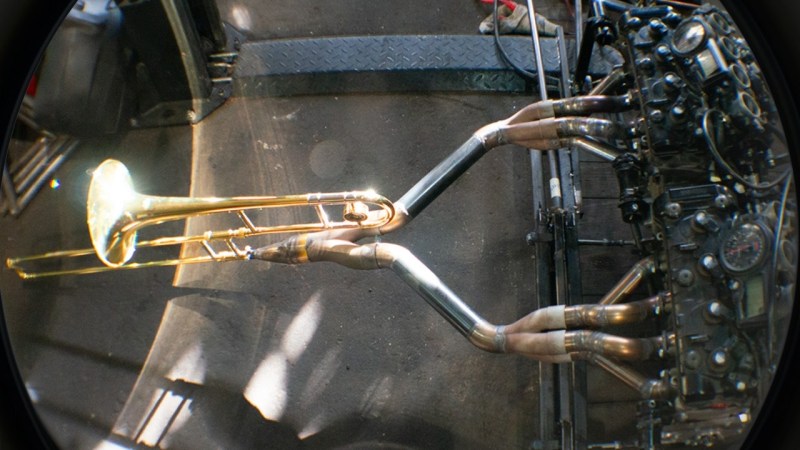
Back during WWII, Chrysler bodged five inline-6 engines together to create the powerful A57 multibank tank engine. [Maisteer] has some high-revving inline-4 motorcycle engines he’s trying to put together too, but unlike 1940s Chrysler, he also has a trombone… and a lot more RPMs to deal with.
The Chrysler flatheads were revving at a few thousand RPM– their redline was almost certainly in the three-thousand range. [Maisteer] is working at 15,000 RPM, which is where the real challenge of this build lies: the trombone in the image is just for fun. He wanted to use a heavy chain to link the crankshafts, but at that rotational speed, a heavy chain becomes really heavy— or at least, it feels a force many times its weight due to centrifugal force. The lietmotief of this video is a quote by an automotive engineer to the effect that chains don’t work over 10,000 RPM.
That leads to a few problems for the intrepid “not an engineer” that take most of the video to deal with and ultimately doom the engine linkage– for now. Not before he gets an iconic 8-cylinder sound out (plus some fire) out of a trombone, though. Of particular note is the maker-type workflow Hackaday readers will appreciate: he 3D scans the engines, CADs up parts he needs and sends away to have them CNC’d and SLS printed.
Hacking motorcycle engines into cars is nothing new. Hacking them together into franken-engines is something we see less often.
Thanks to [Keith Olson] for the tip! Remember, if you want to toot your own horn– or toot about someone else’s project, for that matter–the tips line is always open.








Doing it wrong.
You make 2 inline 4s into a V8, not a straight 8.
This has been done before, many times.
Not for those with small budgets.
Find a block with same piston spacing and bore, only use heads from motorcycle engines.
Super long cranks will resonate and break.
Won’t fit into tiny car.
Still good to see someone not smoking the electric motor crack.
No, you make an I8 into 2 inline 4s. And create an awesome Volvo in the process.
Actually, you should do V12 instead because it has perfect balance. This is one of the reasons why Russian T-34 (and its later models T-55, T-62, T-72 and now T-90) was the first modern main battle tank that finally allowed Soviets to push failed g*rman army all the way from Stalingrad to B*rlin and defeat H*tler.
I think your vowel keys started failing near the end of your paragraph there…
Not my fault, Akismet gets paranoid with those words.
I hate that this is a thing we have to do now in our new age of corporatized paranoia and neuroticism… The Hays Code wasn’t this restrictive.
V12s are very smooth, but not perfectly balanced. You should do an H12 instead, but do a better job than Subaru did of their H12.
I6 and V12 are perfectly balanced, a H12 i not better and come with alot of other problems
In fairness it was a engine by motori moderni with Subaru’s name on
Subaru only funded it but my lord did motori make a complete hash out of that one
using two motorcycle heads to make a V8 is not so simple, one of the heads have to have the cam drive at the opposite end and that is not as simple as it sounds
Or have a cam drive at each end of the block, one for each bank.
As a trumpet player and biker, I never thought of mixing the two in this way…
In my opinion, the best way to experience the quintessence of a GSXR engine is on a race track.
I don’t judge, I just don’t understand (but does it needs to ? :)
Leitmotiv?
https://en.wikipedia.org/wiki/Leitmotif
That chain could kill somebody. What you want is a Lovejoy type coupling.
Also the power should be taken from the center not one end.
*Leitmotif
That guy might have (not?) seen that 1974 “Joachim, Put It in the Machine” movie… https://youtu.be/q7_t8LVYwQQ?t=29
(car air condition fixed by connecting it to a trombone…)