Conveyor Belt GBoard Brings The Keys To You

It must be April in October again, because Google Japan has a new, hilariously impractical reimagining of the keyboard: a conveyor belt. This time it’s on GitHub with firmware, STLs, and a full build guide if you, too, want to wait a full cycle to get the ‘backspace’ key whenever you make a typo, or to write such fun words as “ooid” or “princesship”.

You can watch it in action in the video embedded below, but just the photo probably gives you the idea: the four staggered rows of keys are each 3D-printed chains holding mechanical key switches, driven from a motor in the base. Each row also has a flexible PCB to keep everything wired together, though it’s unclear how those electrical impulses from the key presses get off the conveyor belt and into your computer. That part of the build guide is “TBD” and the source code doesn’t appear to be complete.

Those details may be forthcoming, or it might never be revealed because this is obviously a joke, but now that they’ve gone to the effort of providing STLs, we’re now invested in figuring out how to actually make it work. A BLE-equipped microcontroller in each belt? RFID tags on each key, with readers in the base? SMD LEDs on the flex PCB that flash out the ASCII code of each pressed key as they whiz past a sensor? In theory, any of those should work, but which should we use? You decide!

We like Google Japan and their weird keyboards, and we have to say that compared to the hat from a few years ago, this one is almost practical, though the rotary-phone one wins on style points. In some ways, it occurs to us that this is the exact inverse of the chain printers of yesteryear.

Thanks to [CityZen] for the tip! If October for you is more “spooky” than “silly”, we still want to know about it. Or if you build any of the Gboards. Either way, let us know on the tips line what you’re up to.

Continue reading “Conveyor Belt GBoard Brings The Keys To You” →

Two four-cylinder engines mechanically linked and exhausting into a trombone.

Franken-engine Plays Its Own Swan Song At 15k RPM

Back during WWII, Chrysler bodged five inline-6 engines together to create the powerful A57 multibank tank engine. [Maisteer] has some high-revving inline-4 motorcycle engines he’s trying to put together too, but unlike 1940s Chrysler, he also has a trombone… and a lot more RPMs to deal with.

The Chrysler flatheads were revving at a few thousand RPM– their redline was almost certainly in the three-thousand range. [Maisteer] is working at 15,000 RPM, which is where the real challenge of this build lies: the trombone in the image is just for fun. He wanted to use a heavy chain to link the crankshafts, but at that rotational speed, a heavy chain becomes really heavy— or at least, it feels a force many times its weight due to centrifugal force. The lietmotief of this video is a quote by an automotive engineer to the effect that chains don’t work over 10,000 RPM.

That leads to a few problems for the intrepid “not an engineer” that take most of the video to deal with and ultimately doom the engine linkage– for now. Not before he gets an iconic 8-cylinder sound out (plus some fire) out of a trombone, though. Of particular note is the maker-type workflow Hackaday readers will appreciate: he 3D scans the engines, CADs up parts he needs and sends away to have them CNC’d and SLS printed.

Hacking motorcycle engines into cars is nothing new. Hacking them together into franken-engines is something we see less often.

Thanks to [Keith Olson] for the tip! Remember, if you want to toot your own horn– or toot about someone else’s project, for that matter–the tips line is always open.

Continue reading “Franken-engine Plays Its Own Swan Song At 15k RPM” →

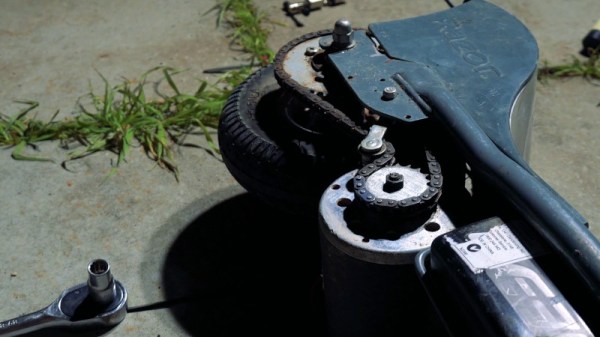
How To Make An Electric Scooter Chain Sprocket With Nothing But Hand Tools

Sometimes, mechanical parts can be supremely expensive, or totally unavailable. In those cases, there’s just one option — make it yourself. It was this very situation in which I found myself. My electric scooter had been ever so slightly bested by a faster competitor, and I needed redemption. A gearing change would do the trick, but alas, the chain sprocket I needed simply did not exist from the usual online classifieds.

Thus, I grabbed the only tools I had, busied myself with my task. This is a build that should be replicable by anyone comfortable using a printer, power drill, and rotary tool. Let’s get to work!

Continue reading “How To Make An Electric Scooter Chain Sprocket With Nothing But Hand Tools” →