
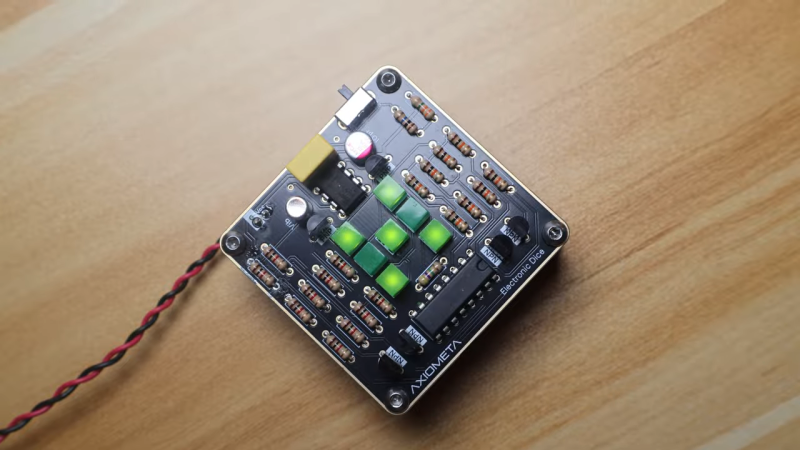
If you wanted to build an electronic dice, you might grab an Arduino and a nice OLED display to whip up something fancy. You could even choose an ESP32 and have it log your rolls to the cloud. Or, you could follow the lead of [Axiometa] and do it the old-school way.
The build is based around the famous 555 timer IC. It’s paired with a 4017 decade counter IC, which advances every time it receives a clock signal from the 555. With the aid of some simple transistor logic, this lights the corresponding LEDs for the numbers 1 to 6, which are laid out like the face of a typical six-sided die. For an added bit of fun, a tilt sensor is used to trigger the 555 and thus the roll of the dice. A little extra tweak to the circuit ensures the 555 keeps counting just a little while after you stop shaking. This makes the action feel like an actual dice roll.
Schematics are available for the curious. We’d love to see this expanded to emulate a range of other dice—like a D20 version that could blink away on the D&D table. We’ve covered some very exciting technology in that area as well.












Good, now put an OLED there instead and make it show a picture of the dice’s face.
also support multiple dice and more than 6 faced ones. 1d20 is the backbone of dnd
And there I made a fool of myself by not reading the last paragraph.
ducks on my way out from flying shoes
The first electronics kit I got for my daughter was the Velleman dual dice kit (WSG3400), which is a similar concept. While the cycling through each number is meant to be fast enough to be near enough random, in practice it rolls a lot of snake eyes.
Almost the same, dad built a circuit from Elektor around 40 years ago, which apparently was also available as a kit as Velleman PMK1091. Single die though.
put it through the https://en.wikipedia.org/wiki/Diehard_tests otherwise it’s bogus!
I’m just goofing around. Cool project, nice idea on the motion sensor.
So we’ll use a 555s to build this dice?
The 555 is overkill here…
It are?
I used a 556 and a load of 7400 logic when I made one in school (about 20 years ago)
It’s always refreshing to see real electronics once in a while! 🙂🩶
Let’s see… Count the number of alpha particles emitted from a radioactive source in a fixed amount of time… modulo 5 + 1. That’s random, right? 🙂
My Radio Shack electronic dice are not random at all. It “spins” for a fixed RC time-delay after you release the pushbutton. 555 and 4017 osc+counter is not random.
The time you press/release the pushbutton can rig the spin.
Same for Velleman Electronic Roulette Kit (uses a PIC) it starts to spin down when you release the pushbutton. Tap the button the same way and get the same final number. I’d guess the say 25msec tap is so much faster than the spin.
Make a Magic 8 Ball. The circuit core almost the same.
u made dice and didn’t even mention anything about generating true random numbers? lol