
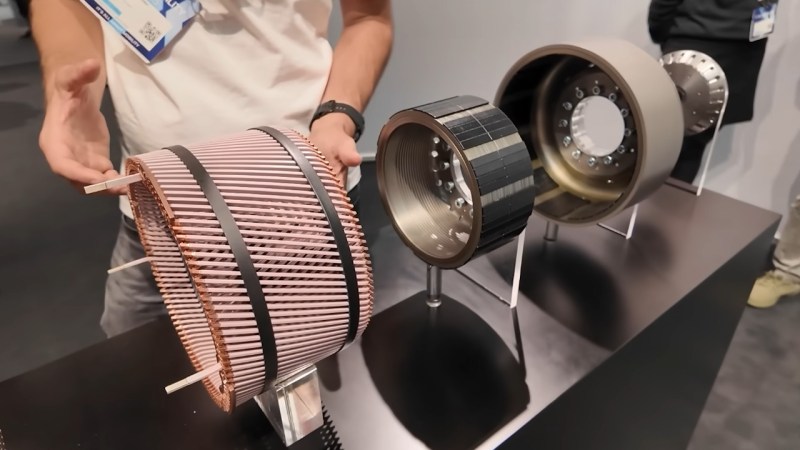
Compromise is key to keeping a team humming along. Say one person wants an inrunner electric motor, and the other prefers outrunner. What to do? Well, if you work at [Deep Drive], the compromise position is a dual-rotor setup that they claim can be up to 20% more efficient than standard designs. In a recent video, [Ziroth] provides a deep dive into Deep Drive’s Twin-Rotor Motor.
This is specifically a radial flux permanent magnet motor, like most used in electric vehicles today — and don’t let talk of inrunners and outrunners fool you, that’s the size of motor we’re talking about here. This has been done before with axial flux motors, but it’s a new concept for team radial. As the names imply, the difference is the direction the magnetic field is orientated: axial flux motors have all the magnetism oriented along the axis, which leads to the short wide profile that inspired the nickname “pancake motors”. For various reasons, you’re more likely to see those on a PCB than in an electric car.
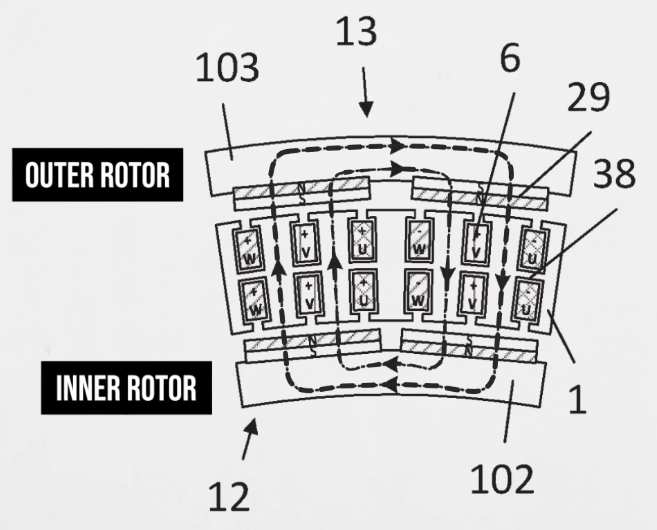 In a radial flux motor, the flux goes out the radius, so the coils and magnets are aligned around the shaft of the motor. Usually, the coils are held by an iron armature that directs their magnetic flux inwards (or outwards) at the permanent magnets in the rotor, but not here. By deleting the metal armature from their design and putting magnets on both sides of the stator coil, Deep Drive claims to have built a motor that is lighter and provides more torque, while also being more energy-efficient.
Of course you can’t use magnet wire if your coil is self-supporting, so instead they’re using hefty chunks of copper that could moonlight as busbars. In spite of needing magnets on both inner and outer rotors, the company says they require no more rare-earths than their competitors. We’re not sure if that is true for the copper content, though. To make the torque, those windings are beefy.
Still, its inspiring to see engineers continue to innovate in a space that many would have written off as fully-optimized. We look forward to seeing these motors in upcoming electric cars, but more than that, hope they sell a smaller unit for an air compressor so after going on a Deep Drive deep dive we can inflate our rubber raft with their twin rotor motor boater bloater. If it works as well as advertised, we might have to become twin-rotor motor boater bloater gloaters!
Thanks to [Keith Olson] for the tip.












The rotors are co-rotating and coupled. We have baking enamelled copper wire for self-supporting coil structures, GF overwrap and vacuum impregnation with epoxy resin. the ironless stator is built so rigidly because the coil doesn’t need to support itself, but transfers the output torque to the motor mounting points.
All while also looking like it could be air-cooled (closed-loop).
We already have hairpin windings that allow flat wire to be end cooled, so that’s not the novelty here, although it’s conveyed as such.
The design is perhaps closest to the smaller coreless DC motors that have been around for what feels like decades (I particularly remember the Faulhaber ones, but see https://www.nidec.com/en/technology/motor/glossary/item/coreless_motor/).
‘20% more efficient’
Please explain how that number is reached.
Standard outrunner engines have a typical mechanical efficiency of 85-90%.
We obey the laws of physics…
It would suck to constantly have to pull over and have your car’s battery drained.
That’s amazing! If they wound the stator poles around iron it would be even more efficient. Maybe even 200% efficient.
I believe the claim is 20% overall efficiency improvement over a real world drive cycle, which includes a lot of off-peak operation. No perpetual motion claims made.
Yes this is the answer. You guys think too complicated: To me 20% better could just mean I can drive 120 miles/km distance instead of only 100 units. And I won’t even get into the difference between city and highway traffic.
The problem is, in a modern electric drive-line, the total losses are less than 20%, so even if the new system is absolutely 100% efficiënt (it isn’t), you still wouldn’t get 20% more range.
It’ll be 20% of the current inefficiencies reduced. If normal EV motors are ~95% efficient, these will be 96% efficient. That’s 20% less inefficient. Its a bunch of marketing nonsense.
20% improvement over 85% is 88%
In general marketing copy is crazy misleading. If they were honest it would say “20% improvement in efficiency over the current peocess, up to 88% efficient” or something. They obviously don’t because the truth isn’t very impressive sounding which sadly is more of a commentary on the state of scientific literacy than anything else. Because the absolute value of efficiency is pretty good and the incremental gain is probably actually significant.
So read it as “20% reduction in losses”. So along with the modest increas in output power, it also means a lighter cooling system that requires less power, meaning longer range or lower battery weight. Which enables a lighter chassis, which means less motive power is needed, etc., etc.
That’s the reason battery electric vehicles are so heavy and ridiculous: For a given payload and range you need a large battery, which is heavy, so it needs a heavier chassis to carry it, which means more weight, which requires more power, which needs a bigger battery, etc., etc. The math simply favors building huge, heavy, expensive, power hungry vehicles.
Modest efficiency and power:weight gains have powerful knock-on effects.
That doesn’t negate the fact that this still smells like snake oil.
nd for some reason every EV has to have a huge range that is 10x what most people needed 99% of the time
Yeah, because I’m not going to sort out renting/borrowing another vehicle every time I need to go more than the 50km to work and back. Same way my couch is bigger than the two people and a small dog who usually sit on it, and I have a spare bedroom in my house, and my impact driver is more than capable of driving the #8 screws I use most of the time, with plenty more battery capacity, and my fridge is only about 1/2-3/4 full most of the time. Should I go on? Slack and excess capacity are essential to a smooth life.
also needs to tow atleast 5t, carry 8 people, go offroad, and drive like a sportscar. Anything less is completely useless, because you never know if you might need it someday /s
You guys don’t know efficiencies of ev motors at all. Yes, they are up to 90-95% efficient, but at light loads (mentioned in the video) they can have very low efficiency, less than 50%. It’s a problem for high power, dual motor cars, cruising at speed can be 5% of max torque and it’s why dual motor will have less range, or front motor disconnects (which suck) so the rear can run at high load where it’s more efficient without front motor dragging. So if this motor is a lot more efficient at light load, 20% more efficient through a drive cycle is easily achievable and a massive deal.
/\ This. Nothing is black or white, the gains are rarely were the motor is at its max efficiency, but in the (huge) percentage of time where it’s not. Achieving 90% power efficiency from 0 rpm / 0Nm to it nominal value is just a dream right now. And if you look at your EV car use, you’ll see you’re using your motor in its 10% to 20% power level most of the time. That’s were the efficiency should be improved, not when it’s creating 1000 HP, you’ll never use in real life.
You’ll have to walk us through the math: How can you get ” 90% power efficiency from 0 rpm / 0Nm …”
The efficiency vs load problem is not limited to electric motors. Internal combustion motors have exactly the same issue, even worse. A transmission with variable gear ratio (“impedance transformer”) improves the situation a great deal.
A variable gear ratio would help EV performance and efficiency too, but the added weight, complexity, cost and additional losses tend to favor omitting it, or using a two-motor arrangement.
there is some EVs with two gears, but it seems like it mostly a gear for normal driving and another lower gear so they can brag about the 0-100km/h time
The original Roadster famously dropped the two-speed transmission because the weight reduction improved performance (with a changed motor design).
Actually, the losses are generally dominated by the I^2*R losses (resistive), and in most motors, torque is proportional to the current, so half the torque is half the current is only a quarter of the losses. Only when you get to the very light load region, and only when using iron core motors, so you get relatively significant iron losses (being Eddy current, hysteresis, and magnetostrictive losses).
There’s a shot of a graph of the efficiency in the video, at 0:16. It’s just a model, so take with a large grain of salt, but it claims more than 90% efficiency over a 10:1 speed range, as long as you keep the torque modest (not too high at low speed, not too low at high speed).
It also obviously shows inefficiency going worse at high speed. This is due to windage, and maybe inverter losses. At least they were honest in including them in the model.
“up to 20% more efficient” means more efficient by some amount that does not exceed 20%.
So it means nothing?
I read a that claim as meaning less then 20% but more than the next lower round number (ambiguous 19, 15 or 10).
Otherwise it’s also ‘up to 1000% more efficient’.
This is yet another BS motor design that will fail in a real life. It’s just a cash-grab start-up. Plenty of those on the market…
Without a yoke the losses will be too much. The axial variant is easier to manufacture, and various examples of pancake generators made without a yoke prove how poor yokeless designs are. I considered an axial BLDC design with yokes, but I could get the same efficiency with less hassle in the same form factor just by buying a commercial electric motor…
So yeah, it’s all BS powered by poor math and snake oil. Besides, it was already done before, I’m sure…
This is not a motor without a yoke. It took me a while to realize what’s going on here. the “dual rotor” is complete bullshit. It’s just a single rotor. The difference is that the yoke ( copper coils + laminated steel) is put in between the two cylinders of the rotor halves.
And I do assume this has a significant effect on the motor performance, and this probably results in a higher power to weight ratio or in a higher efficiency. From what I know of motors, the design is a tradeoff between these two (and other factors such as cost).
With a higher power density, less material is needed, which can result in a cost reduction (But offset by complexity). Overall an interesting design, I wonder how it pans out.
“I do assume…”
“This probably results in…”
“From what I know about motors..”
“Which can result in…”
And the best
“I wonder how it pans out”
That’s a lot of qualifiers pal. You could write these press releases yourself if you wanted to.
Maybe I’m a bit over cautious. But that’s still much better then “calling it BS and a cash-grab” and then giving that only one argument which is also false.
And where does that “poor math and snake oil” come from?
I didn’t like the video (but I did see it), but the motor itself is “different” in an interesting way. That’s for sure.
What are your qualifications?
I am a professional educator for graduate and post graduate students. I have taken and taught classes on scientific writing on a graduate level. My mentor/PI was rigorous on the point of clarity of communication.
.
Publishing or even writing in comments sections with massive amounts of qualifiers on a topic that is outside one’s field makes the writing useless. I stand by that.
You?
Not an electrical engineer then :)
Probably a sociologist. Always so sure they’re right and everybody else is wrong.
Aww. That’s just hurtful.
I’m an EE.
It’s BS and a cash grab because their is an implausible lie right in the pitch.
20% increase in efficiency would be > 100%.
Sociology is not a science.
It’s dogma that uses sciencish language.
Go to any online or offline store that sells RC parts. Look at their BLDC motors. There are hundreds of models from dozens of manufacturers. There are inrunners, with stator on the outside. There are outrunners with stator on the inside. Do you really think no one tried to combine both types before? Even if there is a performance increase, it’s not good enough to overcome the complexity of the construction. That’s why I think it’s a snake oil BS startup idea that is as useless as putting a saddle on a pig and entering a derby…
I’m sceptical of this design. First of all, they may have rotors with magnets on both sides of the stator, which may seem like a good idea at first, but that also means they have doubled the air gap, which is detrimental.
Secondly, the unsupported end of the stator will be pulled towards the inner and outer rotor alternatingly, at high frequency, which will easily introduce fatigue problems. Copper is a great electrical conductor, but mechanically equivalent to chewing gum.
Thirdly, the cooling. All the heat produced in the stator must flow lengthwise through the copper for a long distance, and is then somehow transferred to the casing, while still being electrically isolated from that casing. I doubt the heat transfer is sufficient to cool the motor at high currents; this would limit the maximum current, and therefore, torque. Regular motors have sleeves around the stator, giving a much larger area for the transfer, and much shorter distance to the copper windings.
Lastly, this thing seems very expensive to produce, especially compared to common radial flux motors. Iron is cheap, they didn’t use less copper, and I fail to see why this would require only half the magnetic material in total, considering the air gap is much bigger than in regular motors. In cost-sensitive applications (which automotive most certainly is), this will be a complete showstopper.
Feel free to disagree, and please articulate why you think I’m wrong!
I choose to accept your thoughtful and well articulated comment as is.
.
So there
Thank you to Hackaday for doing this review.
I saw the video thumbnail with words “Game Changer”, as well as the word “insanely more efficient” and decided not to click on it.
Tired of hype :(
Youtube recommended me Ziroth’s channel a while back but I quickly realised his whole thing is just uncritically reading out press releases from tech companies, that’s it.
“Still, its inspiring to see engineers continue to innovate in a space that many would have written off as fully-optimized.”
What? There is plenty of ongoing work on electric motors to make them more efficient and more power dense. I’d say that research and development into electric motors and generators is pretty popular just now, especially because of renewables and electric vehicles. I don’t know where you get the idea that many engineers think electric motors are fully optimised.
For a guy coming from thermic motor, since you’re getting 3x the power efficiency with an electric motor, it’s “fully optimized”. It’s just a question of point of view. People need to forget about thermic motor, it’s being polluting their pragmatic critical spirit too much lately.
I assume the designers ran the numbers but it does look like they left a lot of optimization on the table:
Fully half of the copper mass is not in the region of the magnetic field between the rotors: The turnaround regions at the ends of the coil are outside the magnetic field area. It’s dead weight and doubles the ohmic loss.
Actually, faulhaber winding style does a lot to significantly reduce non thrust producing ohmic heating copper overhang.
I’ve used several of their motors over the years; they have many styles. I’m guessing you mean their coreless variety. Do you have a link to the one you’re referring to?
The two-pole winding type shown in the link (my reply above) has a diagram and picture of the Faulhaber winding, along with a 4-pole competitor.
It even has the cross-winding scheme claimed herein as the key aspect that “unlocked” their design.
OK, yes, I’ve used those. Absolutely remarkable performance in acceleration, but honestly pretty crappy for high (continuous) power. It destroys itself very quickly with even short and modest overload. Your motor control algorithm MUST have a good thermal model, or you have to drive these very conservatively (which negates most of their performance advantage).
Hackaday ought to have a “Time Capsule” section where snippets of the marketing material from the time and the questions it brought up (in context) are handed down to the future in 1, 2, 5, 10.. years so we can enjoy rewviews and autopsies of that time.