
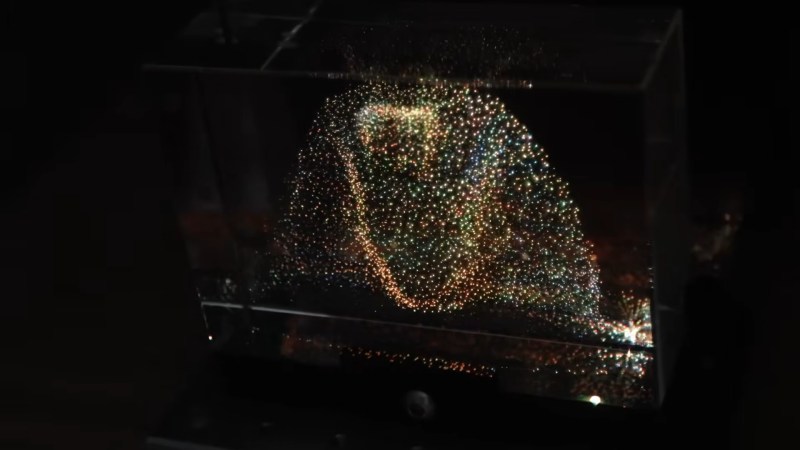
There’s a type of dust-collector that’s been popular since the 1990s, where a cube of acrylic or glass is laser-etched in a three-dimensional pattern. Some people call them bubblegrams. While it could be argued that bubblegrams are a sort of 3D display, they’re more like a photograph than a TV. [Ancient] had the brainwave that since these objects work by scattering light, he could use them as a proper 3D video display by controlling the light scattered from an appropriately-designed bubblegram.
Appropriately designed, in this case, means a point cloud, which is not exactly exciting to look at on its own. It’s when [Ancient] adds the colour laser scanning projector that things get exciting. Well, after some very careful alignment. We imagine if this was to go on to become more than a demonstrator some sort of machine-vision auto-aligning would be desirable, but [Ancient] is able to conquer three-dimensional keystoning manually for this demonstration. Considering he is, in effect, projection-mapping onto the tiny bubbles in the crystal, that’s impressive work. Check out the video embedded below.
With only around 38,000 points, the resolution isn’t exactly high-def, but it is enough for a very impressive proof-of-concept. It’s also not nearly as creepy as the Selectric-inspired mouth-ball that was the last [Ancient] project we featured. It’s also a lot less likely to take your fingers off than the POV-based volumetric display [Ancient] was playing DOOM on a while back.
For the record, this one runs the same DOOM port, too– it’s using the same basic code as [Ancient]’s other displays, which you can find on GitHub under an MIT license.
Thanks to [Hari Wiguna] for the tip.






I wish these laser projectors were not so expensive for their resolution and brightness. I’d really like a cheap module to pair with a camera for doing machine vision stuff.
Give it a few years. Digital camera went from costing as much as a new car to just a few dollars now. We can have cheap 3D video player by next decade
That happened because everyone wanted a more convenient camera. If only 3 people want a laser projector in the next decade it’ll still cost as much as a new car then.
They might when one is scaling bigger than current displays can do.
1080p laser projectors were available over a decade ago for high end conferencing, they still aren’t cheap now.
you never know how popular a new technology will be until you slap a price tag on it.
It’s been (more than a) few years. I saw one close up in the wild more than 15 years ago. It was expensive then. They are still expensive. They’ll remain expensive until someone finds a need and a use for millions of them.
Until then, LCOS will do just fine for small displays, and DLP does the large, bright low-cost display just fine.
How is that laser etching ? Etching removes material. Here the material is heat up very fast on a localized point in 3D, causing cracks it the glass. Also, I’ve never seen any in acrylic, I guess the laser would burn through: acrylic is opaque to – at least – UV lasers. And powerful enough DPSS blue lasers are quite recent tech development.
correction: to IR (CO2) lasers. Excimers are whole different thing
A pedant? On HackADay? Why, I never!
It’s not etching as that is a chemical process, engraving is a more correct term being a mechanical process. Technically engraving also removes material but no-one could be bothered inventing a new word for making marks in the middle of a substance rather than on the surface.
And yes it is done in acrylic, doesn’t work as well as in glass as it isn’t as optically clear. And they use a green laser for the process as it isn’t absorbed by the material. There is also a variant where the laser causes a chemical reaction in plastic causing a bubble – so there’s your etching.
Maybe we can call it “Pulegosoing”, Pulegoso being a type of glass with bubbles in it.
I’ve done this in acrylic with doubled Nd:YAG (green, 532 nm) light. It was 50 MW (yes, megawatts) for 5 ns into a focal spot about 10 microns in size. That power density is high enough to make incandescent sparks in mid air, and has no trouble creating a permanent gas bubble in the middle of a PMMA block. That power is actually is gross overkill but, hey, you dance with the toys you brought, right?
At 10 Hz it takes a while to draw a bunch of dots, but that’s what robots are for.
I remember booths in malls that would turn out custom bubble figures in about 20 minutes using a relatively small system. They were never eager to day anything about it for far off spawning competition but you could bring them an obj and they would run it off for you right there.
Sees the pattern on the cube is of the lunar surface.
Oh, nice, their going to make a 3D map of the moon.
Wait, that’s no moon… :D
<3
I wonder if it might be possible to fill the defects with a fluorescent gas, apply a high voltage and then use a couple of different laser wavelengths to selectively turn the bubbles on an off. Maybe not with solid acrylic but some other medium, Helium defusing in and then sealed with an external coating perhaps.
One can argue word choices all one wants. It’s missing the point completely. This project is pure awesomeness. That’s a metric sht ton of thought and effort. I have had to align projectors in my youth and it’s a PITA. Trying to get this thing aligned? Pixel for puxel? Nloody hell, man! Clever alignment tools were included in the design process. I think it’s a great job.
according to the thread he posted, he’s actually doing binning of like 5×6 pixels to one bubble, which is still very cool but not exactly 1 pixel 1 bubble (the projector from anybeam is a raster laser projector with a galvonometer to steer the beams so what is a pixel is also debatable).
i think it’s a great job too :) very fun volumetric display with no spinning or slip rings to degrade, just the diodes to fade.
Oh hey, I remember that 3d game with the “ufo” type craft over a landscape, on my old Atari 1040st…
That’s very cool
Cool stuff. All the demo is missing is a Princess Leia projection.
but can it run doom?
It did, at the end