
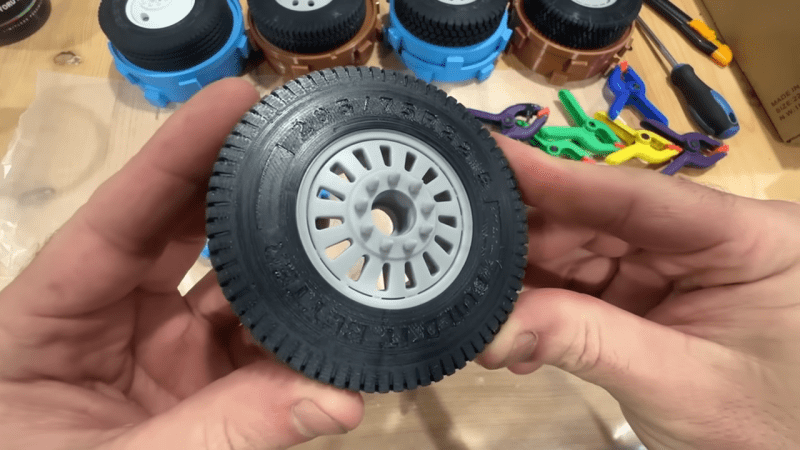
You can buy a wide range of RC car tires off the shelf. Still, sometimes it can be hard to find exactly what you’re looking for, particularly if you want weird sizes, strange treads, or something that is very specifically scale-accurate. In any of these cases, you might like to make your own tires. [Build It Better] shows us how to do just that!
Making your own tires is fairly straightforward once you know how. You start out by producing a 3D model of your desired tire. You then create a two-piece negative mold of the tire, which can then be printed out on a 3D printer; [Build It Better] provides several designs online. From there, it’s simply a matter of filling the tire molds with silicone rubber, degassing, and waiting for them to set. All you have to do then is demold the parts, do a little trimming and post-processing, and you’ve got a fresh set of boots for your favorite RC machine.
[Build It Better] does a great job of demonstrating the process, including the basic steps required to get satisfactory results. We’ve featured some other great molding tutorials before, too. Video after the break.









just an fyi toner powder works well for coloring silicone as well and is often free when they are junked with a bunch left inside. Only downside is WEAR BREATHING PROTECTION!!!!!!!
It’s also very flammable when airborne, so keep it away from any ignition sources. Don’t use a vacuum cleaner to clean up any spilled toner.
Also: Never put a lit candle at the bottom of a stairwell and throw a large disposable cup full of brand new, dry coffee mate (expropriated from break room) tumbling from the top floor.
when i need wheels i usually go for my buckets of lego tires. wheels take up about 1/4 of my lego inventory by volume.
Aaah, yes, LEGO: The worlds biggest tyre manufacturer by numbers 😁
But how does the tyre performance compare between rSBS and moldable silicone?
this is a tricky question here because it depends on what your use case is. I have found that if i am doing tires for my nephews crawlers, i use a silicone with 0a hardness and he puts foam inside the tires. they do not last as long but they outperform anything he has found out there. Now I’m sure you are talking about a specific use case and in so you would have to test out different harnesses and different tread patterns just like regular tires and you probably can get better performance at the end of the day.
to answer some another question below, to release the mold, i hardly ever have issues with silicone sticking to either petg or pla, but if i do i heat up vasoline into liquid form and paint it onto the mold and there is no issue then.
I always wonder why to print your own wheels, while the largest tire manufacturer has a broad scale of tires available (as mentioned by LordNothing/alloydog).
Pick one or all reasons: custom wheels, curiosity, experiment, development, improvement, testing, or just for the heck of it. This is hackaday after all. For better understanding, you might find it helpful on read up on the hacker’s mindset.
Air bubble insurance:
1) A bell jar and a vacuum pump. Bell jar allows you to see when the bubbles stop.
2) A locking lid microwave pressure cooker (~$16 & up @ Amazon) and a hand vacuum brake bleeder pump (~$26 @ Harbor Freight).
Either will help insure bubble removal from your project. I have found multiple short vacuum pulls to provide the best result. Be sure to release the vacuum for the project to cure. And depending on the size of the vacuum chamber it is possible to do multiple molds at the same time thus reducing the overall project time.
I forgot to mention silicon dry mold release spray. No sticking parts.
AndysMachine made a rotocasting machine and then some hollow rubber tires: https://youtu.be/f9c7loJ-RhM?si=TraG_E54-PZZmMMs&t=674
(this is part 2, watch part 1 video for the construction of the rotocasting machine)
I tried silicone for my fast traxx project (it’s on youtube) but if you’re going for a fast RC this isn’t a great solution as bonding the silicone to the wheel will be hard. This works here because of the wheel mechanicals holding them on, though I think you could make a bead locker. Silicone bonding strength (at least platnium cured) isn’t greate. Soft silicones also grip a lot and pick up junk and tear themselves apart on pavement if you’re doing a fast RC. For my so far 50 -60kph dual tracked vehicle VytaFlex 60 has become my go to. Overmolds and bonds to PLA, colourable (otherwise milky white) and good working time for multiple items (like 88 track links). Found it from some indoor RC guy a few years ago.
For larger RC cars you can use pneumatic hand-truck/dolly tires (~10″) without the inner tube. Just a couple bucks (~$4 per) and available locally.
For riding mowers:
You can use solid, slick tires intended for zero turn mowers on the front wheels.
Than pretend you’re limping a pushing/understeering car to the end of a race when you mow.