
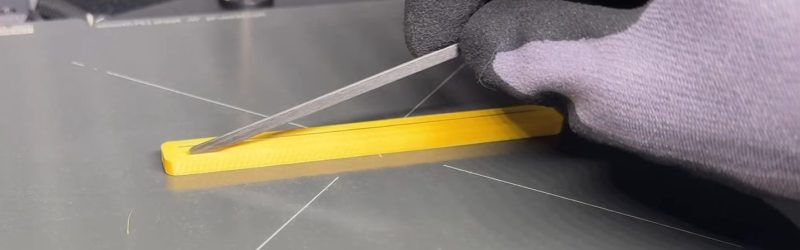
3D Printing is great, but it is pretty much the worst way to make any given part– except that every other technique you could use to make that part is too slow and/or expensive, making the 3D print the best option. If only the prints were stiffer, stronger, more durable! [JanTech Engineering] feels your plight and has been hacking away with the M601 command to try embedding different sorts of hardware into his prints for up to 10x greater strength, as seen in the video embedded below.
It’s kind of a no-brainer, isn’t it? If the plastic is the weak point, maybe we could reinforce the plastic. Most concrete you see these days has rebar in it, and fiber-reinforced plastic is the only way most people will use resin for structural applications. So, how about FDM? Our printers have that handy M601 “pause print” command built in. By creatively building voids into your parts that you can add stronger materials, you get the best of all possible worlds: the exact 3D printed shape you wanted, plus the stiffness of, say, a pulltruded carbon-fiber rod.
[JanTech] examines several possible inserts, including the aforementioned carbon rods. He takes a second look at urethane foam, which we recently examined, and compares it with less-crushable sand, which might be a good choice when strength-to-weight isn’t an issue. He doesn’t try concrete mix, but we’ve seen that before, too. Various metal shapes are suggested — there are all sorts of brackets and bolts and baubles that can fit into your prints depending on their size — but the carbon rods do come out ahead on strength-to-weight, to nobody’s surprise.
You could do a forged carbon part with a printed mold to get that carbon stiffness, sure, but that’s more work, and you’ve got to handle epoxy resins that some of us have become sensitized to. Carbon rods and tubes are cheap and safer to work with, though be careful cutting them.
Finally, he tries machining custom metal insets with his CNC machine. It’s an interesting technique that’s hugely customizable, but it does require you to have a decent CNC available, and, at that point, you might want to just machine the part. Still, it’s an interesting hybrid technique we haven’t seen before.
Shoving stuff into 3D-printed plastic to make it a better composite object is a great idea and a time-honored tradition. What do you put into your prints? We’d love to know, and so would [Jan]. Leave a comment and let us know.












In Rod We Trust.
Comment of the year haha
Praise Rod. Send money.
Personal favorite is a bike spoke. Cheaper, long, easy to hide in a fairly thin walls.
Umbrella metal spokes too!
That and paper clip for smaller items that can bend. Been using both here and there.
Someone made an excellent suggestion on Reddit that to facilitate insertion of the hardware you can beforehand 3dprint out supplemental supports, or ‘covers’ to put on the metal parts. This allows for good adhesion, eliminates bridging problems, etc.
Funny to see this right after the article that claims it’s worse than useless to include carbon fiber in PLA prints.
Chopped carbon fiber.
I am a big fan of strength through adding metal after the fact, but doing it in the middle of the print doesn’t make much sense to me.
First, there’s just the basic principle of the thing. I want the plastic to be in compression, and the metal to be in tension. So i want the metal to be clamping the plastic, which intrinsically means the metal has to go all the way through the plastic and clamp it from the outside. Any plastic outside of the metal is going to be the weak point. And the plastic holding onto the metal isn’t going to work nearly as well as the metal holding onto the plastic.
The other is just something I noticed recently…i paused my print to insert a stack of copper-zinc discs, just to add weight. And that worked perfectly, but it was a rough draft and i decided to make another to refine some dimensions. So I wanted to reclaim my ballast, and i noticed there was an imperfection in the surface finish where the pause was, and i just inserted my x-acto into that imperfection and it snapped apart easily and cleanly.
I’m always saying that meditating on layer adhesion is mostly wasted time, but once the pause was added into it, it really made a difference. I’m sure there were things I could do to work around this problem, and I think it’s probably more severe with PETG than other filaments, but practically speaking I think pausing a print adds a defect layer so it can’t really “add strength.”
Is that a temperature issue? Perhaps if you warmed the print with a heat gun right before resuming, the adhesion would not be as tenuous at that layer?
Another tactic would be to raise the extrusion temperature of the layers immediately following the pause. This should help it adhere to the previous layer. Also might want to stop part cooling on the few layers before the imsertion. Lastly you might be able to come up with a mechanically keyed in geometry so that you are not entirely relying upon layer adhesion.
Make a piggy bank slot to insert pennies after the print. And a snap cover for the slot?
What happened is that your ballast caused the bed to drop by a 30-100 micrometer. This causes the layer adhesion to be… pretty bad.
that’s kinda awful but a fair assessment. Pity even today’s 3D printers still don’t touch off on the most recent layer to resume a print.
Wow that’s an exotic explanation i hadn’t even considered…and it actually fits what i observed visually. i’m not sure if it’s true or not but it definitely makes me think thanks!