
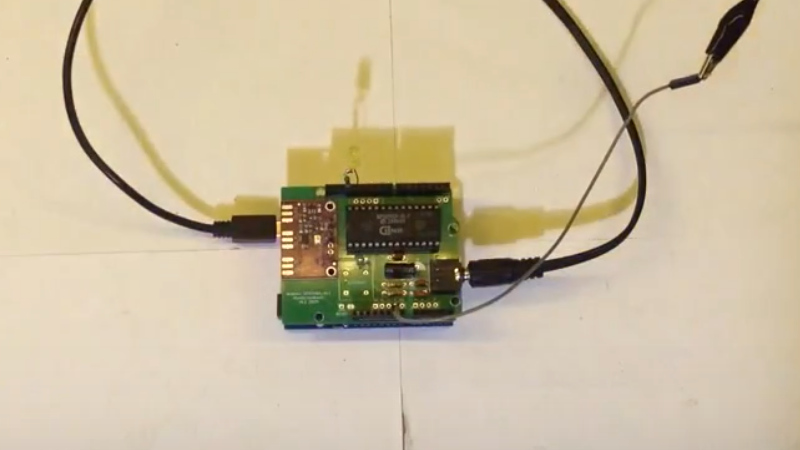
In a curious historical twist, the “Twelve days of Christmas” are actually the days of revelry that followed the 25th. The preceding period, Advent, was traditionally a fast, not unlike Lent. When and why a fast became an excuse for chocolate calendars we cannot say, but this historical information is presented to explain that this great hack by [Kevin], making a vintage speech synthesizer chip sing the classic carol will remain relevant at least until January 5th — or perhaps even the 19th, for the Orthodox amongst us.
The chip in question is an SP0256A-AL2, which you may remember from various speech projects for 8-bit computers back in the day. It can talk, after a fashion, by reproducing 56 “allophones” — the sounds that make up English speech — from ROM. Singing, though? We cannot recall much of that back in the day, but then, a talking computer was impressive enough.
As it turns out this is building on an earlier hack [Kevin] did in which he used an Arduino to make the venerable speech chip MIDI controllable. In that project’s write-up it is revealed that a Si5351 programmable clock module is used to give a variable pitch signal to the speech synthesizer. In this way he’s able to get about an octave an a half, which is good enough when the carol in question only spans one octave.
Of course the pitch signal needs to be varied by something and for that the venerable Arduino once again takes the place of an 8-bit computer. In this case it’s pre-programmed, but can also be set up for MIDI control.Of course nothing says you can’t use true retro hardware or a more-capable RP2040 instead of the Amtel chip.
It’s sad to think how much compute power has been wasted this year on AI-generated novelty carols when a little bit of 1980s silicon and some ingenuity can do nearly as good — or better, depending on your tastes.












Could this have been done in the 1980s (i.e., without the Arduino)? This seems to indicate it could have, “Of course the pitch signal needs to be varied by something and for that the venerable Arduino once again takes the place of an 8-bit computer. “
The key trick here is being able to vary the frequency of the oscillator driving the speech chip. It usually requires ~4MHz, but by varying it in a semi-controlled way, almost an octave and a half is possible. If that can be controlled and synchronised with the allophones, then yes, in principle an 80s microcontroller could also do it.
Kevin
I used that part on a ham radio repeater controller I built. They were quite hard to get, even in their prime. They weren’t perfect, you had to tweak the text to get the right pronunciation, but they were cheap ($10 or so?) and worked well. Processor driving the controller was a Motorola 6802.
A switchable oscillator could be made and addressed to switch set frequencies for each note. Think of a music synth where the keys are changing the frequency. You could also include raising or lowering frequencies with ADSR filtering. If the output of a synth were used as the oscillator source, it should be possible to make the chip sing in tune.
I built one for my ‘capstone’ course in EET. I didn’t know it was that but it was. I built a board for the Apple II. Worked well with Apple BASIC. It was fun. Wish I have kept it.