
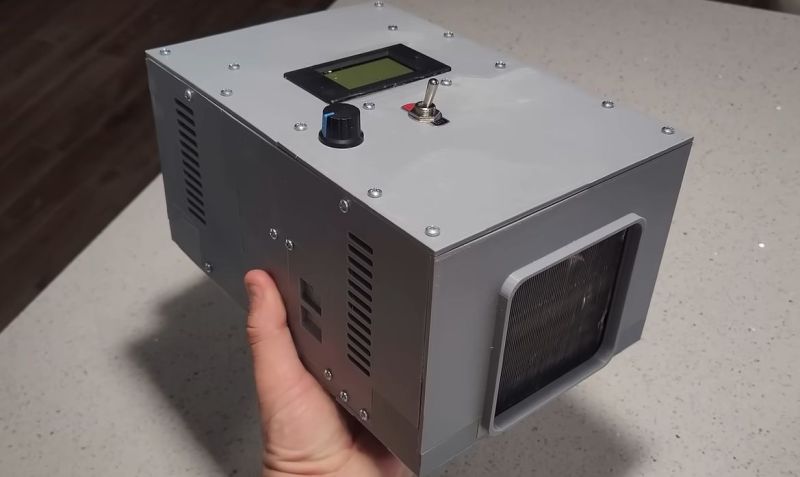
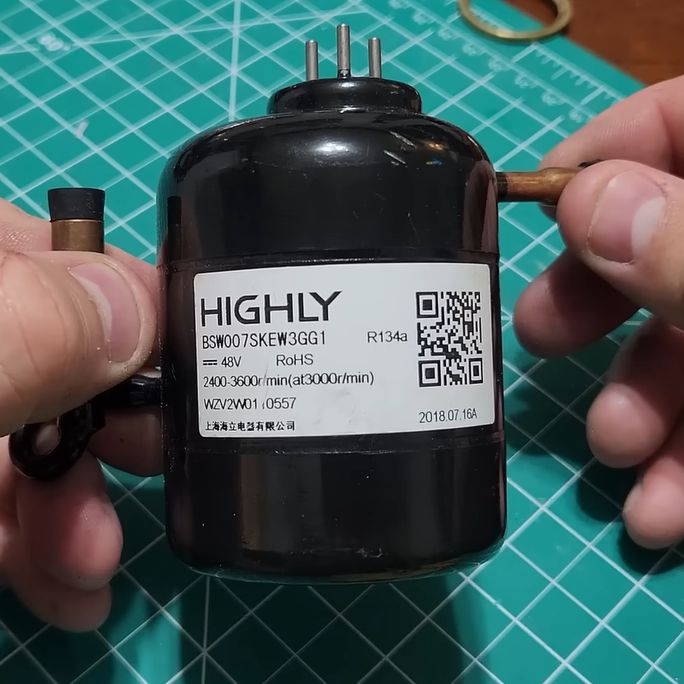
When you think of air conditioners, you tend to think of rather bulky units, with the window-mounted appliances probably among the most compact. There’s however no real minimum size limit to these AC units, as long as you can get an appropriate compressor. If you also manage to pick up a small, DC-powered compressor like [Hyperspace Pirate] did, then you might be tempted to make a hand-portable, battery-powered AC unit.
At their core vapor-compression AC units are very simple, featuring the aforementioned compressor, a condensing coil, expansion valve and the evaporator coil. Or in other words, some radiators looted out of other devices, various plumbing supplies and the refrigerant gas to charge the AC unit with.
Since the compressor uses a BLDC motor, it has three terminals that a typical ESC connects to, along with two 2200 mAh Li-on battery packs that can keep the portable AC unit running for a while.
As for the refrigerant gas, although the compressor lists R134a, this is both quite expensive and illegal in parts of the world like the EU. Alternatives are butane (R600) as well as isobutane (R600a), but due to unfortunate circumstances the use of propane (R290) was forced. Fortunately this worked fine, and after some testing and running of numbers it was found that it had about 42 Watt cooling power, with a coefficient of performance (COP) of around 1.
Considering that most AC units have a COP of 3.5 – 5, this shows that there’s still some room for increased efficiency, but at the very least this portable, battery-powered AC unit provides cold air on one side, and hot air on the other while completely blowing Peltier thermocouples out of the water in terms of efficiency.










Awesome details and video. I may try this with the goal of a cascade system for ultra low temperatures (ethylene refrigerant, but that’s going to take a lot of trial and error to get there)
BLDC variable speed is a big advantage here, as it allows you to keep the stages in balance. (according to a firm who made cpu cryocoolers a long time ago)
This YouTube channel did exactly that with larger compressors.
When i was a miserly college student, i often dreamt of a portable AC and a connected tent that could let one person sleep inside it. Regular ACs were too expensive, and evaporative coolers stop working if the humidity rises. Besides, you don’t need to cool an entire room to sleep well, just the immediate air around you
Surely such a device has a market and it will sell.
Tent air conditioners are a thing. They’re all over amazon and ali
When you live somewhere with included utilities (say a dorm) you can ziptie a coil of copper pipe to a desk fan and run cool water through it. Makes for a good spot-cooler.
Arent dorm faucets on timer like in prisons and hospitals?
Every down I’ve ever been in had no plumbing at all in rooms but a common bathroom etc at the end of the hall. But we were poor maybe the dandy ones had a sink. Like prison.
.
Dorms suck.
You would have to route the other end outside or keep all the windows open all night but maybe you are doing that anyway. something – otherwise you would be cooling your little sleeping tent at the cost of heating up the rest of the room, right? Plus the condensed water has to go somewhere.
.
When I was in dorms there was a brisk used window mount AC market. The unit was cheap but the real surprise is how darn expensive they are to operate. And the cheap dorm construction meant that the second it stops running the heat and humidity very rapidly return to ambient levels so you basically had to run it non stop.
A COP of around 1. So, substantially worse than a simple vortex tube. Probably quieter though.
A bigger radiator would probably help to keep the hot side temperature down and improve CoP. The unit should be tested with the radiator dunked in cool water to find out what the maximum performance could be.
What do you mean exactly by “but due to unfortunate circumstances the use of propane (R290) was forced”?
The butane he ordered never arrived.
What is the novelty here? All cars, portable fridges, ages now, use “mini” size compressors, 12v battery operated. There are even 8cm items. The oldest and maybe article-worthy is the Sawafuji swing motor from the 60’s(!).
This micro, and it’s brushless 3 phase.
Nice. However I have heard of people using high voltage to enhance evaporative cooler operation. Apparently, charging the evaporative cooler pads to 30,000 volts can tremendously increase evaporation, and thus cooling power. I’ve heard they can make a swamp cooler snow.
So, putting a lot of voltage and power into water can make it evaporate more quickly. OK. Got it.
Not at all clear how that leads to increased cooling power, except maybe by increasing the airflow through the pad through ion wind.
You could put that power into fans instead, and make less ozone.
Making it smaller with no guidance as to the ideal installation is misleading. If the unit is run in a closed room there will be no overall cooling effect, the heating/compression cycle will heat the room and add extra heat, that the cooling cycle will not even counter balance, ie no net cooling gain. Unless it is well mounted in a window and with external fan forced heat dissipation, and the internal cooling well isolated from the exterior, it will not even get close to its efficiency reading of one.
I have r12 I’d like to give it a whirl
You probably could use the modern r410 or something