
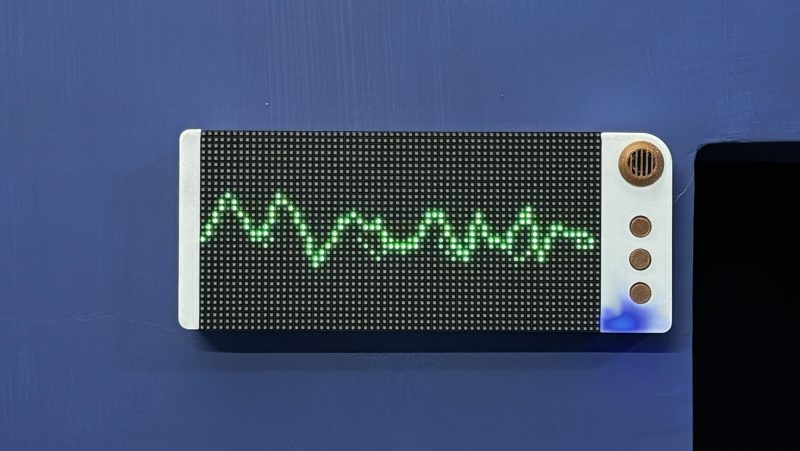
Visualizers used to be very much in vogue, something you’d gasp in at amazement when you’d fire up Winamp or Windows Media Player. They’re largely absent from our modern lives, but [Arnov Sharma] is bringing them back. After all, who doesn’t want a cool visualizer hanging on the wall in their living room?
The build is based around the Raspberry Pi Pico 2. It’s paired with a small microphone hooked up to a MAX9814 chip, which amplifies the signal and offers automatic gain control to boot. This is a particularly useful feature, which allows the microphone to pick up very soft and very loud sounds without the output clipping. The Pi Pico 2 picks up the signals from the mic, and then displays the waveforms on a 64 x 32 HUB75 RGB matrix. It’s a typical scope-type display, which allows one to visualize the sound waves quite easily. [Arnov] demonstrates this by playing tones on a guitar, and it’s easy to see the corresponding waveforms playing out on the LED screen.
It’s a fun project, and it’s wrapped up in a slick 3D printed housing. This turns the visualizer into a nice responsive piece of wall art that would suit any hacker’s decor. We’ve featured some other great visualizers before, too.












I setup something similar but using those basic 8×32 LED matrixes.
Those Hub75 displays just never work long for me, in a week or so I’ll end up with a variety of failing LED rows or odd patterns
I’ve literally have 40 in use only only have 1 failed pixel.
Deaf people use sound visualizers. You can see it in the Korean movie “Midnight” (Silence kills)
It was also used in Squid Game
i would imagine that dragging a little AI into the creation of visualizations could be interesting — i’d rather have it doing that instead of deciding whether or not it was time to harvest my organs
I made something similar-ish a few years back, but much bigger. I used strips of NeoPixels arranged in a grid behind a diffusers. It’s currently hanging on the wall of Dawkes Music’s “Luna Room” in Maidenhead. After it went, I found myself missing it, so I built a mini version using a 64×64 Hub75. Big shout out to Monsieur Desodt, a retired French radar engineer. He taught me how to do FFTs properly.
Spectrum display would be more useful as both eye candy and hearing impaired use than an old fashioned un-synced time base display. It shows mostly gibberish unless it’s in tune with a tonic note. With speech its always moving around. Triggered sync is what all scopes but old Heathkits have for viewing a waveform.