
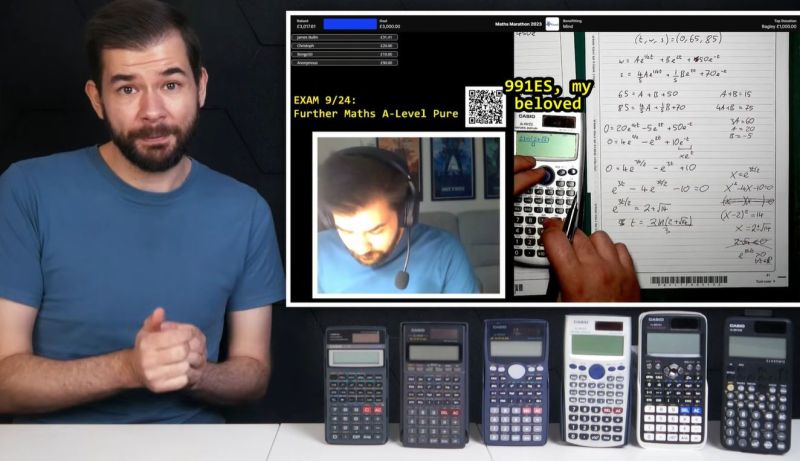
Scientific calculators are an amazing invention that take pocket calculators from being merely basic arithmetic machines to being pocket computers that can handle everything from statistics to algebra. That said, there are a few layers of scientific calculators, starting with those aimed at students. This is where Casio is very popular, especially because it uses traditional algebraic notation (VPAM) that follows the written style, rather than the reverse-polish notation (RPN) of HP and others. However, much like retro Casio wristwatches, it appears that these Casio calculators are now being (poorly) faked, as explained by [Another Roof] on YouTube.
The advanced fx-991 models are updated every few years, with the letters following the model indicating the year, such as fx-991EX standing for the 2015-released model. This was the model that got purchased online and which turned out to be fake. While the fx-991CW is newer, it changes the entire interface and is rightfully scolded in the video. Arguably this makes it the worst Casio scientific calculator in history.
After this run-down of how we got to the current Casio fx-991 model, we question why we don’t just use smartphones with a ‘scientific calculator’ app. The answers are ‘exams’ and ‘less complexity’, along with the tactile experience and how this enables muscle memory. Yet due to the CW model’s issues and disdain for muscle memory, the EX model is recommended by teachers. This then opens the market for knockoffs as Casio wanted everyone to move on to the CW model, and parents are always looking for that bargain deal with school supplies.
These fake EX models suffer from a variety of issues, depending on the internals. Some are noticeably slower, have omissions and even outright errors in their firmware that make them unusable for a variety of calculations. This makes it rough for both teachers and parents to find a good Casio scientific calculator, even as Casio has already reverted some of the controversial changes in the CW model in an admission of the problems they have caused.
Here’s hoping that Casio fully reverts to the EX-style of UI in its next 991-series calculator and finds a way to curb the spread of bad clones of its currently last good scientific calculator.







Had one of these about 15 years ago, it looked identical to the real thing at first glance but was slower and would even hard crash solving certain differential equations, requiring me to open it up and disconnect the battery.
Battery life was much worse too, I later got a real Casio in 2012 and it still runs on its original AAA even today.
Hunh? I’ve been out of the calculator game for a few years so may have missed it: When did TI start making RPN calculators?
I did a double-take there too. I assume they meant HP and had a brain fart.
I remembered incorrectly it seems. Although I have a TI-89 kicking around that I’m nursing back to health, I’m very much a Casio calculator person as you noticed :) Fixed it in the text.
“especially because it uses traditional algebraic notation (VPAM) that follows the written style, rather than the reverse-polish notation (RPN) of TI and others.”
Which TI calculators use RPN?
I hoping he meant HP, but many calculators do use RPN for many operations – like when you enter the argument to the trig functions before executing the trig operation ( e.g. to do cos(pi) you type pi first, then cos). Or the number to find the square root of then the square root key.
Casio VPAM you enter cos, then the argument to cos, so “cos” then “pi”. Or “square root” then the argument.
Personally it’s HP for me, and there’s nothing better than running the official HP firmware on a computer emulator because HP calculators are so hard to find these days. And apparently they aren’t made by HP.
“especially because it uses traditional algebraic notation (VPAM) that follows the written style, rather than the reverse-polish notation (RPN) of TI and others.”
Which TI calculators use RPN?
I suspect TI mentioned was meant to be HP… a n easy mistake to make! :)
Hilarious. I still remember several TI (algebraic) vs. HP (RPN) arguments among us STEM students when I was in college. I had a TI 55 then and got an HP 48G when I started work so I love them both.
RPN 4 LIFE!
LIFE RPN 4 !
1 +
ENTER, 1, +
I’ve still got my FX-82. Over 40-years old and still working better than my brain…
FX-82A here. A bit slow, but still working like a champ.
A year or so newer here, but my fx570 is still alive after exactly 40 years. Battered, bent and well-used, but still working perfectly.
Just got a ‘Hey, that sounds familiar’, checked in my drawer and yep, two of my two old calculators are Casio FX-82LB. Apparently 33 years old, put in batteries and both worked correctly.
Yep… My FX-81 still works as well.
Still have my fx-100. The original batteries still work!
I use it a lot for imperial measurements as it does fractions. Do all the additions, subtractions, etc., then multiply by 25.4 to get freedom units.
Most CASIO calcs will calculate 100+10%=111…
I was trying top sell original Casio calculators in Mongolia, but sold zero. Even for $20. They get a lot of imports from China and a lot of knockoffs. Some have names like COSIO, CASIA. And some will have just different names and cost about $5. And that people would prefer.
I have an OSALO calculator that I bought purely because they’d got the font on the case so close that at a glance it looks just like CASIO. I just loved the level of chutzpa :)
I only need it for basic maths, otherwise it’s not a patch on my beloved fx-992s
Our school allowed me to take my Casio FX-180p, a programmable scientific (which had a definite integrals mode) into my ‘O’ level (age 16) exams if I cleared its measly 38 step program areas. And at ‘A’ levels (age 18), they allowed the same thing for my Casio FX-4000p (which had hyperbolics, but not definite integrals).
IMHO, the disappearance of programmables for kids is a major step backwards. User-defined functions just aren’t the same!
UK? Here in the US, I went to a well known fast food place the other day. The bill was $15.12 and I gave her $20.12. Maybe there was something wrong with the electronic cash register which would have told what looked like a high school aged (~age 15-18) girl the proper change, but she instead used a calculator and then grabbed a $5 bill and started to grab some coins. I repeated what I had given her and that the change should be just $5. She gratefully handed me the five.
I”ve ran into that as well… a couple of times. Stump the cashier :) .
I still use HPs RPN calculators. Just seem ‘right’.
My point was that Julian was complaining about kids’ programmable features disappearing in calculators and here we had a high school aged girl who apparently doesn’t know how to properly use a simple calculator and can’t do the simple change due math in her head.
Historically, no matter the educational system and policies in question, there is not 100% success at instilling math skills.
What you’re really seeing is that employers do not view math skills as being worth a premium in that job, so employers for that job are unwilling to compete with other sectors to hire people with those skills.
If you are paid allowances instead of normal minimum living wage, I’d too use $1 calculator instead of my (undervalued) brain.
(old school here, btw, we grew up without calculators, they were mostly unaffordiums, even in the early/mid 1980s, people had more important things to spend the bulk of their sorry wages on, like food or cloths).
While I agree that the US public education is one of the worst in the world, US minimum-wages are, too, are quite bad – we are paying our poor (the class that has been roughly doubling every decade) the worldwide equivalent of $1/day; compared with the average so-called “manager” who is usually paid three to ten times that, average worker is not paid to think smart.
I don’t think it’s an hourly wage versus living cost issue. I think it’s more like there’s a device to do your math for you. Unfortunately, she couldn’t even properly use a calculator.
i’m not sure but it seems like we’re talking about a different kind of beast than what i think of when i think ‘scientific calculator’ ? imo a scientific calculator is just a regular calculator with trig functions and exp/pow/log. Crucially, it satisfies the “simplicity” attribute by having a one-line display, it always just displays the result and then your operator works on that, making infix (without operator precedence / nesting) a kind of unremarkable foregone conclusion. And i’ve always assumed that for this, the knockoffs are essentially as good as anything??
If we’re getting into more complicated things with like algebra and calculus engines, that’s a level of complication where i cannot possibly imagine wanting a dedicated device. We’re talking about a big piece of software at that point and for software you want a computer. I loved my hp48 but only because at the time a portable computer was an untenable expense for me.
Test taking always raises an interesting challenge but fwiw my kids are taking tests with an ipad with some nanny software installed lol. Any serious test taking should use standardized equipment but of course there’s no serious testing anymore.
“standardized equipment” — Pencil and Paper. Good to go. Or should be. Less expensive too.
“Standardized equipment” — Tooth and Claw (er fingernail). Good to go. Or should be. If you can’t kill it, you can’t eat it, and it can eat you. Oh, and if you get a chill, you probably should die and remove that weakness from the gene pool.
Err… uh… we are tool users. Any tool that is of use is a valid tool. The range for useful debate is only over whether it is of use, and whether the cost is greater than the benefit.
And even if we’re wrong, it’s actually really hard to kill off all of humanity. Even after a nuclear war, there would still be many more humans around than the 10,000 year average population for the species.
Serious testing? That can only properly be done 1 for 1 with real life. If they die of old age, they passed the test :)
What you’re talking about is standardized testing. Which is much cheaper to do, has some valid predictive value, but isn’t at all equivalent. And yet, people fight to make policy based on it…
This stirred up an ancient memory. There is a calculator in a vinyl wallet stuffed in a cubby above my desk as I’m reading this. Was it a Casio? I don’t remember, so I reach for it. Nope. TI-35 Plus, 1986, USA factory. I press the “ON/C” button.
How the hell does this thing preserve LR44 batteries for decades, when everything else I put them in they last a month, or a year at most?!? Well, they’re actually A76 batteries, but it’s the same chemistry!
The display is as clear and sharp as day one!
If you have and older phone, there’s an emulator app.
https://play.google.com/store/apps/details?id=com.fx991ex.fx991exoriginal
Also:
https://share.google/BcnYx0lahd2oSsXo6
With all the negative flak that comes towards “fakers”, few things come to (my limited) mind.
1 – you never learn if you don’t copy the best. (How do you learn music, for example? By writing your own operas? No, you go learning step by step by playing the scores written/arranged by others – AND repeating what geniuses did before you started this path).
2 – US pricing is one of the worst in the world. Average person in, say, Vietnam gets by with around ~$60 per day (my estimates, quite likely even less, I’d say >$40).
3 – Technology of making these has became so cheap, $1-$5 is the actual REAL cost of making and selling these for profit is, the rest of the forced/mandatory $10 is paying for the infrastructure, shipping it around the world, storing in a warehouse waiting for the average Sam to walk in and buy it, etc. (average chinese-made copycat is probably made for even less, I’d say ~50 cents when bought in bulk).
4 – Time to move forward and invent something that would be even better, cheaper, and fulfill other needs so far unmet (that’s how Liberal Capitalism supposed to work, spurring companies into inventing better cheaper things, and since it seem to be sputtering worldwide, time to move on with the non-profits and cooperatives to pick up the slack and limit for-profit entities to their original part of the market, monetization without ruining life for the rest of us). Copy from what’s popular on Google/Apple Play and make THAT calculator.
I owned a Casio 991CW, the addition of the OK button was great, also the home screen is organized, the problem is you can’t do equations in calculation mode, you have to switch to another mode in order to do that. Plus the AC button does no longer switch to the previous mode you are using, you have to press the mode once again. Even after pressing ON.
It’s resolution and buttons and additional options are very well made, i am just upset they had to move some shortcuts into a catalog button in sake of removal the alpha button.
https://m4th5.co.uk/classroom-interactives/gcse-calculator-simulator/
I made this to try and keep the old design ideals of the Casio alive. I hope you find it useful.