
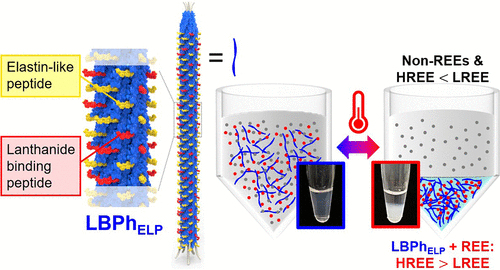
Although rare-earth elements (REEs) are not very rare, their recovery and purification is very cumbersome, with no significant concentrations that would help with mining. This does contribute to limiting their availability, but there might be more efficient ways to recover these REEs. One such method involves the use of a bacteriophage that has been genetically modified to bind to specific REEs and release them based on thermal conditions.
The primary research article in Nano Letters is sadly paywalled, but the supporting information PDF gives some details. We can also look at the preceding article (full PDF) by [Inseok Chae] et al. in Nano Letters from 2024, in which they cover the binding part using a lanthanide-binding peptide (LBP) that was adapted from Methylobacterium extorquens.
With the new research an elastin-like peptide (ELP) was added that has thermoresponsive responsive properties, allowing the triggering of coacervation after the phages have had some time in the aqueous REE containing solution. The resulting slurry makes it fairly easy to separate the phages from the collected REE ions, with the phages ready for another cycle afterwards. Creating more of these modified phages is also straightforward, with the papers showing the infecting of E. coli to multiply the phages.
Whether the recovery rate and ability to scale makes it an economically feasible method of REE recovery remains to be seen, but it’s definitely another fascinating use of existing biology for new purposes.











Thanks for the great paper and article, happy New Year 2026!
What methods must be taken to contain the phages? Great idea and all, but if we know one thing from the industrialization of our planet it’s that profit always wins. Industry will use this, and will find out that proper disposal may be expensive, so let’s just dump this into the environment. What will happen then? Do these phages have specific needs that make them dormant or subject to breakdown if not met? Will they cause massive harm to the environment once dumped by some uncaring industry or country?
We have come a long way to cleaning up the industrial mess we’ve made so far (and we have so much further to go) but the fact that these processes can extricate REE in new amounts, if there’s profit to be made, they will be used, and if there’s money to be saved by just dumping the waste, that’ll happen.
We need to understand the ramifications of these things better.
What could possibly go wrong? It needs e. coli to replicate, which isn’t found in humans, right? Also it could not possibly bind to any trace elements humans might need to survive, right?
I’m all for new and less environmentally impactful ways to get the rare earth elements we need for the energy transition, but sounds rather risky to me. I am, however, not a biologist.
They are specifically engineered to bind to REEs which are not found in humans. Also, if they destroyed e. coli in humans, then it would be a benefit.
Your response comes off as someone who would sign a petition against the distribution of dihydrogen monoxide or scared by the use of ethyl mercury in vaccines. Leave the science to the scientists.
There are several subspecies of E. coli. Some are beneficial and might even be regarded as essential to human life.
“Please be kind and respectful.”
I’m not going to be kind and respectful to bacteria found in human shit lel
“What methods must be taken to contain the phages?”
None because they aren’t a threat and their original version is from soil.
However, simple UV exposure or heat will destroy them.
Just like it destroyed COVID-19 right? ( ͡° ͜ʖ ͡°)
“biomining” with sulfate-reducing bacteria has been used for decades to remediate mine tailings, and even extract copper. Even a half century ago in the podunk backwater town near where I lived. They were not engineered back then, merely self-selected by what would survive in that toxic brew. It’s nice to see specifically engineered constructs for more targeted applications.
If you can use little bugs to make beer or yogurt or insulin or pesticides or motor fuel, why not use them for mining.
As for cost: If you can make something as energetically ridiculous as motor fuel production work at scale, then why not?
The counterargument being that ammonia production still isn’t being done biologically by microbes at nice room temperatures and pressures like nature does. Instead, to make it commercially-feasible at scale we still have to make it using a dangerous high temperature, high pressure process.