
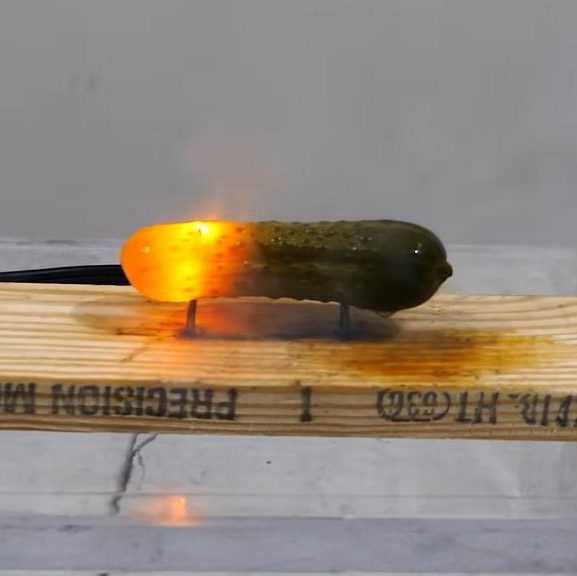
While we’re 100 years past Edison’s fear, uncertainty, and doubt campaign, the fact of the matter is that DC is a bit easier to wrap one’s head around. It’s just so honest in its directness. AC, though? It can be a little shifty, and that results in some unexpected behaviors, as seen in this video from [The Action Lab].
He starts off with a very relatable observation: have you ever noticed that when you plug in a pickle, only half of it lights up? What’s up with that? Well, it’s related to the asymmetry he sees on his Jacobs ladder that has one side grow hotter than the other. In fact, it goes back to something welders who use DC know about well: the Debye sheath.
The arc of a welder, or a Jacobs ladder, or a pickle lamp is a plasma: ions and free electrons. Whichever electrode has negative is going to repel the plasma’s electrons, resulting in a sheath of positive charge around it. This positively-charged ions in the Debye sheath are going to accelerate into the anode, and voila! Heating. That’s why it matters which way the current goes when you’re welding.
With DC, that makes sense. In AC, well — one side starts as negatively charged, and that’s all it takes. It heats preferentially by creating a temporary Debye sheath. The hotter electrode is going to preferentially give off electrons compared to its colder twin — which amplifies the effect every time it swings back to negative. It seems like there’s no way to get a pure AC waveform across a plasma; there’s a positive feedback loop at whatever electrode starts negative that wants to introduce a DC bias. That’s most dramatically demonstrated with a pickle: it lights up on the preferentially heated side, showing the DC bias. Technically, that makes the infamous electric pickle a diode. We suspect the same thing would happen in a hot dog, which gives us the idea for the tastiest bridge rectifier. Nobody tell OSHA.
[The Action Lab] explains in more detail in his video, and demonstrates with ring-shaped electrode how geometry can introduce its own bias. For those of us who spend most of our time slinging solder in low-voltage DC applications, this sort of thing is fascinating. It might be old hat to others here; if the science of a plain Jacobs ladder no longer excites you, maybe you’d find it more electrifying built into a blade.









“have you ever noticed that when you plug in a pickle, only half of it lights up?”
At the risk of disappointing, but give me credit for my honesty: no, I haven’t.
… except that (1) the positive ions should be attracted to the cathode (the negative electrode, where you’ve described the sheath as being), yet (2) both my memory and several welding references I checked show the opposite of what his chart shows: about 70 percent of the heat ends up in the positive side (which is indeed the anode). Presumably because it’s being hit by the relatively mobile electrons.
That’s why you normally set up a DC TIG/GTAW welder (where you don’t want to melt the electrode, and instead want to put the heat directly into the weld pool) as electrode-negative, whereas you often set up a DC stick welder (where you want the electrode to melt and spray onto the work) as electrode-positive.
Also, I’m not a welder by trade, and I’m actually a pretty bad hobby welder… but I’ve read a certain number of references aimed at welders, and I don’t think I’ve ever seen the phrase “Debye sheath” in any of those. ..
and that is why you need AC for aluminium, one polarity the electrons pull the oxide of the part, other polarity electrons hit and heat the part
Please do not experiment with hot dogs. The Chicago Board of Trade will take your wiener back. If ketchup is involved there will be continuances.
Just gonna leave this here: https://simh.trailing-edge.com/semi/docs/WRL-TN-13.pdf
Good Lord! That’s a thing?
This is an excellent study, and deserves a Hackaday article all its own, so it more likely to be read by all. Please submit this to H.A.D. tip line!
I was expecting an arc rectifier to be mentioned eventually, but no.
Should this be a Schottky Pickle because it uses metal-semipickle junction, or rather a LEP – Light Emitting Pickle?
Was that pickle fermented or brined?
You need this:
http://www.bitsavers.org/pdf/dec/tech_reports/WRL-TN-13.pdf
Anyone who was on USENET back in the ’90s will remember it.
Funny that I learned about this principle just a couple weeks ago when my furnace control board died. Like mine, most (gas) furnaces have a safety circuit that cuts gas when a flame isn’t detected within a short time. The flame “sensor” is nothing more than a conductor that can withstand the heat of direct exposure to the furnace flame. The control board passes an AC voltage to the sensor and the flame acts as a rectifier, much like the pickle or plasma in the video. The board simply looks for a few micro amps of DC current returned via the flame through the burner body. If present, all is good. If not, kill the gas and shutdown.
I think with kimchi it will be a surefire triode and with some extra galchi or junchi it may even be a pentode – with extra chili and garlic.
On another tangentially related thought, just why the Jacob’s Ladder is a V? What if it was helical narrowing kind, ie, introducing the vortex as it goes up and speeding it at the same time, thus, reproducing the Z-Pinch?
Basically, I wonder if is there a Jacob’s Ladder way to wind up ionized channel into the ball lightning? (it is speculated that the ball lightning starts as Z-Pinch that collapses into a ball assisted by the Earth’s gravity – similarly how detached water drops from a hose become tiny balls breaking the laminar flow into Z-Pinch, and then twisting into helical strands that eventually connect into selfs, somewhat like Tokamak).
“This shouldn’t curve”
A PD pickle?