
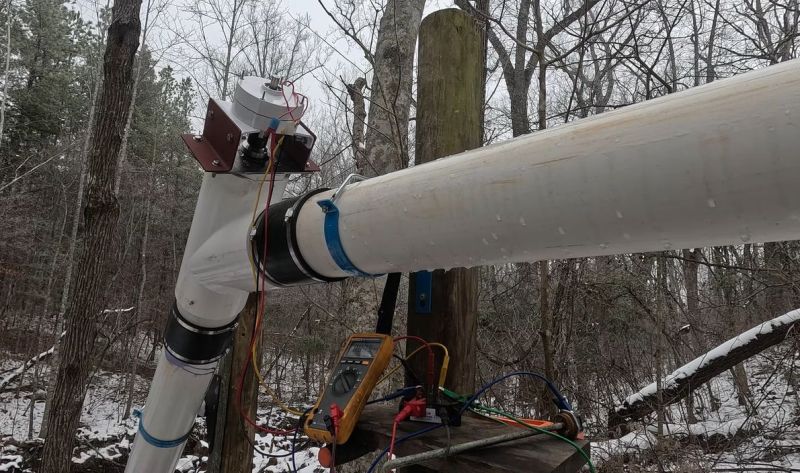
The concept of building your own hydroelectric generator seems simple at face value: use gravity to impart as much force as possible onto a turbine, which spins a generator, thus generating electricity. If you’re like the bloke over at [FarmCraft101] trying to DIY this with your farm pond and a lot of PVC pipes, you may have some significantly more in-depth questions, especially pertaining to what kind of generator to use. This and other questions, some of which were raised after the previous video in which the first prototype generator was assembled, are answered in this follow-up video.
When you DIY such a hydroelectric system, you have a number of options when it comes to just the turbine design alone, with the Kaplan-style turbine being one of the most straightforward ones – especially if you use a fixed pitch instead of adjustable – but you can go pretty far in the weeds with alternatives. As for the sharp drop-off after the turbine in the used design, the technical term is a draft tube, which is actually more efficient in this kind of low head, high flow hydroelectric dam situation.
After getting his money back for the unusable ‘3 kW’ generator, there were three options left: try an EBay special, get a purpose-built one from a US company, or rewind an alternator stator for higher voltage output than the standard 12/24V. Ultimately option four was chosen, as in ‘all of the above’, so that comparison is coming up in a future video.
There were also questions from viewers about why he opted to rectify the AC power from the generator and use DC transmission to the nearest farm building. The main reason is efficiency, as DC transmission lines lack the skin effect losses. The other is that the grid-tie inverter that he plans to use needs DC input anyway. Not having to deal with AC transmission issues like losses and reactive power shenanigans is a major plus here.
Once the three new generator versions are being tested it will be interesting to see how they perform. One thing with the Kaplan-style turbine is that too fast RPM induces cavitation, which will erode the propeller pretty quickly. Generally car alternators require a pretty fast RPM, so that may not work out too well. There is also the question of the DC voltage generated, as for DC transmission you want to have as high a voltage as possible to reduce the current.
The purpose-built generator he purchased tops out at 48V, which is quite low. The goal is to have at least 230 VAC before rectification, so a step-up transformer may be needed. Unfortunately three-phase transformers are pretty pricy again, making the rewound alternator seem less crazy. The wild card here is perhaps whether the EBay-purchased generator is a diamond in the rough and works out of the box as hoped.










There’s no significant loss from skin effect at low frequencies in small conductors.
For an introduction: https://en.wikipedia.org/wiki/Skin_effect
not only that, reactive power is basically irrelevant if you’re just rectifying back to DC.
I’m pretty sure the viewers are right here – there’s no scenario where it’s actually better to run DC over those distances.
Also not clear to me why you’d need to re-wind an alternator if you want higher voltage – surely that’s just limited by the voltage regulator and/or the excitation voltage going through the brushes into the rotor? higher voltage should work fine with the same size copper wires as long as overall power stays the same, no?
also gear reduction/overdriving (or perhaps more literally, pulley-size reduction/overdriving) seems like it’d be a good potential alternative to redesigning the turbine…
.. but I’m no hydroelectric power expert, so please feel free to tell me how I’m wrong about all this.
you would need more windings on the stator to produce higher voltages for the same rpm input. less windings = lower voltage, higher current – while – more windings = higher voltage, lower current
for sure, but
a) assuming you can control the RPM through gearing, why re-wind rather than increase RPM? I mean, I know efficiency losses due to friction are worse at higher RPM, and heat management is an increasing concern, but in practice, how much does this matter? because
b) if you’re repurposing a car alternator, many of them are designed to produce full output at around 1500rpm, but are perfectly capable of spinning and generating at 5000+rpm (they just depend on their voltage regulator to ensure they don’t feed more than the 12v nominal system can handle.)
Car alternators actually work better at slightly higher RPM because the regulator can reduce the excitation current, so the efficiency goes up.
The regulator is changing the field strength of the generator instead of dropping voltage to heat – that’s how it’s able to regulate 50-100 Amps without huge transistors and heat sinks.
of course, but until friction/heat/etc becomes the dominant concern, the work required to produce a given wattage is roughly the same regardless of windings, no?
so unless the resulting RPM is completely insane, surely using a belt drive to spin the alternator faster than the turbine is easier than re-winding.
especially if you’re repurposing an automotive alternator, surely. most of them are designed to produce peak output by 1500 rpm or so, but they’re also happy to spin much faster, and as a result, happy to produce much higher voltage if their internal regulator doesn’t get in the way.
use an alternator without fan blade, if possible, they cost a lot of energy at higher speeds
For the same RMS current, voltage and power at these levels, DC and AC are virtually identical. AC is very slightly worse due to dielectric loss, but it’s not much.
Guy lost his mind. He wants to run 600′ to his shop. Using DC he would need like 4 gauge wire to keep the voltage and current loss low. So that’s 1200′ of 4 gauge wire he has to get. Hat to see the cost of that bill.
DC vs AC has nothing to do with it.
You do realize that high voltage DC is a thing, right? The article hints strongly that this guy is desiring HVDC, with the current 48v system being too low voltage.
He’s not gonna get HVDC, which is another thing entirely. “Low voltage” is technically up to 1500 Volts DC.
He can use two transformers and run high voltage with low current. With a tiny gauge cables.
The main reason to use DC is safety and licensing requirements.
The Low Voltage Directive (LVD) in the EU starts from 50 Volts AC and 75 Volts DC. If you stay below the LVD limits, you don’t have to mind those regulation. The IEC also defines “Extra Low Voltage” as anything under 50 Volts AC and 120 Volts DC, and some jurisdictions may use that as the limit for when you need licensing or not. In either case, using DC allows you to use higher voltages and transmit more power within the regulatory limits.
A regular consumer without suitable qualifications, making their own AC line voltage generators and wire installations would at least void their insurance in case of an accident when the contraption is discovered by the investigators, and it may lead to criminal sentences if people are involved in the accident. To avoid that, you need to draw up plans and have the work inspected by a qualified electrician or other authority, and have them sign it so you can wave the paper at the court and say it was not your incompetence or negligence that caused the problem.
Sometimes people do this when renovating their homes, and the qualified electrician they hire is some clairvoyant buddy of theirs who signs up the work without ever visiting the site, and then later people discover that you get electric shocks from the shower when the washing machine is running (missing ground etc.).
At last in some European countries there is a max power of 200W in audition of voltige below 50V for amateurs
There used to be a safety limit of 250 Volt-Amperes for any single wire, so in case of a short circuit it won’t catch on fire before the safety fuses can trip. For a practical circuit, you would have to de-rate the allowable current by around 20% because a fuse does not trip instantly after the rated current. That’s where the 200 Watt limit might come from. I’m not sure if that applies anymore in any official capacity.
For me I’d suggest the main reason is if you are building off grid type stuff you almost certainly are using DC devices, lighting etc as much as possible, with some other generators and a battery/capacitor to deal with the spikes. Unless you are very lucky your hydro isn’t likely to be enough to meet all your needs in most places – but if you have that big river…
Nothing wrong with using AC of course, might be the best choice depending on your use case and your point is very valid on the legal red tape stuff, I’d just think it is the second most influential part of your reasoning with a setup like this – as you point out its not hard to get that qualified authority to sign off on it if you do want to go beyond the unregulated.
Doesn’t need to be a big river. Even a tiny stream will give you a kilowatt if you have decent elevation on your property, like 10 meters from the dam to the turbine.
For lights you don’t need that many watts, so the difference is rather irrelevant. For the rest, the RV DC stuff is just more expensive and less efficient or less powerful, and the options are more limited. Things like kettles or coffee makers, vacuum cleaner, hot plate, fridge, microwave, TV… all the big appliances that consume the most power and energy are cheaper and more efficient to run through one big inverter.
Plus, with 230 Volt AC from an inverter, you get to use regular sockets, switches, and regular gauge wiring which is also cheaper. Circuit breakers and other protective gear don’t work so well for low voltage DC because a DC arc doesn’t suppress itself (no zero crossing), so all the plugs and sockets, switches and interrupters, have to be made extra heavy duty to survive the arcing even for light loads. Your typical 15 Amp switch may handle a 3.7 kW load at 250 Volts AC but only 450 Watts at 30 Volts DC because it would weld the contacts at higher voltages. You’re not brewing much tea with that.
Messing around with DC power inside your cabin is only a thing if you really really want to DIY everything and don’t want to pay an electrician to come and inspect it. There’s no real practical advantage to it unless your power demands are very low.
Getting the power into the house is a different matter, because with DC you can take advantage of off-the-shelf components that are built for DC inputs, like multi-source solar/wind charge controllers and inverters – instead of inventing your own AC micro-grid and getting that signed off by an electrician. The only issue is distance and cable losses, which is where you would like the higher voltage.
Small scale off-grid inverters are ~80% efficient, while buck conversion is 95%+. The inverter itself will draw 25-100w idle as well.
Efficient generation, storage, and use of power is one of the larger if not the largest concerns in any off-grid power solution. 15% power efficiency is certainly a “practical advantage”.
The practical advantage is that small scale off-grid inverters are at most 80% efficient. Buck conversion is 95%+.
15% power efficiency is a big deal
So you’re saying it’s better to run relatively high voltage DC to the house at around 230 Volts, then buck it down to 12-24 Volts DC, and then put it into a 300 Watt RV tea kettle that can barely boil a cup of water and loses more than 15% efficiency because it’s so slow.
Point being, it’s not that the system is bad in principle – it’s that the DC appliances you have are all terrible.
“small scale off-grid inverters are at most 80% efficient. ”
20 years ago. Modern inverters typically offer high efficiency, with pure sine wave models often reaching 90-98% peak efficiency
I was thinking big more in terms of large enough to reliably to have the volume of water to take all the time at whatever rate you desire. You do also tend to need elevation, but that one is a bit easier to cheat in on your own property if it is required at all as big enough rivers just sticking the water wheel in the flow will do most folks nicely) where water catchment areas tend to be rather larger than you can do anything about.
Having a small inverter to do the relatively few things that are still not available as really good DC appliances isn’t a problem, and means you get to keep all the benefits of DC efficiency and easy off the shelf parts wise. But I certainly wouldn’t do without my UK spec kettle, tea would take far too long to brew. Though I guess just having the “always” on DC water boiler tank with some decent insulation might solve that problem. But either way only needing the inverter on while those loads are in use rather than all the time wasting some energy even with no load as they tend to do…
The inverter is part of your battery management and charging system, which you would have always on anyways.
It’s basically the same thing as the buck-boost converter that would run your DC system from the batteries, but designed to make regular AC instead.
If its always on that is a bad idea if you are not actively needing it – the nature of these inverters is to waste energy – quite high efficiency under load is possible even common now. However it is still eating rather more power while idle/under utilised as a rule.
Where the buck boosts really don’t care about load much their efficiency curves and power consumption are darn nearly flat lines. Which is why all the portable power backs with AC output options I’m aware of do have a way to turn that inverter off when you are not using it as just having it turned on under no load at all will drain those small batteries in rather few hours.
“If its always on that is a bad idea if you are not actively needing it – the nature of these inverters is to waste energy”
I wholeheartedly disagree. Modern inverters really do not waste much energy.
We have two inverters on our homestead. a 5kw inverter for the house and a 15kw inverter for the workshop. The 5kw inverter pretty much always has some load so its hard to say how much power it actually uses itself, but the shop inverter…..It sits in no load for most of the night so its an easy to meter. Now remember this is a 15kw inverter, three to five times the size of a normal households inverter. In no load it draws a whopping 20W of power.
While actively detailing a reasonably large waste for off-grid type scales while being entirely inactive. Also wouldn’t call that a whopping inverter myself – an all electric household is going to easily be demanding that same ballpark, 5KW barely covers boiling a kettle with any margin for the rest of the house…
I’m not saying modern inverters are bad by any means, what they are not is highly efficient at the low loads and idle – wasting that few extra KWh every week for it being out of its efficiency window or eating up power to not useful purpose at all while idle really adds up for most in off grid type situations. If you are lucky enough to really not need to care about it super you can keep things simple and never have to remember to turn the inverter on or off, you prepaid for a large enough off grid generator setup to make those losses easy to absorb.
“5KW barely covers boiling a kettle with any margin for the rest of the house…”
5kw handles our entire house withut issue.
We arent alone in that either.
https://tinyurl.com/mv4xfasy
“Though it largely depends on your house’s size and the number of appliances you want to run with the inverter, a 3000W to 5000W inverter is enough to power most appliances of an average household.”
https://tinyurl.com/rp5bzdzy
“he size of the inverter you need depends on the total wattage of all devices you plan to power simultaneously. Sum the wattages of your appliances, add a 20-25% safety margin, and choose an inverter with at least this capacity. A 3000-5000 watt inverter is usually sufficient for an average household.”
https://rb.gy/ta5mu8
“Many homeowners wonder what size inverter is needed to run a refrigerator or a microwave during a power outage. The right inverter size depends on your energy needs. For basic emergency power—such as keeping the lights on, running a small fridge, and charging devices—a 1500W to 3000W inverter may be sufficient. However, if you plan to run multiple high-power appliances, a 3000W to 5000W inverter is recommended.”
Off grid life requires a bit of adaptation. Most of us comprehemd that doing a load of laundry while baking a turkey isnt worth the expense. So if you MUST have your tea at blazingly fast speeds, make sure you arent using every appliance in your house simultaneously.
All of this is inconsequential though. Your statement that “the nature of these inverters is to waste energy ” is completely incorrect, as illustrated by the 20W my 15kw inverter draws. Youre over here talking about the joys of a 3000W+ tea kettle and my shop inverter is using about as much power as one or two LED lightbulbs. Inverters are QUITE efficient.
Tricky given here in the UK a kettle that isn’t 2KW or more is almost impossible to find, till you get down to the 12v in vehicle barely boils a tiny half sized cup in 20 mins ones, and in the all electric house your heating, cooking etc are all loads that last hours drawing significant loads… 5KW is just cutting it way too fine for a practical all electric experience.
Also heating the water faster is vastly more energy efficient as it isn’t radiating nearly as much heat into the environment with that slow gradual heating of a weedy kettle. And off grid that is likely to really matter, as most folks don’t have enough generation capacity to be so inefficient everywhere and actually stay in power.
Difference is the Kettle is on only when you are actively using it, and if you have hit a power crunch moment you can even if sadly do without. Even without enforced limits its maybe its working a whole hour every week, if your family really really like tea maybe its got a whole 2 hours of uptime in that week – sure that is 3-6KWh, but the constant inefficiency of that inverter is on 100% of the time, so in that week its wasting to no purpose whatsoever about the same as the kettle has used…
Plus if all you are running on it is a few lights etc it is way out of its efficiency band to make whatever load you are running significantly more power consuming than it could be too (not to mention these days 99% of those lower load devices are DC devices at heart, so you have DC to Mains AC then back to DC so both an extra conversion and the generally lower efficiency AC-DC switching one… So combined with the fact that all it takes is to have something like a Kettle and the Oven/Toaster/grill on at the same time – which you’ll likely want to do often to over run the 5KW units capabilities.
“And off grid that is likely to really matter, as most folks don’t have enough generation capacity to be so inefficient everywhere and actually stay in power.”
The amount of power generation does not determine your momentary capability nor the duration of availability. Thats an issue of your battery size and capacity.
Ultimately, your many objections aside, the vast majority of offgrid home power installations only use 3-5kw inverters and do just fine. BUT AGAIN, my 15kw shop inverter barely uses any power on its own.
Yes many if not most devices are going to convert the AC my inverter made from the DC batteries back to DC, but buying DC devices comes at a huge premium. A DC refrigerator of a similar size to the one we have costs over $1000 more than ours. The same is true for MOST appliances. Additionally, at least where we live, you cannot get a certificate of occupancy without an electrical inspection which DOES NOT allow the use of high amp DC, so its a moot point anyway.
Finally, yes the inverter is on 24/7/52. So is my computer which uses far more than 20W. We also use NiFe batteries instead of lithium. They charge less efficiently, and they have greater self discharge rates, but unlike lithium batteries they dont have to be swapped out every 5 years, instead requiring routine periodic maintenance, and a reconditioning every couple of decades. Ours have been in service since the 1950s. Our inverter wastes less energy than our charging and discharging inefficiencies do. Its inconsequential in the grand scheme of things.
Like I said, No I cant do laundry and cook dinner at the same time. Yes I could spend some money and put a much larger inverter on the house, as we did for the shop, I could even divert shop power to the house if I really wanted to. We had the option when we updated our system a decade ago. We didnt find it necessary then and have actually seen our power needs drop since then due to newer more efficient appliances and lighting replacing old ones.
Indeed, that bit I agree with entirely, it is a good reason not to go DC only (assuming all the devices you need even exist to try that). And should your local red tape require regular mains AC of course you must have it, at which point you might as well use it, already paid for the inverter – I’m not trying to poke at how you are living at all!
I can 99% guarantee the guy building this doesn’t care. Not saying it’s right. just the truth.
He might if he wants to back-feed it to the grid like he said. Many places demand certification before they let you receive net metering.
They would want to see you’re using appropriate parts, installed in the appropriate way, by qualified people – so as to not encourage things like solar panel theft or using illegals for labor, or in the case of hydro stealing someone else’s water or causing a flood hazard by a shoddy dam… etc. etc.
if nobody checks what you’re doing, then you might as well burn old tires and waste oil for power and sell that for renewable energy subsidies.
For hydropower fans who somehow have missed this project (or any DIYer out there that want to know how it feels to tackle a very big project) here’s some delightful reading :
https://brushless.zone/new-big-project-the-hydro-dam-part-1/
warning: contains heavy doses of mechanical engineering, electrical and electronic engineering, and masonry
Did he measure the pressure drop across the turbine? I’m doubting the placement at the top of the drop, as did people in the comments. Hand waving and talk about the system is great, but 2 simple pressure measurements during operation should settle it for good.
the placement doesn’t do anything to the pressure difference, but the lower the turbine sits, the less problems with cavitation you have
I’ve had great luck using discarded AC servomotors as generators. The ones I have generate reasonably high voltage (~30-50V) at reasonably low RPM (300-500 RPM) at a few amps under bicycle pedal power. You’d need a good sized one to get kilowatts of power though. Mine are physically smaller than a typical 1/2 horse AC motor, so I figure you’d have a hard time pulling more than a few hundred watts from them as a generator, but I can’t pedal hard enough to ever worry about that.
Why not just use the AC output of an alternator then rectify it on the delivery end??
Alternators usually output like 230v
The prices on Peloton systems are pretty reasonable, Amazon has a 10KW for under $5,000.
Once you take a step back you can just grab a used 1,800 RPM generator head, have a local shop make a hub to bolt on some commercially available water wheel ‘spoons’. Use an old style ‘fire hose’ nozzle to make a jet of water into the spoons. Place the generator on a stainless metal box for the wet side.
Use a bank of oil filled heaters to regulate the sine wave down to 1,800 RPM. If heating your house use the main house to do that, and have a fail-safe set in the Generator shack.
I had a really amazing website where a man built a serious one for his (Round, 2 story?) 2,000 square foot house. Can’t find it anymore.
Problem with starting small with blinders on is you could do some free research, also ask the right people the right questions, and start by finding the minimum viable commercial offering and asking yourself what issues they have solved. Copy their homework so to speak. Also finding the nearest off-the-shelf or scrap generator to what you need (shocker, the generator head on a gas generator is . . . A generator) is always going to be cheaper at scrap prices than trying to re-engineer something yourself.
Low voltage DC is not the way, unless copper and labor are near enough to free. Nothing wrong with 120v or 220v AC.
Yeah, except one gives you a very very nasty shock and the other simply kills you. There’s a reason why they use AC for electric chairs in prisons.
Absolutely! That’s why I don’t have 240Vac in my house. Nor does anyone, as far as I know.
In the US. almost everyone I know that doesnt have gas is running 240V in their house to power their stoves. My clothes dryer is also 240V. I was pretty sure but went and double checked, my central heating/AC system and my hot water heater are also running on 240V. So pretty much my lighting and wall sockets are the only thing in my home not running 240V.
What country are you in? what do you run your electric stove on?
if you are connected to the north american grid, you have 240vac.
it is two legs of 120vac 180 degrees out of phase with each other, with a center tapped neutral/ground.
240vac is the nominal voltage it has a working range from 220-250 some apt buildings get three phase power, where it ends up as 208vac.
almost every household uses it, the most common uses are stove, a/c, water heater, and clothes dryer. also EV chargers are getting more popular and they use 240vac.
Dear god. Yes. I do have 240Vac in my house. So does everyone else. It was a facetious reply to spiritplumber who seems to think we shouldn’t have 240Vac because it’s dangerous. I’m sure he’s happy parking his buggy whip in his hay-filled barn lit by kerosene lamps.
I’ve been shocked by both. Obviously the latter didn’t kill me although if anyone had been in the wrong place at the time, a screwdriver injury could have happened.
I don’t have any screwdrivers in my house…