

After previously putting carbon fiber-reinforced PLA filament under the (electron) microscope, the [I built a thing] bloke is back with a new video involving PLA-CF, this time involving co-extrusion rather than regular dispersed chopped CF. This features a continuous CF core that is enveloped by PLA, with a sample filament spool sent over by BIQU in the form of their CarbonCore25 filament.
In the previous video chopped CF in PLA turned out to be essentially a contaminant, creating voids and with no integration of the CF into the polymer matrix. Having the CF covered by PLA makes the filament less abrasive to print, which is a definitely advantage, but does it help with the final print’s properties? Of note is that this is still chopped CF, just with a longer fiber length (0.3-0.5 mm).
Samples of the BIQU filament were printed on a Bambu Lab H2D printer with AMS. In order to create a clean fracture surface, a sample was frozen in liquid nitrogen to make it easy to snap. After this it was coated with gold using a gold sputtering system to prepare it for the SEM.
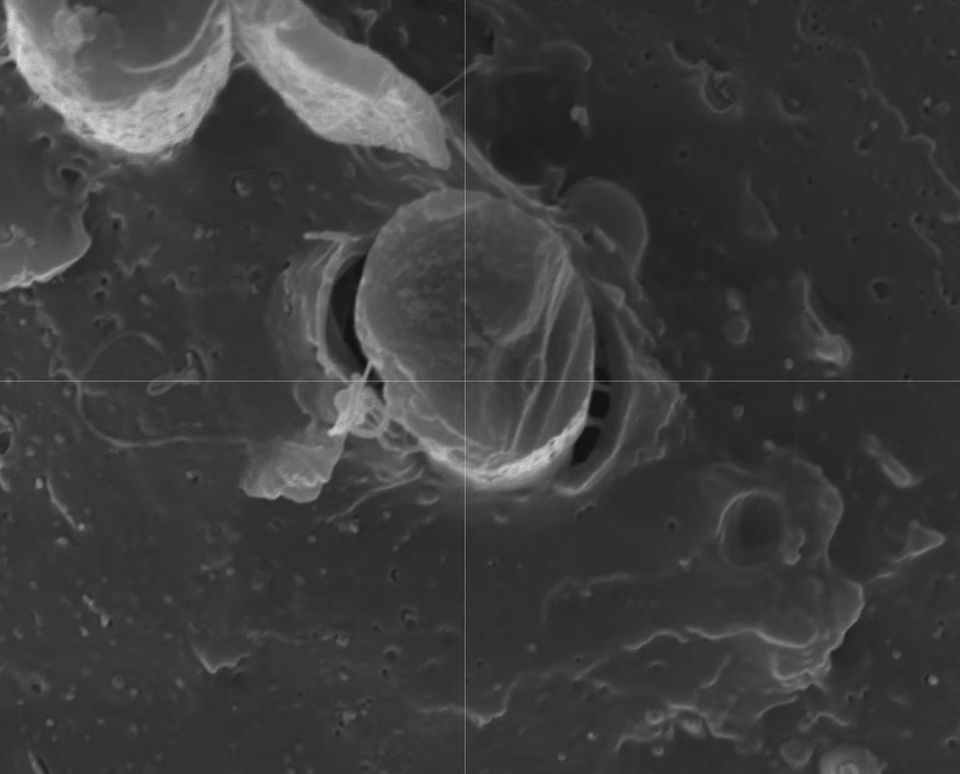
Compared to the finer chopped CF PLA-CF, what is notable here is that CF is not present between the layers, which is a good thing as this degrades layer adhesion significantly. Less good is that the same lack of polymer matrix integration is visible here, with the PLA clearly detaching from the CF and leaving behind voids.
This shows that BIQU’s PLA-CF filament fails to address the fundamental problem with PLA-CF of extremely poor matrix integration. To verify this, an undisturbed sample was put into the Micro CT scanner.
Fascinating about the Micro CT findings was that there is carbon black in the filament, which is ironically highly abrasive.
Also in the images were again what looked like air bubbles, much like in the previous video’s results. These bubbles turned out to be always linked to a CF strand, which could be due to how the PLA-CF mixture cools with the mismatch between the solid CF inside the still liquid PLA.
After a series of mechanical tests on the printed samples, the conclusion is that the part is stiffer by about 15% and due to the CF contaminant not intruding between layers it’s also better than typical PLA-CF. Of course, regular PLA outperforms both types of PLA-CF in most tests by a considerable margin, so most people are probably still better off with regular PLA.












Are ther eother fialments besides PLA, attaching better to CF ?
Many years ago when I was on my industrial placement I worked on Carbon Fibre reinforced thermoplastics. One of the key things to consider is that when carbon fibre tows are manufactured they are coated in a size to facilitate handling, so the reality is that to get a good bond between the fibre and the matrix you either need to have a size and polymer that are compatible or you need to introduce another component that can facilitate the bond.
The difference in properties, particularly impact strength could be pretty dramatic. It looks to me like that hasn’t been taken account of here.
I spent some time talking to one of the designers of the National Aerospace Plane years ago, and he talked extensively about how difficult it was to make the metal composites they were using for the aircraft: titanium with silicon carbide strands, because the two would delaminate. They had to do exactly what you’re suggesting: coat the ceramic strands with an interface that would stick, on a molecular level, to both the ceramic and the metal matrix material. That requires both chemical compatibility and material that has enough flexibility to tolerate thermal expansion mismatch, and is a huge challenge with any composite. Without that, putting fancy stuff like chopped carbon fiber in is just filler material.
I take issue with the liquid nitrogen aspect of this experiment. The CTE of carbon fiber is nearly zero with plastics being wildly higher. By freezing the samples, this nearly guarantees fiber to matrix de-lamination.
Great point.
I know that carbon fibre tow intended for use in CF+Resin composites is generally coated with a thin layer of some “sizing” (presumably by analogy to the way paper is coated) to ensure better adhesion and compatability with the specific resin it’s intended to be used with.
Somehow I have my doubts that there’s any existing thin film sizing that would act as a bonding aid between carbon fibre and PLA. If it weren’t necessary to put the PLA under heat and pressure to make it into filament in the first place I could almost see something exotic like microspheres of epoxy resin and hardner along the CF core such that they’d burst, mix, and bond the PLA to CF coated with the right sizing for that epoxy, but I don’t know…
He’s still using a 0.2 mm nozzle to deliberately get bad results!
Didn’t learn a thing from being called on it last time.
Not that he’s looking at this lame site.
Left the 100um scale right on the images cited.
While never mentioning using the small nozzle.
That is never recommended for fiber reinforced filament.
Clickbait.