
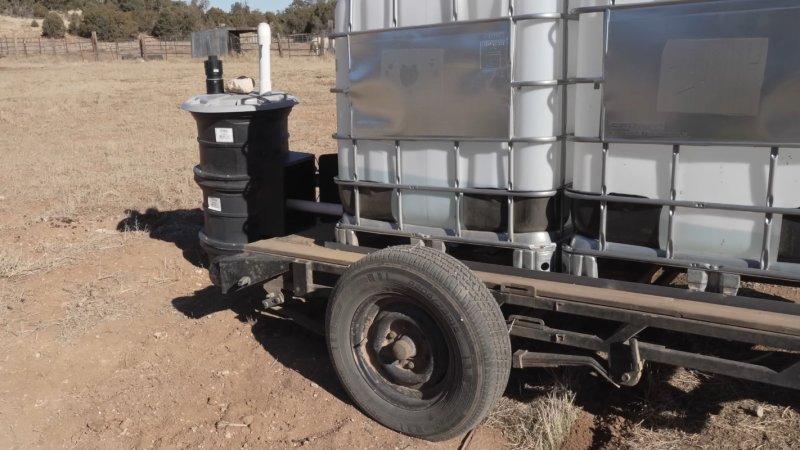
Living without standard utility hookups like electricity, Internet, water, and sewer comes with a whole host of challenges, all of which are most commonly solved by spending lots of money. For electricity, a solar array or a generator is fairly common. The Internet can similarly be accessed via a satellite link if wires aren’t available. For water, most people will drill a well, but that gets similarly expensive. [Cranktown City] recently bought an off-grid home and needed a way to get water to it on a budget, so he built this water trailer instead.
The trailer started off as a standard single-axle utility trailer. The weight rating was probably around 3,500 pounds or 1588 kg. A few support structures were welded in. The supports serve double duty as a frame for two IBC totes, which can hold about 550 gallons or 2082 liters of water. The trailer also got upgraded wiring, including some extra wires to support a backup camera. The two totes were then plumbed together with a ball valve for an outlet. That valve was mated to a motor that can be remotely activated from within a truck to dump the water out into a cistern.
On the cistern side, [Cranktown City] welded up a door with a linear actuator and a remote control. When he’s ready to dump the water into the cistern, he can easily back up the trailer using the backup camera, open the door to the cistern remotely, and then activate the ball valve on the trailer to start filling the reservoir. It’s a clever solution to bringing water to his off-grid property at a fraction of the cost of a drilled well. We’ve seen some other unique ways to live off-grid as well, like this hydroelectric generator, which might offset the cost of an expensive solar array.












I love how conversions are done here. “Two IBC’s providing about 550gallon or 2082L”. A standard IBC is 1040 l (by definition, 1000 L capacity plus expansion room) so you added 1 l by converting to imperial and back.
Likewise for the trailer rating you added precision that wasn’t there.
Not meant as blunt criticism, but be aware of such conversion errors.
I suspect the author was not investigating the standard capacities (plus headroom) on containers. He was likely just going by the video where the maker states “the capacity is about 550 gallons”. When one does the conversion on 550 gallons, the answer is (a tad under) 2,082L. For this author, there was no “back and forth” conversions – just one conversion based on what the maker said.
Also, as an aside, I would guess that any thousand liter container that is built to hold 1,040 liters might really be able to handle 1,041 liters. That’d be my bet. :-) YMMV.
Well now you have opened Pandora’s Box.
If you want to go by engineering standards, a quoted volume of 550 gallons is only two digits, implying an error of +/- 10 gallons or about 2%. Which means yeah, a 1040 L capacity (actually 3 digits, erroneously implying an error of 10L, or magically 1%) would mean +/- 10L.
Anyway your 1040 might hold 1050L, or even as little as 1030L as written.
2082 is just, like 0.1% tolerance which is clearly wrong. 2080L would be better.
Allllll that said, I know this is an Arby’s
Honestly, if we are going by the high level engineering view here. 2082 liters of water weighs 2082kg, and that trailer (when new and not rusty) has a stated weight capacity of 1500kg. Which is a safety factor of 0.72. Godspeed dear maker…
I guess the age of the useful standard ten-pound gallon is long gone. The only one left in common use is the funny stunted american one, just 3.8 litres, 8.3 pounds.
A gallon is a volume, a pound is a weight, and the two have no fixed ratio (unless you’re strictly talking one specific fluid/material and even then not with thermal density differences).
And while there is a fluid ounce, I’m not aware of a fluid pound!
its water. A pints a pound the whole world round. 1 gallon = 8 pounds.
Its a commonly used generalization, though with the range of density across waters fluidic state and the quantity of water given, the actual weight can vary as much as 168.3# (76.3kg). While significant mathmatically, relatively insignificant to the practical application involved.
“One US liquid pint of water weighs 1.0431756 pounds (16.6908 oz), which gives rise to a popular saying: “A pint’s a pound the world around”.[15]
However, the statement does not hold around the world, because the British imperial pint, which was also the standard measure in Britain’s former colonies – such as Ireland, Canada, Australia, India, Malaysia, New Zealand and South Africa – weighs 1.2528 pounds (20.0448 oz). “
What’s going on here? Isn’t a US liquid pint exactly 16 fl oz? Isn’t 16 fl oz = 16 oz = 1lb at standard temp pressure? Where is the 0.0431756 error factor coming from?
An Indian pint is very different to a British pint, as I found out with much disappointment when ordering a pint of beer
Sure thing, but it was still a ten pound gallon, and that was very useful.
If you’re being picky, recall that a gallon is defined to be 3.785.. litres, and a litre is defined to be the volume occupied by 1 kg of water (well, was defined that way until the bright SI folks broke it by redefining the metre a smidge a few years ago). So by that definition, a US gallon (of water, at 4 C and 760 mm Hg) is 3.785… kg. And since the pound (mass) is legally defined as 0.453… kg, a US gallon is 8.3 pounds.
And usually a pound is a unit of mass. Unless, of course, it’s a unit of force.
God bless traditional unit systems. They are so useful for generating discussion.
BTW a fluid ounce is 1/16 of a fluid pound. A fluid ounce is defined as 1 cup of water at room temperature 20°C to 25°C (68°F to 77°F) at which waters density is 0.9982g/mL to 0.9970g/mL so 236.1621416g to 235.878236g a potential inaccuracy of 0.2839056g or ±1/3ml if you use a scale instead of a line on a cup.
A fluid ounce is defined as 1 cup of water
That’s a pretty small cup.
In my corner of the universe, a cup contains 8 fluid ounces.
Not to be confused with ounce (weight) or ounce (force) or ounce (troy).
yeah I thought I copy pasted a ⅛ but I didnt notice that the copy didnt catch it. My bad for not realizing before hitting reply
Since we dont know the true rating for the trailer I’m unsure but if it carries 550 gallon that’s over 4500 lbs then the trailer seems to be way over its weight rating. The ratings for the axle should be on a specs tag. I just hope this isnt on public roads that far overweight especially given waters propensity to move around. This could be very dangerous. That’s my two cents. I’m just an RV tech. What do i know.
Areas in northern Arizona depend on water hauling for off-grid living. There are vending dispensers connected to wells. Since the water table is over 3,000 feet deep, having your own well is usually not in the budget. Nice write-up.
A family member was looking at land in arizona a few years back and ran into this issue.
For self-hauling potable water in Flagstaff, AZ, expect to pay roughly
$0.01 to $0.07 per gallon X 1100 gallons = $11-77. From a quick google stalk the creator lives with at bare minimum his girlfriend but could potentially have 3 others living with him. So lets go with a conservative figure of 3 people in the household. Flagstaff residents often use less than the state average of 146 gallons/person/day, potentially landing around 4,000-7,000 gallons for indoor-only use.
So reasonably he is hitting the water depot weekly. $572-4004/yr
In Louisiana well depths vary from 30-500 feet and its easy drilling. If you can hit GOOD water between 100-200ft. 1-3 years at that higher water price would pay for it.
BUT This guy is in flagstaff. Well depths in flagstaff are 1200-1500 feet unless you are lucky and are south of the city where you can hit shallow perched aquifers between 600 and 800 feet. Even with that luck Youre looking at a cost of roughly $20,000 to $45,000 which could be as low as 5 years or as high as 78 years of water hauling (fuel expense not included). And if he isnt lucky, the deeper wells run $37,500 to $120,000+.
146 gallons/person/day?? Assuming i’m understanding my utility bill correctly, my family in Indiana (no attempt at conservation) uses about 1000 gal/person/month, or 33 gal/person/day. With even a token nod towards conservation I think we could halve that value. Like, showering for 15 minutes is a great treat but i happen to know i can clean my body in 2 minutes or less of the water being on.
Not saying you’re wrong it just sounds like that 146 figure must include agricultural, industrial, landscaping, or something?? Or i’m confused somehow. I know this is totally beside your main point :)
146 gallons/person/day is the average per person water consumption in Arizpna. I would assume that people in a hot dry state have a higher consumption rate than other more temperate states. Flagstaff is said to use significantly less than the state average. I found a reference that states Flagstaff’s indoor use (bathing, cooking, cleaning) is likely around 30-40 gallons per person indoors. So yeah, I guess my initial figures are pretty far off, but that really just boosts the point I was trying to get across. Where they are, haulings a hassle but drillings an unreasonable expense that only pays off across generations.
I expect that figure includes a lot of other usage that’s been factored down to a per-person average, including decorative plant irrigation, evaporative cooling (I’m looking at you “AI”), and “transmission losses”. IMO all reasons why building massive-scale settlements in desert environments is just dumb, and why the Colorado river almost never reaches the ocean…
Interesting. 146 gallons per person per day?!? What the heck are people doing with their water there?
We are not frugal in water use in our house — We draw water from the Great Lakes and frankly make no effort at all in conservation, and use 35 gallons per person per day — a quarter of Arizona average. We have an ancient top-load washer and original 80-year-old big-tank toilets, and water our lawn and trees and keep an outdoor fish pond full. I can’t imagine how we could use more water.
What are they doing in Arizona? Running swamp coolers all the time?
I snagged the wrong figure, included outdoor use per person. Indoor use was only 30-40 gallons per person.
Pissing in a sink you can reduce your water usage by 70%. Even more if you remove bacteria on your hands with IPA spray bottle instead of soap and water.
I worked in an environmental LEED Gold-rated building that had zero-water urinals like that. The whole building stank of them. Stupid idea.
Water is cheap and it’s 100% recycled.
I was installing some manufacturing equipment in a warehouse in tucson a couple of years ago. The equipment needed to tie in to their waterlines, so I tagged along with the facilities manager and the plumber. While the plumber installed the lines I needed, the facilities manager showed me a system they had for recycling water within the facility. They used it for both their urinals and their machines process water. It used plates of aluminum and iron charged by solar panels on the roof. Its called electrocoagulation. It turns all the impurities in the water into a floaty frothy foam that skims off the top. They reused the water in their machines and the urinals only but he said that the water was clean enough to drink. I found a few videos of electrocoagulation where the guy giving the demo drank the water coming out of their systems. I think Id still want to run it through some UV exposure, prefiltration, and reverse osmosis before I drank recycled sewage but its still pretty cool that such a simple device was so effective.
It’s true that water is cheap but sewage pumping is very expensive and you’re forced to keep invoices. If you use water but don’t have invoices from pumping company confirming you paid for sewage disposal, you’re commiting a crime.
Since that looks like a 5-bolt pattern, I would say 1588 kg of Gross Vehicle Weight Rating is a good guess.
But when you subtract tare, the total weight of all the equipment (even the axle itself) estimating 400 kilos for the trailer, maybe 50 each for the totes, and let’s go 150 for all the plumbing, support structure, and pump and you are left with a net of 938 kg. That doesn’t even fill one tote.
And this is assuming legal GVWR for his jurisdiction is actually 1588, and it’s not just the factory rating for the axle.
My tank truck axles (tri-drive and fat steers) can haul around 84500 kg, but the law in Alberta only allows me to haul 31300. And that’s before I subtract the 15600 tare.
And moderator dude? I was looking for a way to upvoter or like InvisibleMan’s post. Don’t take that “report post” seriously please.