
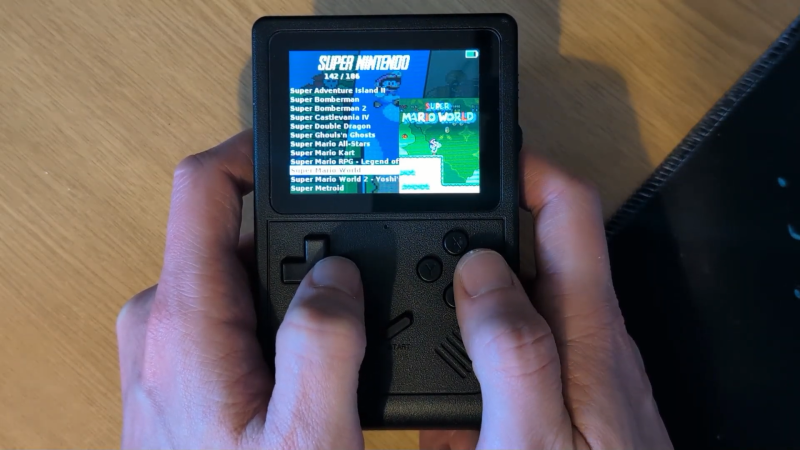
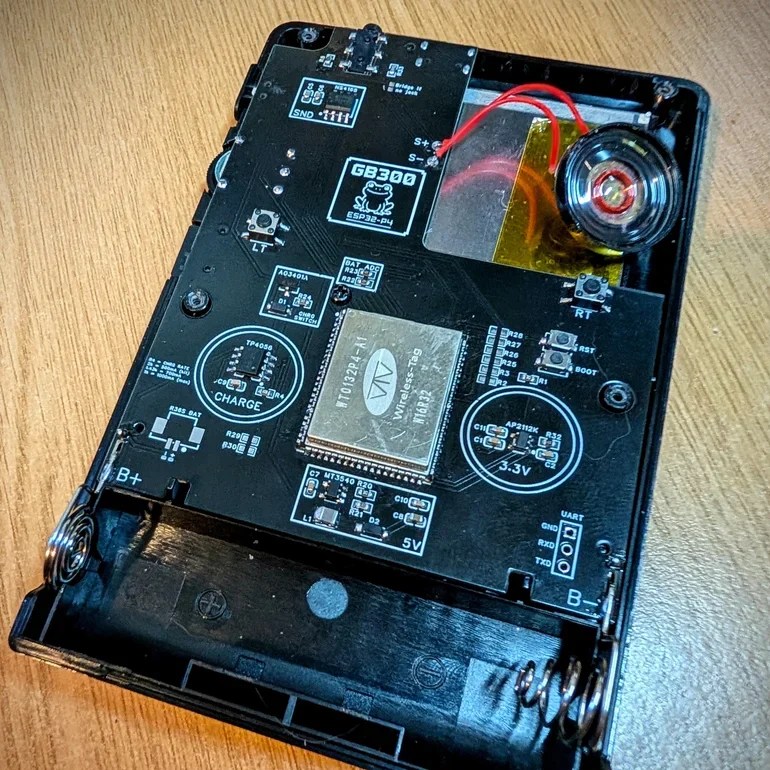
The ESP32-P4 is the new hotness on the microcontroller market. With RISC-V architecture and two cores running 400 MHz, to ears of a certain vintage it sounds more like the heart of a Unix workstation than a traditional MCU. Time’s a funny thing like that. [DynaMight] was looking for an excuse to play with this powerful new system on a chip, so put together what he calls the GB300-P4: a commercial handheld game console with an Expressif brain transplant.
 Older ESP32 chips weren’t quite up to 16-bit emulation, but that hadn’t stopped people trying; the RetroGo project by [ducalex] already has an SNES and Genesis/Mega Drive emulation mode, along with all the 8-bit you could ask for. But the higher-tech consoles can run a bit slow in emulation on other ESP32 chips. [DynaMight] wanted to see if the P4 performed better, and to no ones surprise, it did.
If the build quality on this handheld looks suspiciously professional, that’s because it is: [DynaMight] started with a GB300, a commercial emulator platform. Since the ESP32-P4 is replacing a MIPS chip clocked at 914 MHz in the original — which sounds even more like the heart of a Unix workstation, come to think of it — the machine probably doesn’t have better performance than it did from factory unless its code was terribly un-optimized. In this case, performance was not the point. The point was to have a handheld running RetroGo on this specific chip, which the project has evidently accomplished with flying colours. If you’ve got a GB300 you’d rather put an “Expressif Inside” sticker on, the project is on github. Otherwise you can check out the demo video below. (DOOM starts at 1:29, because of course it runs DOOM.)
The last P4 project we featured was a Quadra emulator; we expect to see a lot of projects with this chip in the new year, and they’re not all going to be retrocomputer-related, we’re sure. If you’re cooking up something using the new ESP32, or know someone who is, you know what to do.











Since the ESP32-P4 came out, I’ve been wondering how its two RISC-V cores compare (in broad, general real-world performance) to the similar ESP32s with two Xtensa cores… and it’s been remarkably hard for me to find useful data or examples. So even though this doesn’t address that in detail, it’s still good to see.
I mean, according to the datasheets from espressif, the P4 is both much faster and more performant per Mhz in CoreMark, which makes it clear how quickly RISC-5 designs are improving:
2489.62 CoreMark; 6.92 CoreMark/MHz for the ESP32-P4 (both cores, 360mhz version, not the 400)
1181.60 CoreMark; 4.92 CoreMark/MHz for the ESP32-S3 (both cores, 240mhz)
but although that’s very helpful, it’s still a synthetic benchmark and we’re taking their word for it.
RISC was meant to be the revolution that will rid the market of all the PICs, AVR, STM32s and others; yet I can buy a 400 MHz STM32H7 from TME for a price of a pizza and have it delivered next day while RISC-V are hit and miss.
And don’t get started on the price of J-Link when I can buy ST-LINK clone cheaper than one night in a Peter Puffer’s Inn.
Nobody realistically expected ARM to disappear overnight. Parts like ch32v003 and ch32v006 already make new designs with PIC and AVR hard to justify starting. Normal 32-bit C and C++ are just way easier to program and the parts are about a dime in hobbyist quantities. Importantly, the tools are the same GNU and LLM that’s used (and funded by) the big guys, so it’s always up to date.
On up the scale, all members of the ESP32 family launched since 2020 or so (after s3) are RISC-V. MILK-V, JH-7110, and the ocean of C906 and C910 parts have made a big dent in the space between microcontrollers and Pi-class boards. There isn’t really a competitive that’s at a price/performance point of Pi4 or 5 yet,. But jumping above that, there are 128 k parts and boards with good price performance *per watt”. So if you’re driving 10,000 in a data center, there are RISC-V parts with performance that’s OK (not threadripper) but that can save on cooling.
On the RISC-V parts with USB from Espressif, you don’t need ST-LINK or external JTAG dongles as at all; they provide JTAG and a serial port-style connection to the chip on board. No more pads for JTAG, no more external ch340s. Different vendors can make different choices.
Microcontrollers are easier to make inroads into. Big chips take time. The specs to make server-class parts with virtualization and such really only became available rather recently. They also take money.
There are scores to hundreds of RISC-V boards you can get delivered for the price of a decent pizza.
Impostor, I see : – ] Could have went with “Sammie STM32”, Gee.
The P4 is a beast. But it ain´t cheap.
If $5.00 for single piece isn’t cheap, you need a better paying job ;-)
I think $5.00 is cheap.
You can also just buy a gameboy shell from Aliexpress – search for “gameboy shell” or “game console housing”.
I’m kind of surprised they wrote Expressif given how popular all of their microcontrollers are in this circle