

Getting a significant energy return from tokamak-based nuclear fusion reactors depends for a large part on plasma density, but increasing said density is tricky, as beyond a certain point the plasma transitions back from the much more stable high-confinement mode (H-mode) into L-mode. Recently Chinese researchers have reported that they managed to increase the plasma density in the EAST tokamak beyond the previously known upper Greenwald Density Limit (GDL), as this phenomenon is known.
We covered these details with nuclear fusion reactors in great detail last year, noting the importance of plasma edge stability, as this causes tokamak wall erosion as well as loss of energy. The EAST tokamak (HT-7U) is a superconducting tokamak that was upgraded and resumed operations in 2014, featuring a 1.85 meter major radius and 7.5 MW heating power. As a tokamak the issue of plasma and edge stability are major concerns, even in H-mode, requiring constant intervention.
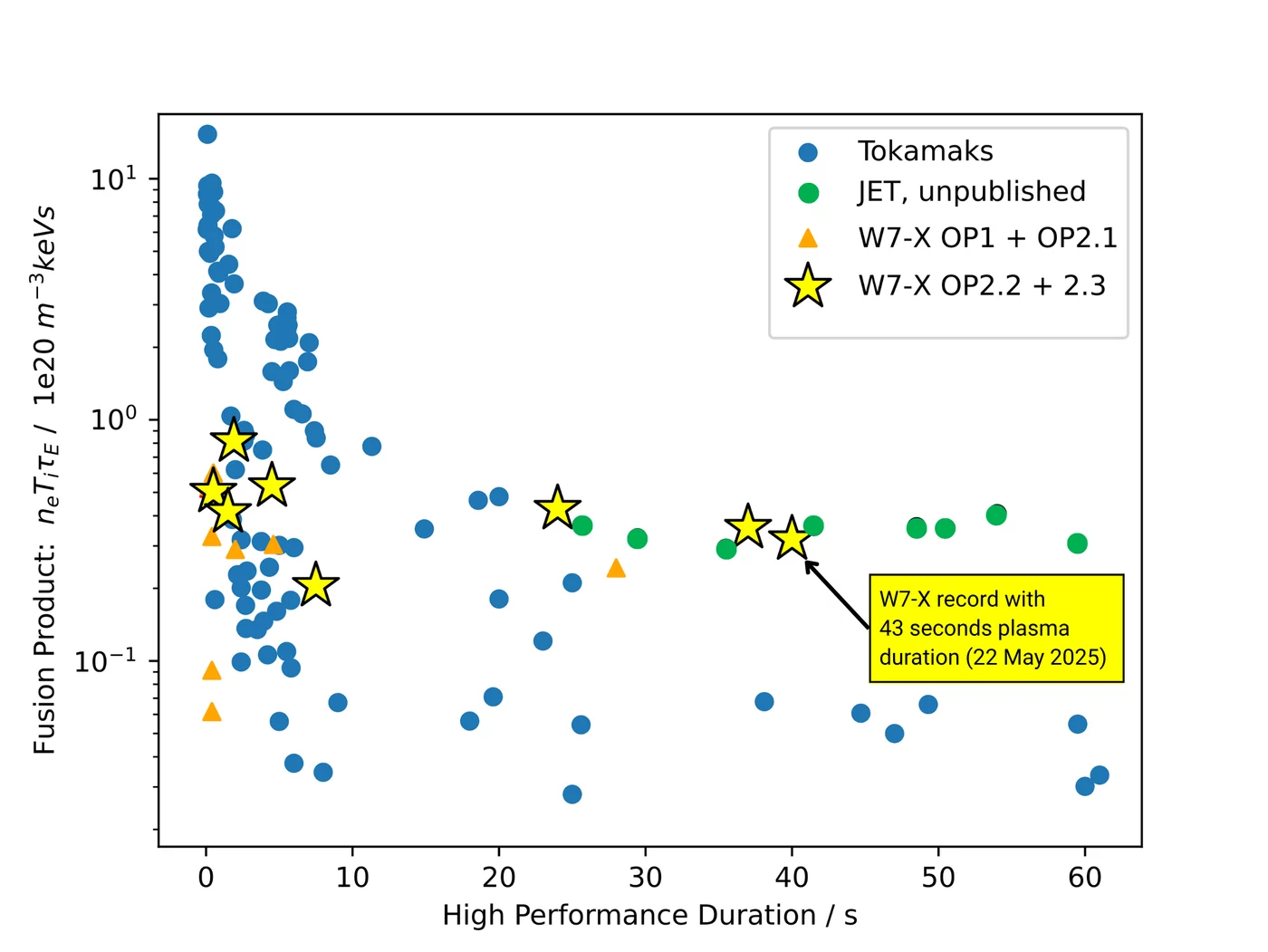
In the recent EAST findings, the real news appears to be more confirmation of the plasma-wall self-organization (PWSO) theory that postulates that one of the causes behind plasma wall (edge) instability is due to the interaction between plasma dynamics and wall conditions through impurity radiation. By using electron cyclotron resonance heating (ECRH) and/or pre-filled gas pressure this impurity level might be reduced, enabling higher densities and thus exceeding the empirical GDL.
What’s interesting is that the paper also compares EAST and the Wendelstein 7-X (W7-X) stellarator, making the argument that tokamaks can operate in a way that’s more similar to stellarators, though W7-X is of course gifted with the same advantages as every current stellarator, such as no real GDL or the necessity of dealing with H- or L-mode. It’s therefore not surprising that W7-X is so far the most efficient fusion reactor to achieve the highest triple product.











Thanks ChatGPT, still I don’t have a clue what are H-mode and L-modes though.
Anyway, I’m sure that in 10 to 30 years from now we’ll have cheap fusion energry, as promised in early 1990s pop sci articles.
always ten years away…
Looking at the rate at which news of new achievements comes out these days, it does look like it 10 years is a reasonable time scale for the technology to be viable.
You forgot /s bro
(;
Wait for replication…
The number of examples of “Wait for replication” are enourmous.
Its always exciting to read about any pushing past any limit. Its usually an error, its sometimes dishonesty, its sometimes a dishonestly hiding behind an “error”, then there are the few cases (the few part is what makes us cynical) where replication is easy, and it becomes part of the body of knowledge of science.
So in short, wait for replication.
At global scale, hardly any resources do or have ever been poured into this, yet it’s still progressing. A lot of folks are cynical, but this has always been one of those technologies where it’s gonna be a pipe dream until suddenly it isn’t. Tech has already passed thresholds the cynics of my youth scoffed at the prospect of surpassing. I’m not gonna bet the farm on a near-term timeline, but I remain hopeful, and it’s certainly worth nation state level investment.
The second link in this article, the one that says “we covered these details”, covers those details.
Yep, cheap as RAM.
I do love me some Free Energy.
Fission was supposed to be free. See how that worked out.
Who promised you it would be free? Pretty silly to expect that to be true.
It was expected to be “too cheap to meter”, but we never deployed enough reactors for that. That doesn’t cover infra and delivery costs of course.
Anti-nuclear activists who take the words of a single guy, who once said it could be “too cheap to meter”, and use that to argue that the entire industry is lying.
But that’s not even saying it would be free – just cheap enough that you don’t have to bother metering it. That is actually true. I’ve lived in apartments where the electricity was not metered and you just paid a flat fee, and it just so happened to come from a nuclear power plant – so it is true that fission power can be too cheap to meter.
The landlord paid the metered bill.
Divided the bill by half the number of apartments and wrapped that in the rent.
Meters cost money and don’t make a ROI for landlords, especially compared to just charging everybody double the average cost.
To be fair, that ‘single guy’ was an industry spokesman and advocate.
It’s not like using the words of some rando hippie to impeach climate alarmism.
It’s like using the words of Al Gore.
True, and irrelevant to the point.
That is the point. If they had put a meter on every apartment, they couldn’t have justified charging as much because people would know how much they’re actually using and paying. The electricity was too cheap to meter.
And it was cheap. Roughly half of what I’m paying now that my contract says solar and wind power. They’re not offering the nuclear option anymore.
Also true, but the actual words were “It is not too much to expect that our children will enjoy in their homes electrical energy too cheap to meter”, and then the NYT switched it into “It will be too cheap for our children to meter”.
Expectation is hope, not certainty. Dropping that one word distorted the statement into a promise.
Yeah, the idea was that once we stop burning enormous volumes of fuel, the marginal cost of energy will be so low that it’s pointless to meter it – you would presumably just pay a flat fee for the “size” of your electrical supply.
It was, and is, 100% true that the cost of running power infrastructure other than fossil fuel plants does not depend on how much power is used. It should be billed like broadband, instead of like old-timey phone service. It’s not nuclear that has failed on this point (or hydro or solar or wind) – the failure is that we still have a crappy system built for coal and gas generators’ business model.
Dude, interesting clarification, especially the distinction between “too cheap to meter” and “free,” which often seems to get lost in the debate. How do you think that phrase could be better contextualized today so it’s understood as a comment on system design and economics, rather than taken as a literal promise about cost?
The difference is that with broadband the infrastructure is always on whether you use it or not. With power generation, the supply has to match demand, so variations in both supply and demand cause difficulties and increasing costs.
It doesn’t matter. It will be taken out of context and distorted anyhow. People with an agenda will hear what they want to hear.
I still see little explanation of where all the tritium needed to fuel these things is supposed to come from.
The Tri Alpha Energy fusion reactor approach is more interesting for actual energy generation as it isn’t a tokomak, uses Boron and hydrogen as fuel, and doesn’t produce any nuclear waste.
I’d love to see an article on that machine in hackaday.
I’ve heard about TAE’s too, but this tidbit about describes what probably happens next: “…TAE Technologies, a private company, has received significant funding and is merging with Trump Media…”. I am afraid it still will be 25+ years away for the average Sam :[
Except that to reach any useful efficiency, the plasma needs to get 2x hotter than for Tritium/Hydrogen based fusion reactor, which is already a challenge for hydrogen reactor and an currently inaccessible technical step for boron.
All reactors produce nuclear waste. Who claims otherwise, lies.
Short lived low level nuclear waste is literally orders of magnitude better though. The primary nuclear waste material is solids that essentially amount to keep contained and leave it alone for a few decades. Effectively the nuclear waste decays within a human lifespan after which it’s not nuclear waste.
The general idea with these is that that your reactor that consumes tritium and deuterium can bombard lithium with neutrons to generate more tritium, waste helium and useful heat.
If you haven’t got any tritium to start with you can generate it from fusing deuterium with itself, but your reactor will consume energy in the process.
GREAT question, so I asked:
The primary production today comes from nuclear fission reactors, particularly heavy-water reactors (HWRs), where tritium is generated as a byproduct when neutrons interact with deuterium in the moderator or coolant.
These fission-based sources are sufficient for current research and initial fusion experiments (e.g., ITER’s needs), but they cannot scale to support a global fleet of commercial fusion reactors without significant expansion of HWR infrastructure, which is unlikely given the aging of many reactors built in the 1970s.
To achieve long-term sustainability, fusion reactors are designed to produce (or “breed”) their own tritium through a process integrated into the reactor itself. This is essential because external supplies alone cannot meet the demands of widespread fusion power—estimates suggest that powering the global electricity grid with D-T fusion would require hundreds of tonnes of tritium annually. Breeding leverages the fusion reaction’s output to generate more fuel, creating a near-closed-loop cycle.
ITER’s Test Blanket Module (TBM) Program — ITER will be the first fusion device to test tritium self-sustainment concepts in a real fusion environment.
ITER cost:
The U.S. Department of Energy (DOE) has estimated total construction costs (including all in-kind contributions valued consistently) at up to $65 billion as of recent assessments (e.g., referenced in 2025 contexts for costs through ~2025 milestones), though ITER disputes this as an overvaluation of in-kind items.
Other sources, including congressional reports and analyses, place the total (construction + operations to completion) between $45-65 billion, reflecting delays pushing full deuterium-tritium operations to 2039.
So, besides the energy balance issue, we haven’t even begun large scale experiments on tritium production.
This, please:
Several Generation IV (Gen IV) fission reactor designs incorporate walkaway-safe features—meaning they can passively shut down and cool themselves without human intervention, active systems, or external power in the event of an accident—while also being capable of utilizing transuranic (TRU) waste (elements like plutonium, americium, and curium – reactor waste) as fuel.
How long could the world run using 4th generation reactors burning previously created reactor waste?
Fully utilizing existing spent fuel in Gen IV closed-cycle systems could power the world (electricity-only) for 1–2 centuries at current demand, making it a substantial bridge resource while reducing long-lived waste radiotoxicity by orders of magnitude. It is not infinite like breeder reactors with fresh uranium or thorium, but it is far more than enough to eliminate any near-term fuel availability concerns and “eat” the legacy waste stockpile.
We’re sitting on top of a giant fission reactor and there’s a giant fusion reactor in the sky and both will last longer than we will.
Actually, there isn’t a giant fusion reactor in the sky, it’s much farther away :)
You know, the sky is as far as you can see right?