
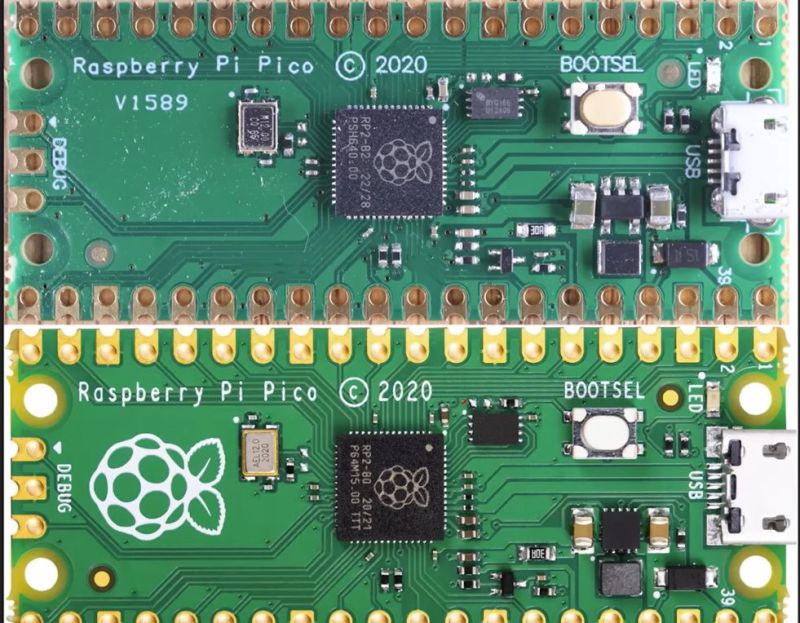
Since the RP2040 microcontroller is available as a stand-alone component, it’s easy enough for third parties to churn out their own variations — or outright clones of — the Raspberry Pi Pico. Thus we end up with for example AliExpress sellers offering their own versions that can be significantly cheaper than the genuine article. The ones that [electronupdate] obtained for a test and decapping session cost just $2.25 a pop.
As can be seen in the top image, the board from AliExpress misses the Raspberry Pi logo on the silkscreen for obvious reasons, but otherwise appears to feature an identical component layout. The QSPI Flash IC is marked on the die as BY250156FS, identifying it as a Boya part.
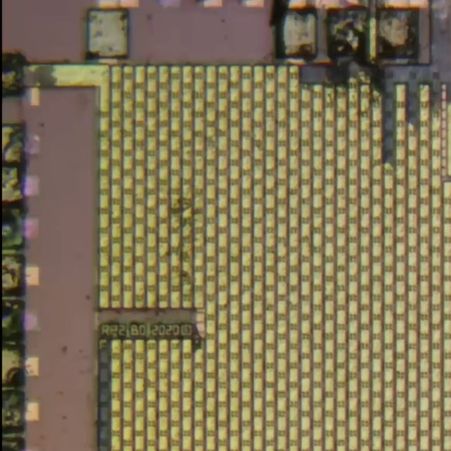
Niggles about flash ROM quality aside, what’s perhaps most interesting about this teardown is what eagle-eyed commentators spotted on the die shot of the RP2040. Although on the MCU the laser markings identify the RP2040 as a B2 stepping, the die clearly identifies it as an ‘RP2 B0’ part, meaning B0 stepping. This can be problematic when you try to use the USB functionality due to hardware USB bugs in the B0 and B1 steppings.
As they say, caveat emptor.









A question here what the B2 stepping actually looks like under the cap – I don’t know if the layer with “RP2 B0” on it needed to be changed between B0 and B2 – maybe it was a mask ROM only fix? Nobody’s yet published a decap of B2 that I’ve seen. (please prove me wrong in reply!)
Yep. B1 is just a mask ROM change. B2 is a mask ROM change plus a single metal ECO to a counter in the USB controller to make the fatal FSM state drop through following enumeration.
These are all in the lowest metal/via layers. The layers visible in the photograph (RDL/M7) were not changed so are still labelled B0, because they are the B0 masks.
Also, there are very few B0 devices out in the world. B0 is development silicon that lacks double float support in the ROM, and only around 100k were made (these were just the five “typical” engineering sample wafers). They all went on Picos and pre-launch partner boards. There is no way this is a B0 die.
You can always check the chip revision from software or the debugger by checking the CHIP_ID register in SYSINFO.
Seems like the clickbait factory bought enough equipment to play at decapping ICs and they were just looking for ICs to decap just like the guys with a hydraulic press are always looking for new things to destroy. Mis-identifying the stepping of the rp2040 is just a footnote to the fact that they didn’t actually intend to characterize the thing at all. If you wanted to know the stepping, or to know if it has a fatal USB flaw, usage would be far more revealing than decapping.
And the upshot is, raspberry’s intentional policy of releasing the chips cheaply enough that third parties would put them on their own cheap boards has paid off like it was meant to.
Yeah, I wonder why Hackaday is calling this board “fake” when it doesn’t even have the logo and is not trying to pass itself as the original official board.