
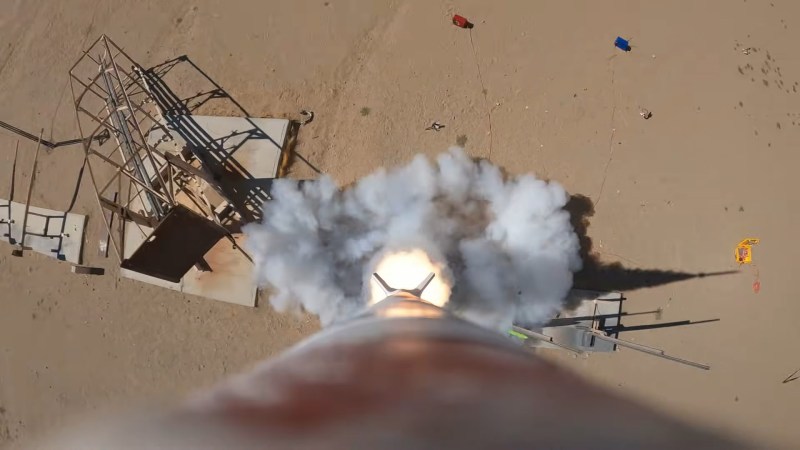
While some may see amateur rocketry as little more than attaching fins to a motor and letting it fly, it is, in fact, rocket science. This fact became very clear to [BPS.space] when a parachute deployed on a rocket traveling at approximately Mach 1.8.
The rocket design is rather simple — essentially just 3D printed fins glued onto a motor with a nose-cone for avionics. A single servo and trim tab provide a modicum of roll control, and a parachute is mounted in the nose along with a homing beacon for faster recovery. Seemingly, the only thing different about this flight is properly validated telemetry and GPS antennae.
After a final ground check of the telemetry and GPS signal quality, everything is ready for what seems like a routine launch. However, somewhere around Mach 1.8, the parachute prematurely deploys, ripping apart the Kevlar rope holding together the three rocket sections. Fortunately, the booster and avionics sections could be recovered from the desert.
But this begs the question, what could possibly have caused a parachute deployment at nearly twice the speed of sound?[BPS.space] had made a quick untested change to the flight control software, in an attempt to get more accurate speed data. By feeding into the flight controller barometric altitude changes during the decent stage, it should be able to more accurately estimate its position. However, direct static pressure readings at supersonic speeds are not an accurate way of measuring altitude. So, during the boost phase, the speed estimation function should only rely on accelerometer data.
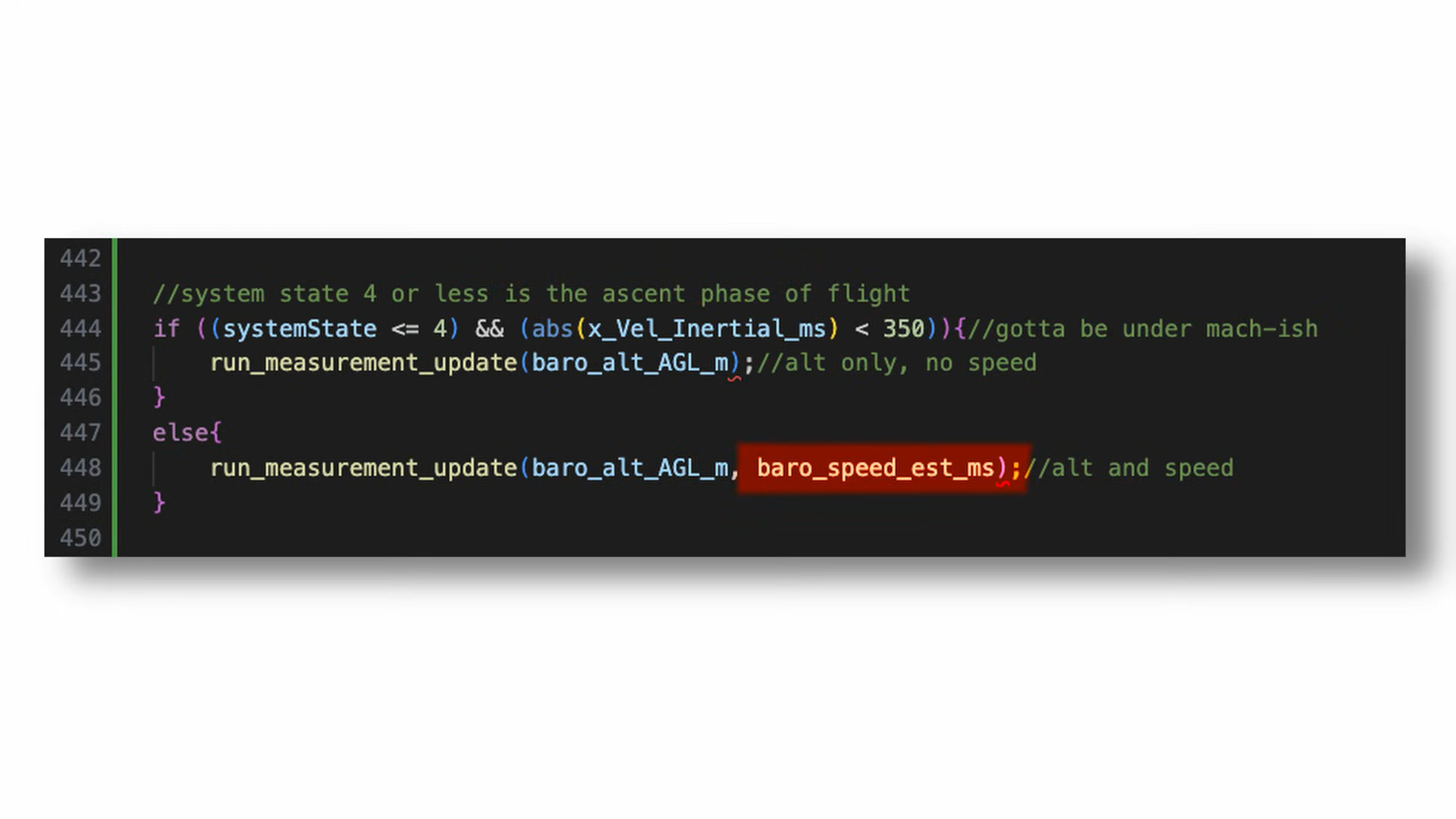
However, a simple mistake in boolean logic resulted in the accelerometer velocity being passed into the velocity estimate function during the boost phase. This gave an erroneous velocity value below zero triggering the parachute deployment. Nevertheless, the test was successful in proving antenna choice resulted in poor telemetry and GPS readings on earlier launches.
If you want to see a far more successful [BPS.space] rocket launch, make sure to check out this self landing rocket next!












“I don’t often test my code, but when I do I do it on production.”
Microsoft? Is that you?
Yea I see them in there…along with all their friends that they now own.
“Tesla” is spelled with a “T”, not an “M”.
@Vik Oliver
That name rings a bell from the past, was it reprap or some other place?
A bit off topic, but I’m trying to decide what little VNA to get. And of course, all but the original are bad, but which of the not original is the least bad? He’s using the “SeeSii” one, is that a fairly good bad one?
So disappointed, was hoping for camera view of literally an insect desperately trying to hold on as the rocket accelerated
sorry, wanted to like your comment out of agreement, but i hit the “report comment” button and don’t know how to undo it. i am idiot.
All good! It takes more than one mistake to push a comment back to the moderation queue.
Can we get a like/dislike thing for the comments? Maybe if one gets enough dislikes it’ll go to a hidden section we we can weed out the “others”.
“Can we please have a reddit groupthink circlejerk?”
Please no
Just for you
https://www.reddit.com/r/nasa/comments/10x7hxw/video_sls_knocks_out_a_bird_then_vaporizes_it/
https://www.reddit.com/r/WTF/comments/6l7tnk/bird_hits_space_shuttle/
Heh! I read that headline thinking I’d see high-speed photos of a cockroach clinging to the windshield of a land-speed vehicle. I suppose one man’s bug is another’s beetle.
Interesting. I immediately thought that issue was going to be the GPS max speed limit of 1200 mph.
ie. The rocket attained 1200 mph and the GPS stopped working, avionics assumed 0 mph and apogee was reached.
Software can fail in so many unexpected ways…
What’s that?
Integral of acceleration with respect to time, I presume.
Misread that at first, thought an insect had reared it’s head at Mach II.
“Splat!”
BPS.space is always rushed to finish up for a launch date. The shortcuts and assumptions and number of details virtually always lead to things going wrong. This seems to plague amateur rocketry in general. In the case of BPS.space it is frustrating to see good and interesting ideas fail in test for unrelated reasons. There is an element of Styropyro in the approach.
I have been watching rocketry stuff since grade school and I think they need a really bullet-proof completely reliable high bandwidth telemetry solution – and cheap. Also an ejection method that does not use black powder. These things do not seem that hard. But then this IS rocket surgery.
Used to be called ESTES or for big CENTURI in the midwest of USA
Rapid Unscheduled Disassembly.