Turning Energy Drinks Into Rocket Fuel

Sometimes claimed to give you wings, energy drinks can, at the very least, be used to make rockets fly. This is what [Nate Scovill] did in a recent video, where cans of the sugary stuff are processed to give a rocket its proverbial wings.

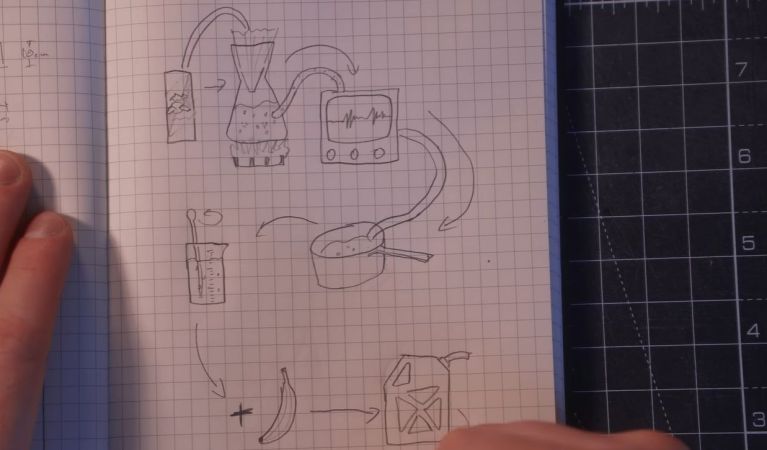
The basic concept is so-called rocket candy, which uses the fact that sugar is a pretty decent fuel type that — when combined with an oxidizer like potassium nitrate — can be turned into solid rocket fuel. Naturally it’d be easiest to start off with a pure source of sucrose or sorbitol for the sugar, but what if you only have access to cans of sugary soda?

Removing the moisture from the energy drink was the obvious first step, as water and rocket fuel aren’t a great mix. Adding and mixing potassium nitrate to the resulting thick syrup created the fuel-oxidizer mixture, also known as rocket fuel. This did take a detour involving removing the carbonation using a vacuum chamber, as CO2 and fire do not really like each other either.

We previously covered making your own rocket candy, though it’s far from the only rocket fuel that can be made at home using products bought at the local supermarket. Obviously, doing so comes with a whole heap of risks, not least of which is the notion that the difference between a rocket and a bomb is a pretty thin and fuzzy line that you do not want to accidentally cross.

Continue reading “Turning Energy Drinks Into Rocket Fuel”

Beer Keg Plumbing For A Liquid Rocket

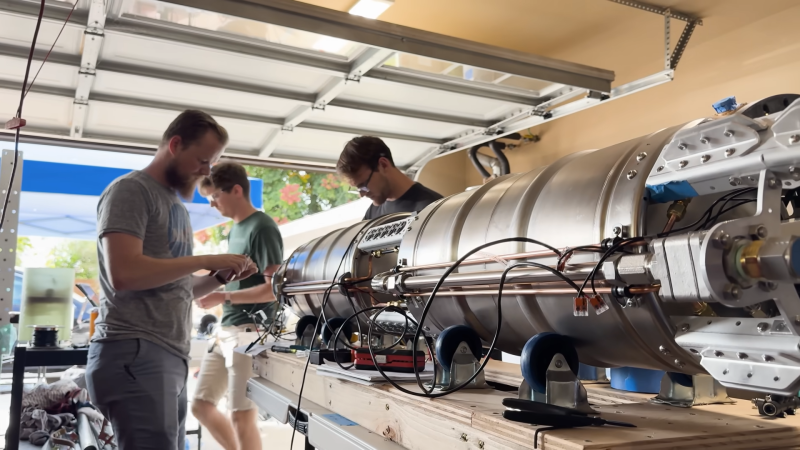
When you think of a high performance liquid rocket, what do you think of? Beer kegs? No? Well, when [Ryan] from the YouTube channel “Project KegRocket” saw a beer keg, the first thing he and his friends saw was a pressurized rocket body.

You wouldn’t be crazy if the first thing you thought of was something designed by a massive company or university. Liquid rockets are far from simple to develop, with Keg Rocket being no exception. Liquid oxygen and alcohol is the oxidizer/fuel mixture of choice. Liquid oxygen in particular is a problem with its cryogenic temperatures and tendency to do what rocket fuel does best, burn. This problem causes a large amount of work to simply connect the pipes. Traditional O-rings have no chance at surviving, along with most other non-metallic solutions.

Continue reading “Beer Keg Plumbing For A Liquid Rocket”

What Happens When A Bug Rears Its Head At Mach Two?

While some may see amateur rocketry as little more than attaching fins to a motor and letting it fly, it is, in fact, rocket science. This fact became very clear to [BPS.space] when a parachute deployed on a rocket traveling at approximately Mach 1.8. 

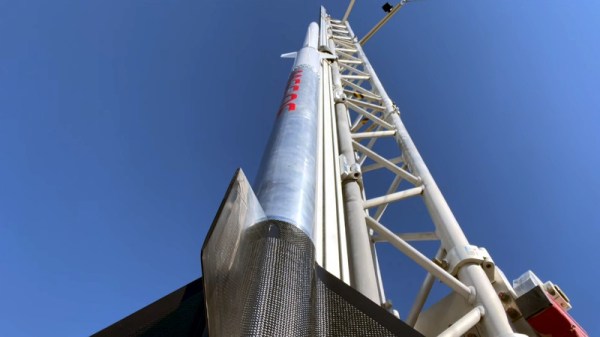
The rocket design is rather simple — essentially just 3D printed fins glued onto a motor with a nose-cone for avionics. A single servo and trim tab provide a modicum of roll control, and a parachute is mounted in the nose along with a homing beacon for faster recovery. Seemingly, the only thing different about this flight is properly validated telemetry and GPS antennae.

After a final ground check of the telemetry and GPS signal quality, everything is ready for what seems like a routine launch. However, somewhere around Mach 1.8, the parachute prematurely deploys, ripping apart the Kevlar rope holding together the three rocket sections. Fortunately, the booster and avionics sections could be recovered from the desert.

Continue reading “What Happens When A Bug Rears Its Head At Mach Two?”

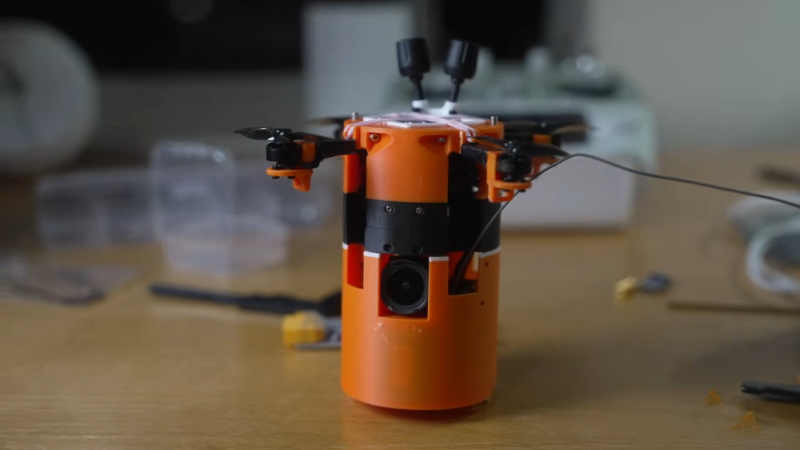
Picture of self landing drone satellite with orange and black body. Propellors are extended.

FPV Drone Takes Off From A Rocketing Start

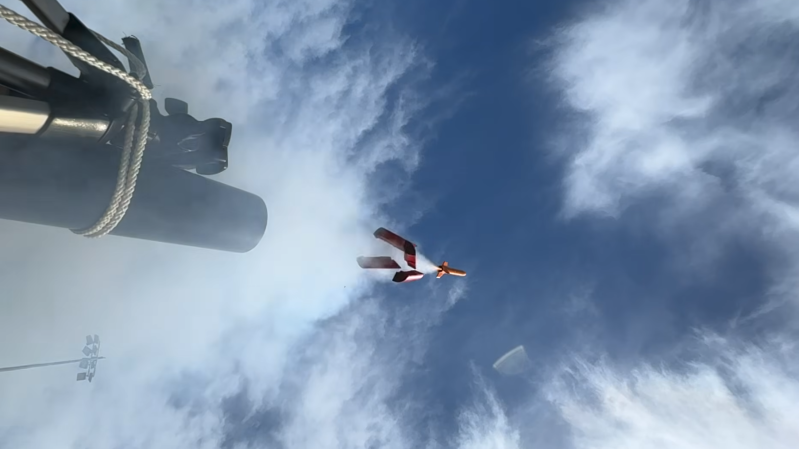
Launching rockets into the sky can be a thrill, but why not make the fall just as interesting? That is exactly what [I Build Stuff] thought when attempting to build a self-landing payload. The idea is to release a can sized “satellite” from a rocket at an altitude upwards of 1 km, which will then fly back down to the launch point.

The device itself is a first-person view (FPV) drone running the popular Betaflight firmware. With arms that swing out with some of the smallest brushless motors you’ve ever seen (albeit not the smallest motor), the satellite is surprisingly capable. Unfortunately due to concerns over the legality of an autonomous payload, the drone is human controlled on the descent.

Using collaborated efforts, a successful launch was flown with the satellite making it to the ground unharmed, at least for the most part. While the device did show capabilities of being able to fly back, human error led to a manual recovery. Of course, this is far from the only rocketry hack we have seen here at Hackaday. If you are more into making the flight itself interesting, here is a record breaking one from USC students.

Continue reading “FPV Drone Takes Off From A Rocketing Start”

Open Source Liquid Rocket Reaches For The Sky

Since the very beginning, solid-propellants have been the cornerstone of amateur rocketry. From the little Estes rocket picked up from the toy store, to vehicles like the University of Southern California’s Traveler IV that (probably) crossed the Kármán line in 2019, a rapidly burning chunk of solid propellant is responsible for pushing them skyward. That’s not to say that amateur rockets powered by liquid propellants are completely unheard of … it’s just that getting them right is so ridiculously difficult that comparatively few have been built.

But thanks to [Half Cat Rocketry], we may start to see more hobbyists and students taking on the challenge. Their Mojave Sphinx liquid-fueled rocket is not only designed to be as easy and cheap to build as possible, but it’s been released as open source so that others can replicate it. All of the 2D and 3D CAD files have been made available under the GPLv3 license, and if you’re in the mood for a little light reading, there’s a nearly 370 page guidebook you can download that covers building and launching the rocket.

Now of course we’re still talking about literal rocket science here, so while we don’t doubt a sufficiently motivated individual could put one of these together on their own, you’ll probably want to gather up a couple friends and have a well-stocked makerspace to operate out of. All told, [Half Cat] estimates you should be able to build a Mojave Sphinx for less than $2,000 USD, but that assumes everything is done in-house and you don’t contract out any of the machining.

Continue reading “Open Source Liquid Rocket Reaches For The Sky”

The Amateur Rocketry Hack Chat Reaches For The Stars

Hackaday has been around long enough to see incredible changes in what’s possible at the hobbyist level. The tools, techniques, and materials available today border on science-fiction compared to what the average individual had access to even just a decade ago. On a day to day basis, that’s manifested itself as increasingly elaborate electronic projects that in many cases bear little resemblance to the cobbled together gadgets which graced these pages in the early 2000s.

Kip Daugirdas

But these gains aren’t limited to our normal niche — hobbyists of all walks have been pushing their respective envelopes. Take for example the successful launch of MESOS, a homebuilt reusable multi-stage rocket, to the very edge of the Kármán line. It was designed and built by amateur rocket enthusiast Kip Daugirdas over the course of several years, and if all goes to plan, will take flight once again this summer with improved hardware that just might help it cross the internationally recognized 100 kilometer boundary that marks the edge of space.

We were fortunate enough to have Kip stop by the Hack Chat this week to talk all things rocketry, and the result was a predictably lively conversation. Many in our community have a fascination with spaceflight, and even though MESOS might not technically have made it that far yet (there’s some debate depending on who’s definition you want to use), it’s certainly close enough to get our imaginations running wild.

Continue reading “The Amateur Rocketry Hack Chat Reaches For The Stars”

Student-Built Rocket Engine Packs A Punch

A group of students at Boston University recently made a successful test of a powerful rocket engine intended for 100km suborbital flights. Known as the Iron Lotus (although made out of mild steel rather than iron), this test allowed them to perfect the timing and perfect their engine design (also posted to Reddit) which they hope will eventually make them the first collegiate group to send a rocket to space.

Unlike solid rocket fuel designs, this engine is powered by liquid fuel which comes with a ton of challenges to overcome. It is a pressure-fed engine design which involves a pressurized unreactive gas forcing the propellants, in this case isopropanol and N2O, into the combustion chamber. The team used this design to produce 2,553 lb*ft of thrust during this test, which seems to be enough to make this a class P rocket motor. For scale, the highest class in use by amateurs is class S. Their test used mild steel rather than stainless to keep the costs down, but they plan to use a more durable material in the final product.

The Boston University Rocket Propulsion Group is an interesting student organization to keep an eye on. By any stretch of the imagination they are well on their way to getting their rocket design to fly into space. Be sure to check out their other projects as well, and if you’re into amateur rocketry in general there are a lot of interesting things you can do even with class A motors.

Continue reading “Student-Built Rocket Engine Packs A Punch”