
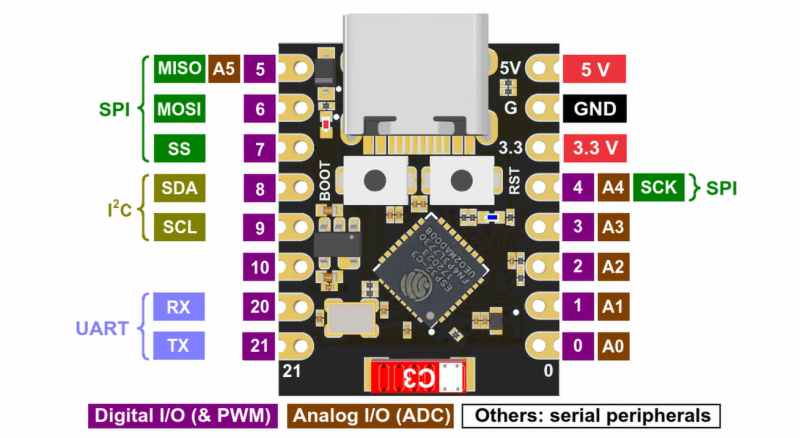
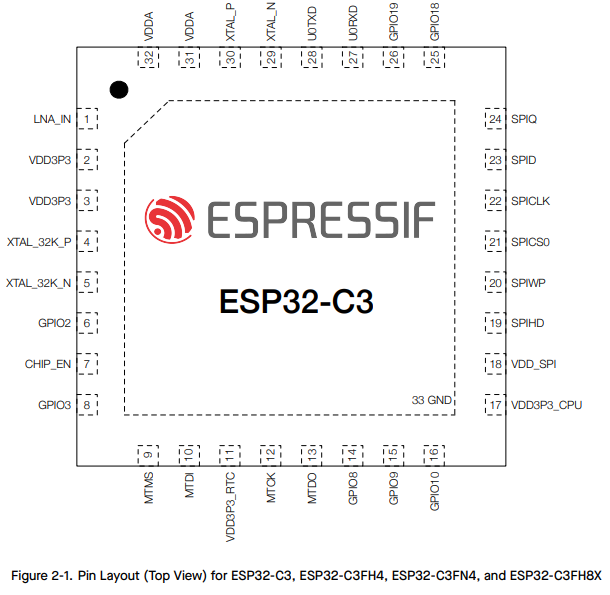
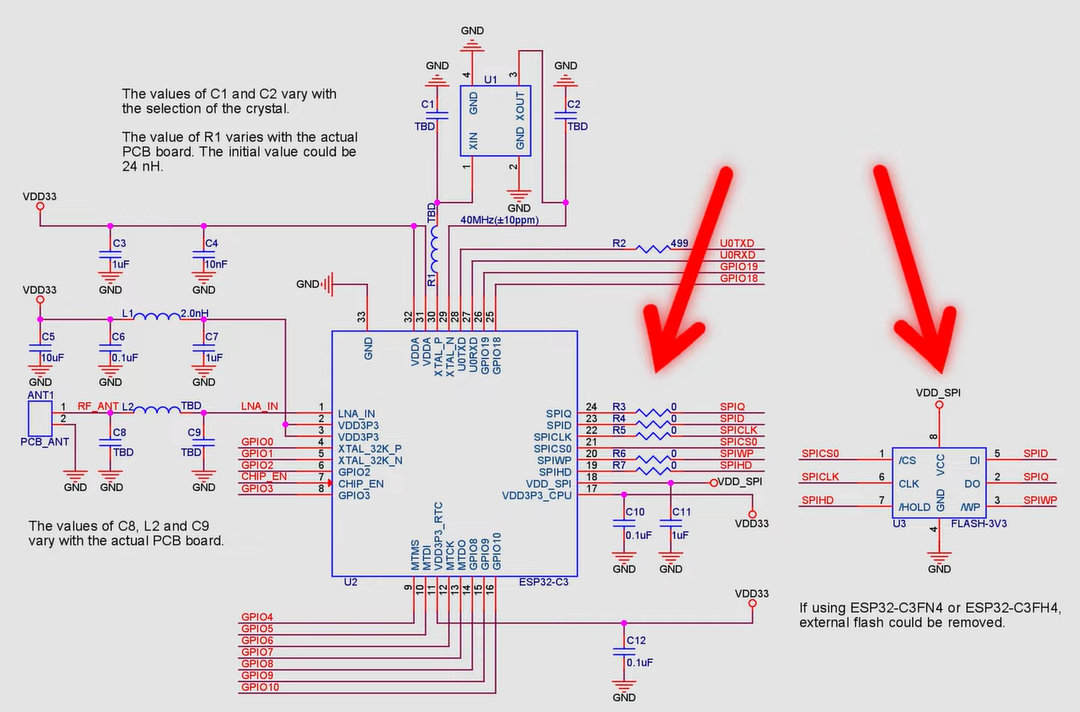
 In an update video by [Hacker University] to an earlier video on ESP32-C3 Super Mini development boards that feature a Flash-less version of this MCU, the question of adding your own Flash IC to these boards is addressed. The short version is that while it is possible, it’s definitely not going to be easy, as pins including SPIHD (19) and SPICLK (22) and SPIQ (24) are not broken out on the board and thus require one to directly solder wires to the QFN pads.
Considering how sketchy it would be to have multiple wires running off to an external Flash IC, this raises many questions about the feasibility, as well as cost-effectiveness. Some in the comments to the video remark that instead you may as well swap the MCU with a version that does contain built-in Flash, but this is countered with the argument that a new ESP32-C3 Super Mini board with the right MCU costs as much as a loose MCU from your favorite purveyor of ICs.
Ultimately this lends some credence to calling these zero Flash Super Mini boards a ‘scam’, as their use cases would seem to be extremely limited and their Flash-less nature very poorly advertised.












is there any use case for such a board as is? consi
Yes, a GSXR gear ratio indicator that can be configured or debugged via telnet :)
https://www.youtube.com/watch?v=fmNS6uBD6gQ
I can think of plenty of times its the better choice in terms of no having parts you don’t need, though price wise and flexibility for reuse perhaps not worth it.
Really any time its a peripheral to a ‘real’ device that can ship it the code its meant to be running and receive the results you don’t need onboard data storage, just enough RAM for the program to run in and a way to get it to run that program. So anything you are breadboarding at your desk, data collection, its got onboard Wifi and Bluetooth looking at the specs so makes a good dedicated bridge for your wireless projects, or a bridge between the disparate parts of a project – perhaps a split HID device for simulator or accessibility where you have one of these in the primary joystick/button box and all the peripherals can talk to it via BT…
Given the price of dev boards with similar features and some built in storage not convinced I’d ever want to pick one of these up, but not because its not useful simply that I’d rather have more scope for finding it useful after salvaging that project/prototype. Though I haven’t contemplated its specs deeply, if those many Analogue pins have great resolution or the PWM is good etc it might just be compelling enough.
Return it, the proper answer is return it.
For an item which is €2.59, even returning it is too much effort (assuming you only bought one). While I dislike that some scammer got away with this, I also value my time more than dealing with a scammer who fights nail and tooth for €2.59 (lol).
For reference, is there an accepted way of using the flashless parts without those SPI lines; or is this board layout essentially only useful for impersonating the version with flash in package?
If there’s an option to push your code into memory when talking to the ROM bootloader(presumably the way esptool itself implements the stub bootloader it uses by default) I could see a viable, if limited, ‘peripheral only’ setup that just gets instructions from the host on boot; but if that’s unsupported or so limited as to be effectively not worth it then a version without flash and without the SPI lines you use to add flash seems like a straightforward scam.
The OG ESP8266 and ESP32 was originally just a ble/wifi module for another processor to use. Selling them as general purpose MCUs with an open sdk that we think of them as today was an extra thing.
They had a host boot mode. The “AT command” BLE firmware would get loaded by the host system into the esp RAM on boot. Avoids the cost of flash, but also makes software updates easier since you don’t need to deal with reflashing the esp from your host processor.
IDK if the risc-v C series chips still do this.
So…if i’m understanding this correctly, your comment answers the question everyone had and the article wouldn’t touch?? The purpose of this board is to act as a wifi modem?
More like zigbee or Thread one. (C3 can do them).
Didn’t get a word of that, but is it just me or does the board resemble a silly face? Can’t unsee it now.
Before I realized this was a HAD article I thought it was a meme post on my news feed
Thanks to you it’s all I can see now! That made me chuckle
Unpopulated footprints are free when a backside of the board is available. Shame on the designers for not providing one for flash. It could have been useful even for boards that already have internal flash.
Why sell such a thing?
Profit.
I get the feeling from a lot of stuff I get from AliExpress that they just slam stuff together and get it out the door ASAP. Someone got a ton of chips in cheap, grabbed the gerbers for this board, and didn’t bother checking that it actually worked.
SPI? sd-card?
replacement a fido UF2 key like yubico or security https://tomu.im/
pity other project are closed now and not open source ;(
So, what can you do then without flash? Just load code into RAM by the USB connector? I can see some minor usecases for that, but nothing where I think “lets save $2 on a board to make it much more specific”
C3 doesn’t have xip to run from RAM. I don’t know why anyone would sell such a board.
As far as I see, not much.
First stage boot loader wants to load the second stage boot software from 0x0 flash memory. No flash, no second stage boot, no nothing then (watchdog will reboot, depending on strapping pin, I think).
ESP32 (without anything) would now go into its tinyBASIC. But that does not exist elsewhere, afaik. Beside, the Zero needs an USB stack. That does not exist, too.
Me not very optimistic.
Imagine being confused on hackaday about why someone would HACK their device.
It sounds like someone bought a bunch of flashes chips because they were cheaper and put them on the same old boards not knowing the implications. And now is selling them cheaper because they’re nearly useless.
It could have been a REASONABLE product if they’re just spun a board with the additional pins broken out.
In fact, there’s arguably no reason not to break them out anyway for all versions against the unused edge, like the old esp12 modules had. Other than a tiny bit more real estate to route the traces and add the pads.
There are Aliexpress C3 boards with bad WiFi antenna (chip) designs out there, you have to dodge that too.
Soldering on the headers is very difficult, really close by 0402 parts which fell off and I did not even notice until bootmode was wrong. Too small a board.
Make a pcb shim with castlated connections for pins 18 to 24. Would be a little odd in shape due to the passive components that are close to pin 17 of the esp32. Might have to add another pcb over the mcu to hold the flash chip.
Or use a flex pcb.
Sometimes it is cheaper to buy a module than the bare chip. For example I buy the Ds3231 RTC module for rpi and desolder the IC from them, to put it on my board. This way I also get a free battery. Didn’t check, but maybe this board is also worth the money if one buys it “for parts”
Design a “better” board, de-solder parts from this one, and transfer.
If all goes well, sell the “barebone” pcb or just make the design open source.
Ok, I do dead bug stuff… Toss the ones you don’t want into a bag, Email Me…. I am searching for any micro controllers i can find for experiments. If you can mail them to Canada, i sure could use them.
evilslain@gmail.com
Thanks.
Use a USB to UART adaptor and connect it to TX/RX/GND and maybe 3v3 if needed for power then bridge Boot with EN to enter a flash mode. after that you should be able to program it using something like ESPtool if you have the correct .bin file.
The problem is that they are using a ESP32 that has no USB-CDC so when plugged in it is not recognised by the computer and assigned a port and without that port being open to communicate to the ESP32 you cant actually upload any firmware you have written.
I made this mistake myself designing a circuit using an ESP32-C3-Wroom chip not realising it came without firmware for the USB-CDC so when i plugged it in for the first time after making it I spent days going over my wiring and components thinking I got something shorted or the wrong component. I eventually realised that my wiring was not at fault and it was the fact there was no USB-CDC on the ESP32-C3-WROOM-02U so the board was not enumerating a USB and therefore not getting a Com Port.
I’m all for cheap electronics, but at what point is it worth the trouble over spending a bit more on the core component of your projects? Especially when a board like this, including shipping it across the globe, costs less than a loaf of bread where you are.
I have a few of the devices from Waveshare, and it’s worth the extra money to me. Do note that these devices are not pin compatible, and a few of these seem to be the exact inverse of each other.