
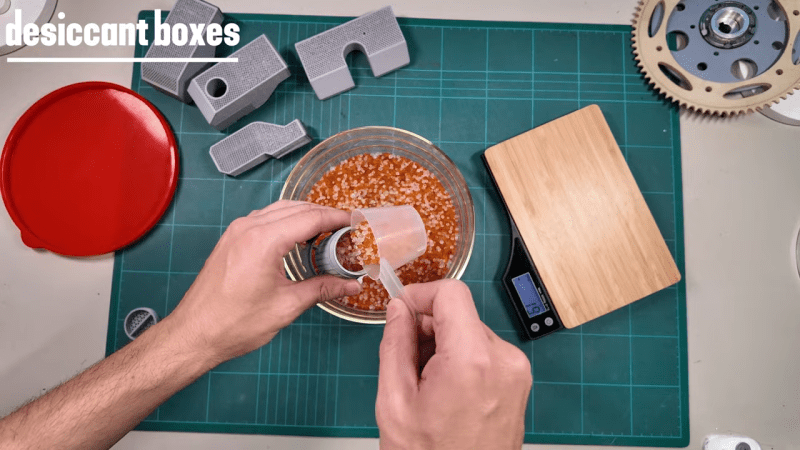
It’s possible to improve your 3D prints in all kinds of ways. You can tune your printer’s motion, buy better filament, or tinker endlessly with any number of slicer settings. Or, as [Dirt-E-Bikes] explains, you could grab yourself some silica gel.
If you’re unfamiliar with silica gel, it’s that stuff that comes in the “DO NOT EAT” packet when you buy a new pair of shoes. It’s key feature is that it’s hygroscopic—which means it likes to suck up moisture from the atmosphere. When it comes to 3D printing, this is a highly useful property—specifically because it can help keep filament dry. Over time, plastic filament tends to pick up some moisture on its own from the atmosphere, and this tends to interfere with print quality. This can be avoided by storing filament in a sealed or semi-seaeled environment with silica gel. The gel will tend to suck up most of the moisture from the air in the sealed container, helping to keep the filament drier.
[Dirt-E-Bikes] does a great job of explaining how best to integrate silica gel with your filament spools and automatic material changer (if you have one). He also explains the value of color changing silica gel which indicates when the material is saturated with water, as well as how to dry it out for reuse. You can even combine some of the color changing beads with the more common plain white beads recycled from your shoe boxes, since you only need a few colored beads to get an idea of the water content.
We’ve explored other filament drying solutions before, too. Video after the break.
[Thanks to Keith Olson for the tip!]












Living in Arizona, I never had a problem with PLA absorbing moisture.
Once I moved to San Francisco I learned the hard way to keep my spools in airtight bins with Damp-Rid. Probably going to switch to silica beads before too long.
“Do not eat silica gel with remaining mouth” just doesn’t have the same vibe as the laser version.
Maybe covered in the video: Take some fresh (or freshly regenerated) silica gel and dribble a few drops of water on it to see why this “do not eat” warning exists.
Now imagine what you’re supposed to do when you have a stomach full of exploded glass shards.
If you use it a lot, you can try it in the sun, am oven or the microwave
SOLVED: What is the best way to dry used desiccant Silica-Gel? – Skills – iFixit https://share.google/i3PxPXezUR7qNmATz
I concur with that link. My dessicator box is an old camping cooler with an airtight lid. I use about 1 kg of silica gel in it. A hygrometer in the box claims it keeps the humidity between 8-9 percent.
About 3 times a year, spring summer and fall, I need to regenerate it, according to its indicator.
Regeneration is in a 120 C oven, 4 hours. Less than 110 C or less than 3 hours is not enough. Much more than 120 C would (they say) damage the silica gel. I have not verified that.
The only real issue is that the darn stuff gets fragile and turns to sand over the years, falling out of the screen containers. Coming up on 10 years with this I’ve had to replace silica gel once, and coming up on needing to replace it again.
Everyone with a 3D printer doesn’t already know this? TIL.
Yeah, one of the first things I did after buying a 3d printer was to buy a filament dryer after a botched petg print
I have 10 year old rolls of pla, never dried or sealed. Still print good. It really depends on where you live.
Cat litter can be bought as large silica gel crystals that already have an indicator.
Put a cloth or sock over a hoover tube to remove the dust.
i store my filament in popcorn tins with surplus silica packets. works fine in rainforest conditions, provided you periodically dry them out in the toaster oven (mine has a dehydrate mode).