
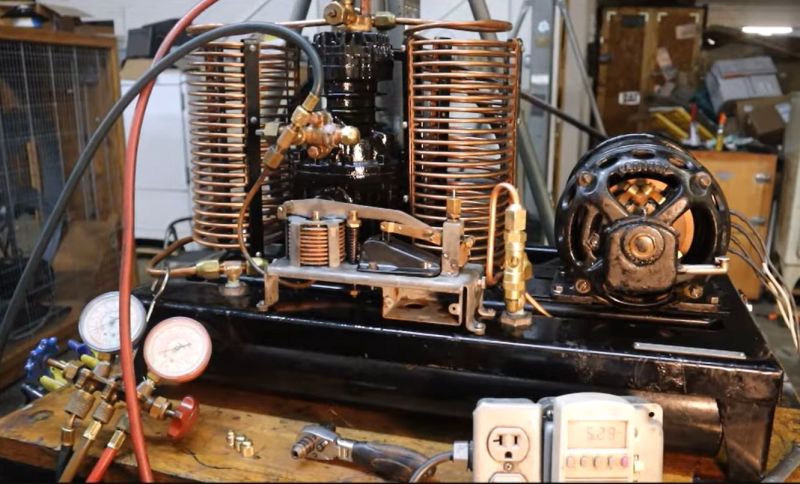
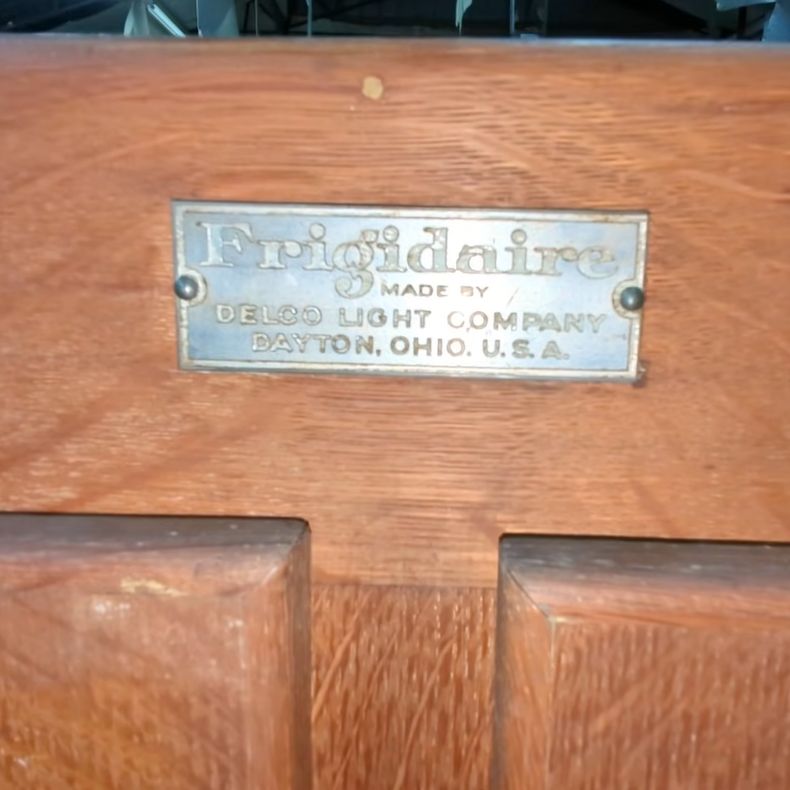
 Before the refrigerator became a normal part of any kitchen, those with enough money to throw around could get an icebox, which used melting ice to cool food and drinks in a second compartment. As refrigerators became available for sale in the 1920s, this created somewhat awkward transition models, like the 1924 Frigidaire B-9 that [David Allen] recently got offered for a restoration. This was part of the restoration of a 1926 house, which foresaw putting this venerable unit back into operation.
As [David] explains, this refrigerator was still in use until about 1970 when it broke down, and repairs proved tricky. Clearly, the fault wasn’t that severe as [David] got it working again after a number of small repairs and a lot of maintenance. The running unit with its basic elements can be seen purring away in the completion video, with the journey to get there covered in a video series starting with the first episode.
What’s fascinating is that during this aforementioned transition period, the vapor compression electric cooling system was an optional extra, meaning that the basic layout is still that of an icebox. Correspondingly, instead of ice in the ice compartment, you find the low-side float evaporator, with the basement section containing the condensing unit, motor, and compressor. The temperature sensor is also a miracle of simplicity, using bellows that respond to the temperature and thus volume of the evaporator coolant, which trigger a switch that turns on the compressor.
Despite a hundred years having passed since this refrigerator was constructed, at its core it works exactly the same as the unit we have in our kitchens today, albeit with higher efficiency, more electronics, and with the sulfur dioxide refrigerant replaced with something less toxic to us humans.












Before the refrigerator became a normal part of any kitchen and as far as antique times, those with enough money storage packed with ice. https://en.wikipedia.org/wiki/Ice_house_(building).
Cool!
I see what I think you did there.
I love watching some of these videos on the video site. As a commercial HVACR technician it astounds me how simple some of these are. All new units have computer controls and VFD drives. The one thing that does concern me though are some of the old refrigerants. I was listening to an old 1940’s radio show where the spouse is having a problem with the gas powered refrigerator. Every time she reaches in and touches the shelf she gets shocked. The unit uses household voltage for the lamp inside but natural gas to cool the fridge. She calls the tech who tells her “your just feeling the cold and it’s not a problem.” When the tech comes out for a look he gets zapped by the shelving. The spouse tells the tech”it’s just cold and it’s not a problem, right?” The tech put away his tools and just left. And for those who wonder what a gas powered fridge is just look up RV fridge. That’s another amazing bit of technology.
https://www.youtube.com/watch?v=cy1W-uWvR9U
If you dig through the comments (I did because I was also curious on the refrigerant), he did not put so2 back in, but replaced it with R152a. It’s much safer and cheaper, besides some flammability risk.
@J The new commercial units that I work on run r454b as the refrigerant and all the service valves have a red circular tag that indicates flammable refrigerants. And yes almost anything is better than So2.
Much as I complain about the build quality and ergonomics of my Good Enough fridge, I’m pretty happy that the only semiconductors in it is the LED light bulb I put in 5 years ago. The fridge is 20 years old and the only thing that has failed is the inside fan motor bearing. I’m not looking forward to the new VFD units. The $1 per month they would save me in electricity would never pay off the added cost and unreliability.
RV fridges – aka 3-way fridges – are pretty cool tech and I’m surprised the principle is not used in more places. You’d think being able to use heat (EG solar energy) directly to make things cool with no moving parts would be a big win.
They are vastly inefficient if you need to use electricity to power them though, compared to a compressor type.
Comment from video 5 on what refrigerant was used:
“This was originally SO2; and I made adjustments to charge it with R152A.”
That would make sense. R12 wasn’t even developed until the 30’s.
My Father was a commercial refrigeration tech back when sulfur dioxide and ammonia were used as refrigerants. He told me that when they emptied the system they exhausted the refrigerant into the city sewer.
When I worked on an orchard in the 1990s the big coolrooms there still used ammonia.
Yep. Ammonia still gets used in industrial refrigeration.
A few years later GE came out with the “monitor top” sealed system. I had a DR back in the 80’s found rusted in a dump. I had it looking good with a similar control box which was missing. Friends that were in the theatre department wanted it for a stage prop. What do I do for food for the month or more?
One day my house mate called my attention to an odor downstairs. I yelled, call the fire department and tell them Sulfur Dioxide refrigerator I’ll see you outside! They came with hoods and tanks and bear-hugged that stinker outside. Like town gas those new fangled coolers could kill.
It was stored in our warehouse and somebody moved out with it.
Im remodeling a house that has one of theses in the basement. Is there any value? Or should I just throw it away