
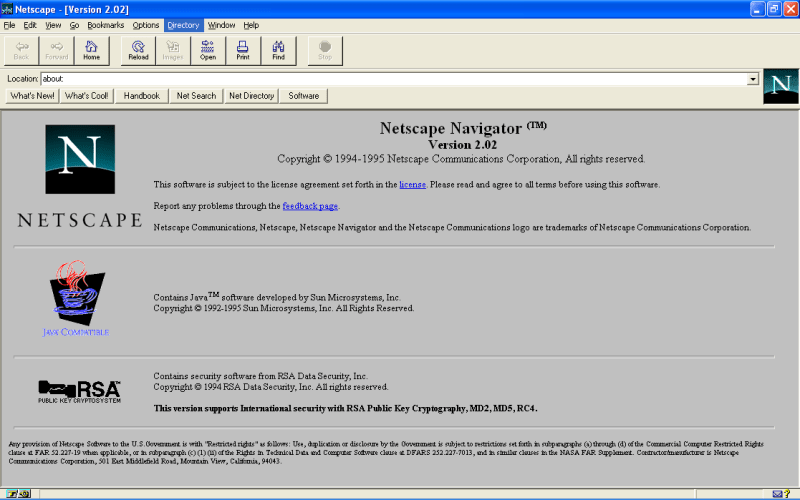
The very concept of the web browser began with a humble piece of software called NCSA Mosaic, all the way back in 1993. It was soon eclipsed by Netscape Navigator, and later Internet Explorer, which became the titans of the 1990s browser market. In turn, they too would falter. Navigator’s dying corpse ended up feeding what would become Mozilla Firefox, and Internet Explorer later morphed into the unexceptional browser known as Edge.
Few of us have had any reason to think about Netscape Navigator since its demise in 2008. And yet, the name lingers on. A zombie from a forgotten age, risen again to haunt us today.
The Bigger They Are, The Harder They Fall
Netscape Navigator was once the browser to use, dominating its rivals with a 90% market share. Unfortunately, that reign of glory only lasted until the last few years of the 1990s, when Internet Explorer began to embrace, extend, and extinguish. Explorer was included with every copy of Windows sold, it was distributed by AOL and minor ISPs alike, and it was better at keeping up with, or outright creating, new standards at a time when Netscape’s developers became stuck in the quagmire of an an increasingly aging codebase.
Netscape was great right through the 4.0s, but Netscape 5 was cancelled, and Netscape 6 was a mess. The company was bought out by AOL, and the product limped on into the early 2000s, but it was eventually declared dead on March 1, 2008. With almost no user base to speak of at that point, it simply did not make sense to continue.
You might think, then, that the Netscape name died with the browser and that it would never be seen or heard again. Unfortunately, that’s almost never the case when it comes to recognizable names in the tech world. Somebody always seems to hang on to the rights to do something with them, even if it’s usually unsuccessful. Sometimes it goes well, but more often than not, it amounts to little more than a hackneyed old logo slapped on a product that nobody really cares about.
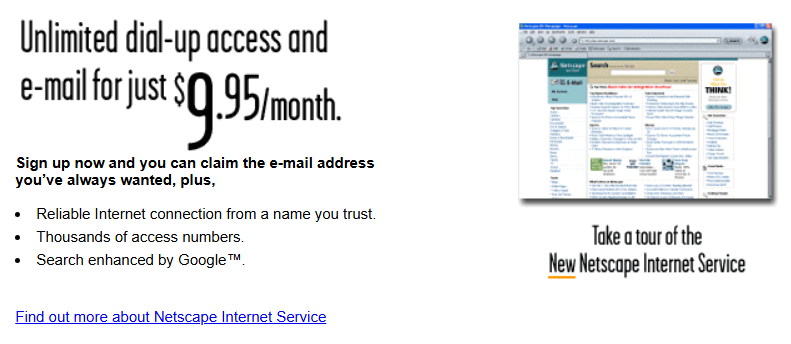
In the case of Netscape, the branding rights became AOL’s when it first purchased the business in 1998. It would go on to use the name to start a dial-up ISP in 2004, called Netscape Internet Service. It’s unclear precisely why this was done, given that AOL already was an ISP in its own right, which ran dial-up service all the way up until September 2025.
But for whatever reason, Netscape ISP kicked off operations on January 8, 2004, initially offering unlimited use for just $9.95 a month. Notably, it seems the name was the point—with the barebones site noting that you were getting a “reliable Internet connection from a name you trust.” It was also somewhat different from the contemporary AOL offering, in that you didn’t need a CD full of bloatware to access the service. The signup site went so far as to explain that you didn’t need to use a Netscape Navigator browser to access the service; any would do. As a cool bonus, you got a sweet “@netscape.com” email address when you signed up.
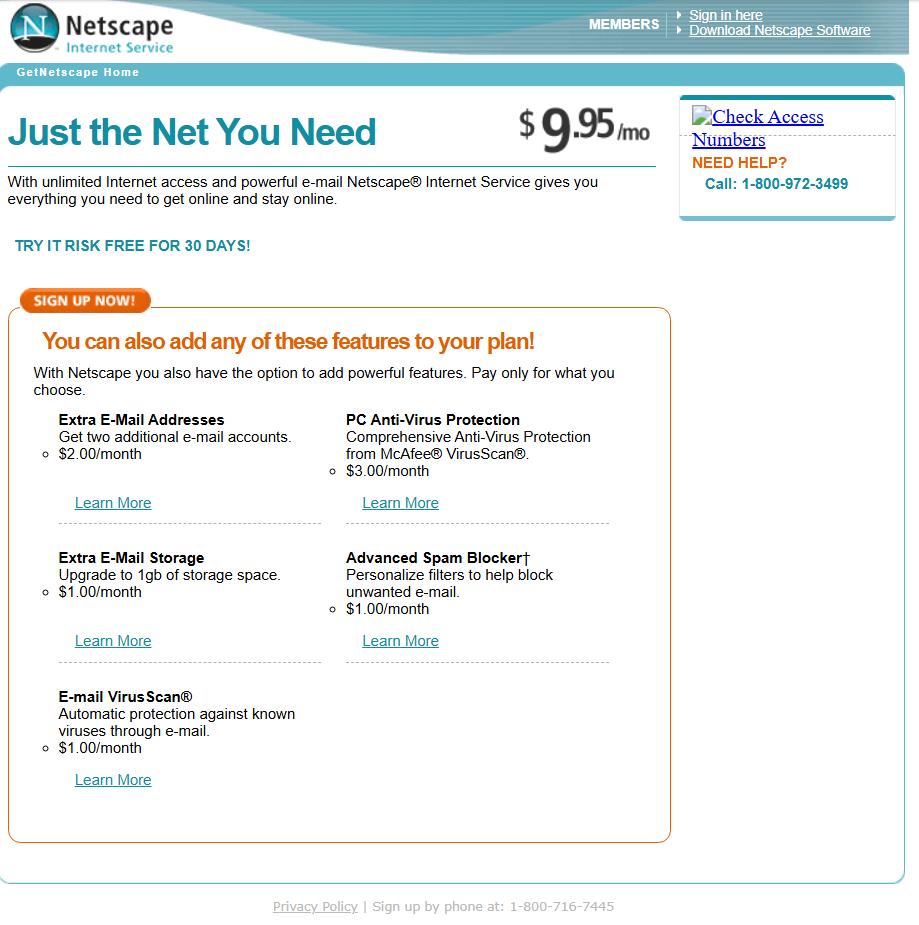
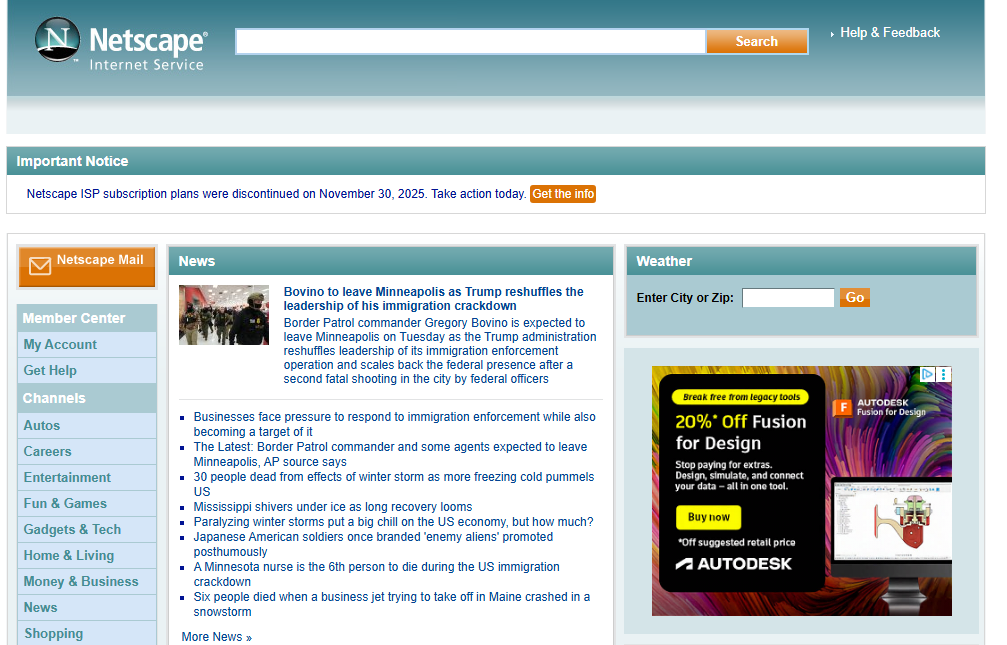
The Netscape ISP maintained its cheap offering for many years. It also later added “Web Accelerator,” which was a simple compression tool that promised to let you surf the web “up to 5x faster.” In reality, it was marketing fluff that did not make a lot of difference to dial-up users chugging along on slow connections. Weirdly, the Netscape ISP never transitioned over to selling DSL or fiber or any sort of modern broadband connection. As recently as 2018, you could still sign up for a service that was entirely dial-up only. Eventually, at some point in the late 2010s or early 2020s, Netscape ISP appeared to stop accepting new signups, with the main webpage (isp.netscape.com) eventually turning into a generic news aggregator. It remains in that state today at the time of writing.
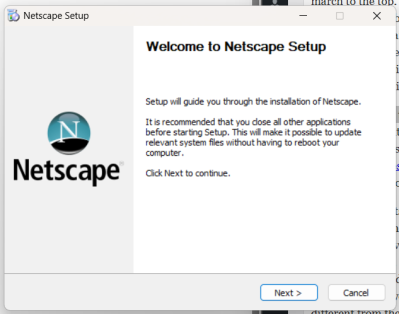
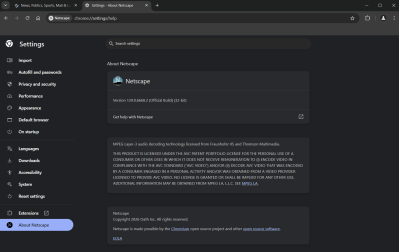
Perhaps the most hilarious part of the Netscape ISP story, though, is that it eventually spawned its own browser. Somewhere deep in the bowels of an AOL office, some poor developer had to hack together a Chromium fork to slap the Netscape ISP branding on it. You can still download it today, thanks to a link lurking on the bottom of the Netscape ISP site. We gave it a look.
Hilariously, it’s an amalgamation of so many dying names from the early Internet—the privacy policy is hosted on Yahoo, because the now-defunct search engine merged with AOL in 2015. The browser is very obviously a reskinned version of Chromium from mid-2024, with a bit of AOL search bloatware thrown in for good measure.
While you can still download the silly 2024 “Netscape” browser, you can’t use the ISP anymore. That’s because AOL killed it dead in November 2025. Affected users will be able to maintain their super-cool netscape.com email addresses, but no more will you be able to dial up to access the Internet with your Netscape ISP account. To ease the change, AOL offered to transition affected users over to the “Complete by AOL” service, while also recommending alternatives like Starlink, HughesNet, Dialup4Less.com, and T-Mobile and Verizon 5G home internet plans. Yes, even in late 2025, your dying dial-up ISP was willing to recommend another that still operates on the old-fashioned phone lines, just as our ancestors intended.
One thing we’d love to see are the user statistics for the Netscape ISP over the past two decades. It’s hard to imagine there were a whole lot of people that were inconvenienced when AOL’s random off-shoot dial-up ISP went down in November 2025. It has to be some tiny figure, even less than the number of dial-up users that were still on the company’s main service, which shut down a month earlier. Still, they felt the need to issue a notice to users, so somebody must still have been calling in now and then, using their glacial 56K connection to check the weather and catch up on the latest updates in the Ivy League squash standings.
In any case, save for a tired old website and a rapidly-aging port of Chrome, Netscape is finally dead. For good this time. Until the logo turns up on a bunch of smart TVs and a badly-rebadged smartphone, or something. Until then, the big N shall hopefully be laid to rest.












“Yes, even in late 2025, your dying dial-up ISP was willing to recommend another that still operates on the old-fashioned phone lines, just as our ancestors intended.”
Oh, that’s for the apocalypses, don’t you know. …or people that don’t want to give Starlink money.
I worked for AOL back in the 90s. It’s not surprising that they would spin off a bare bones ISP. AOL wasn’t an ISP in the traditional sense. They started prior to the wide adoption of the web and internet in general. AOL was an online community, more like a BBS than ISP. By the late 90s, they offered access to the Internet (someday I’ll tell you about the nightmare of the early attempts at making that work) but their focus was always their own curated content.
I only got AOL in the early 90s for the internet, was able to terminal my way into the work email, that’s not AOL’s garden. As I recall there was a button labeled “Internet” but that could be a false memory. I’m not betting either way.
At some point you could dial-up using AOL, minimize it and use your own browser.
From image searches, late Windows 95 or early 98 era.
AoL was a portal, not the true internet (well, there was like a hidden button or something), it would be like opening up an app nowadays and there would be a homescreen, and buttons for facebook, youtube, instagram, netflix, email and zoom. Oh wait, we’ve come full circle to a place where most people just go to a few sites
Hi, yes, that’s a fine comparison.
To most, AOL and WinCIM software was a Windows application, basically.
All the icons and buttons were stored on HDD, not on the “internet”.
The E-Mail window was part of that application, too.
No web browser or HTML was involved so far.
When going online, both applications dialed into their respective native online system.
Again, not the internet so far! The connection was established wuth the mini computers and mainframes at AOL/CS HQ.
E-Mail and Forums were accessed without TCP/IP, UDP etc.
It was still all internal to those networks.
The gateway to the internet was available, though, if needed.
Exchanging e-Mail with non-CS and non-AOL users could involve shipping over internet gateways.
That way, e-Mail communication worked internationally to/from any e-Mail address.
The AOL/CS users didn’t have to connect to the internet yet.
No WinSock DLL or web browser was involved.
Of course, both AOL and CompuServe also provided an internet access.
For this to work, internet traffic was either encapsuled and sent over AOL/CS connection or the AOL/CS client application switched to TCP/IP communications.
Tbe latter also worked directly on Linux and Windows 9x/NT.
By entering the user name/password in a dial-up script, it was possible to connect to internet over AOL/CS without extra software.
That also meant, of course, that the native network services of AOL/CS were not available.
No Forums, no games, etc.
No false memory. The internet was still an optional feature at the time.
+1
The competitor CompuServe was similar, I think.
Like AOL it was an on-line service in first place, rather than an ISP.
Both also had their proprietary access software, while internet access -with the exception of electronic mail- was implemented as an afterthought.
CS had natively used X.25 protocol rather than TCP/IP, I assume.
Like so many networks had used before Internet and the TCP/IP became popular.
I remember this, because CS had other X.25 networks listed in the connection settings of WinCIM (there also was MacCIM, OS/2 CIM etc).
Both AOL and CS had there own forums that were hosted on some older minicomputers, I believe.
So it made sense that AOL aquired CS later on, probably.
I was an inaugural AOL member. User number in the 250’s or something like that. They even gave me a couple years of free service. It was initially a 2400 bps service! How I got on their radar I don’t remember – perhaps it was Comdex?
I was more of a Compuserve guy myself though. That service was useful for getting software updates and information for work.
The Internet was more experimental when I first started using SLIP dialup. Ah the days of mainframes, dialup, Novell, MSDOS, Windows 2 & 3, and the beginnings of Linux. Things were different back then!
Companies like this do all sorts of weird stuff – BT had a cellphone network, sold it, and now owns 2 or 3 other networks but not the one they started with.
They have an ISP business but also bought PlusNet which is a bare-bones ISP and the two advertise separately even though the service is delivered on the same hardware on the same network. It feels like a lot of effort when they could just add a budget tier to their main ISP offering but who knows how big business works?
I wonder if it has to do at all with affordable Internet access subsidies from the Fed government, and they had to create a separate entity for the discounted internet. Just a wild useless guess
I still use my netscape.net email address to this day. I remember it was offered when you registered to download Netscape Navigator. I’m thinking around 2000.
How’s that working out for you andrew@netscape.net?
I do too and it works perfectly fine. Very, very fine. I began mine circa March 1999.
“The very concept of the web browser began with a humble piece of software called NCSA Mosaic, all the way back in 1993.”
ARE YOU FOR REAL
https://en.wikipedia.org/wiki/WorldWideWeb
That Wiki is also interesting:
https://en.wikipedia.org/wiki/History_of_the_web_browser#Web_browsers_by_year
Besides WorldWideWeb, an nowadays unknown web browser named “Erwise” was very relevant in the beginning.:
“Tim Berners-Lee, the creator of the World Wide Web, travelled to Finland to encourage the group to continue with the project.”
https://en.wikipedia.org/wiki/Erwise
Or let’s take “Cello”, an early MS Windows 3.1 web browser:
“Cello was popular during 1993/1994,
but fell out of favor following the release of Mosaic for Windows and Netscape,
after which Cello development was abandoned.”
https://en.wikipedia.org/wiki/Cello_(web_browser)
Then there was “UdiWWW”, another MS Windows browser, written by a German author.
Naturally, it was very sophisticated! 😁😉
“UdiWWW was among the first web browsers to support the then proposed HTML 3.0 standard.
[5][6][7] In doing so, it was also among the first browsers to support the specifications html math, html figures,
and the PNG image format,[7] which other leading browsers at the time such as Netscape and Internet Explorer 2.0 did not.[8]
The browser gained some popularity during 1996, but after development was abandoned, the browser fell out of favor.”
– Wikipedia
All in all, there were so many little web browsers that helped to develop the WWW further.
Comparable to how many fine little word processors there had been back in the day.
There even was IBM’s WebExplorer on OS/2, which was excellent for a year or so (no kidding!).
But by 1996, there were merely Mosaic, Netscape 2 and Internet Explorer 3 remaining that mattered.
These were the three to be found on PC shareware CDs, usually.
With Opera being still exotic and later taking Mosaic’s place.
WordStar 4ever
In 1996, lynx was still useful, though it was getting more and more difficult to avoid sites that functioned badly without images and scripts.
I used to call it “Microsoft Netscape Downloader for Windows”.
No, it wasn’t. What it was good at was dumping disgusting bug-ridden hacks that were hard use and hard to implement, especially, but not only, in any browser that wasn’t Microsoft Inept Exploder. But those hacks, which I wish to emphasize once again were not in any way”standards”, did things that “enterprise” customers wanted, however badly, so IE got a huge boost in corporate use. I don’t think it ever became dominant outside of “the enterprise”. And Microsoft then had to spend many years trying to kill off the resulting truly unmaintainable mass of crap, because of course the usual clueless “enterprise” IT drones had hardwired dependencies on all those hacks into all their internal software, and those drones do not change things.
Let’s not pretend that IE was a better or more maintainable piece of software… and if it had any agility advantage at all, it was because Microsoft was willing to sacrifice unlimited programmers’ souls to the Dark IE God to get each new hack.
IE wasn’t part of Windows 3.1x, NT 3.x, nor Windows 95 RTM (retail).
The original Windows 95 didn’t even have support for FAT32 (it had DOS 7.0), USB or DirectX.
That stuff came later with the updated OEM releases.
What originally was part of Windows 95 was the “The Microsoft Network” software (MSN).
Back then, Microsoft tried rival AOL or CompuServe.
Microsoft didn’t take the Internet that seriously, yet.
And that was good, maybe, because it allowed other online technologies to materialize.
The early Windows 95 days were still a bit experimental, open-ended.
The Internet wasn’t being fully commercialized yet.
That’s what on-line services such as AOL, CompuServe or MSN were good for, by comparison.
Understatement of the century! M$ loves to foster this narrative that they “ushered in the PC and Internet revolutions!” but the reality is very different. At the time Netscape was released, the main consumer version of Windows was Windows for Workgroups 3.11, which was supposed to revolve around networking features but did NOT include TCP/IP. Users who wanted to check out this “Internet” thing had to install third-party products like Trumpet WinSock, which was given away for free by a tiny, kind-hearted Australian software shop. The Microsoft of that era was characteristically so far up their own ass they imagined consumers would eventually prefer the “managed intranet” experience of a commercial product like NetWare or Banyan Vines (with corporate entities that were willing to pay for inclusion in Windows) over the “Wild West” of a decentralized internet.
Windows ’95 finally included a built-in TCP/IP stack, but it was hot garbage, where writing a single byte to TCP port 139 would immediately blue-screen any Windows 95 machine (https://en.wikipedia.org/wiki/WinNuke). That problem was known in the preview builds of Win95 but wasn’t patched for months after the official release IIRC. Definitely not a priority for anyone in Redmond.
The Mac version of Internet Explorer 5 was quite okay, though. 🙂
It used Tasman engine, rather than Trident.
https://en.wikipedia.org/wiki/Tasman_(browser_engine)
Strange that a fork of Plan 9 didn’t emerge from the ashes of “barebones dialup ISP”.
The codebase is still alive in the Seamonkey project: https://www.seamonkey-project.org/
I was looking for this comment :-) is it any good?
I remember the day when Netscape stock went up. It was a shock.
The Netscape suit was pretty good for me, in a round about way…
I created my first website with Netscape Communicator. However, I found weird little things like when editing text, if I hit RETURN, the layout of the paragraph would sometimes change. It often would not do exactly as I wanted.
I ended up find the HTML 4.1 specs, learning HTML and started writing my pages in Notepad.
So, by not being that good, it helped me learn something better 😁
Well done! 😃
By doing things by hand, the loading times could turn out to be better, too!
It’s comparable to writing in K&R C vs ANSI C, I think.
Sometimes, not all the extra fuss is needed.
Back then when dial-up modems were common, an optimized webpage made a difference.
I hate modern webpages on limited data plans though. On my android phone. I tried a 5 or 10 GB data plan for a bit, and simply browsing a few mobile webpages in a day seemed to use multiple hundred MBs of data. So maybe we should go back to the simple stuff to help those with limited data. (Not going to happen though, if businesses don’t care to help or optimize)
Microsoft held a large seminar in late 1999 at a Convention Center in Valley Forge, PA. (outside of Philadelphia) to introduce Office 2000 and Windows 2000. (The venue was also used for Star Trek Conventions.) The Microsofters were on stage demonstrating said products (the computer screens were shown on a huge movie screen in the background) when one fellow brought up Internet Explorer to demonstrate something else…I.E. paused and then Crashed… the other guys on stage scrambled to fix the problem. One wag sitting in the audience stood up and loudly but clearly said, “You should have used Netscape Navigator”. Laughter was heard throughout the audience…
The wag (and it might have been me) was not set upon by Microsoft’s goons, but they did retaliate by “running out” of Danish pastries for the 10 o’clock coffee break… (Many 100’s or a thousand (?) computer geeks and they didn’t double or triple the Danish pastry order??)
“Netscape Navigator since its demise in 2008.”
It lasted that long? Must’ve been in the shadows.
Made me think of AOL Time Warner – the Mother of All Mergers (all hail the great and powerful CEO of CEO’s: Steve Case!), “the biggest train wreck in the history of corporate America.”