
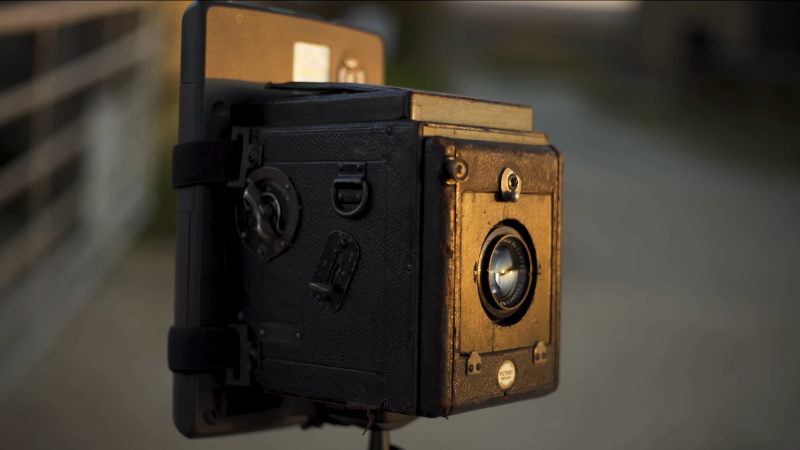
Every collector ends up with items that are worthless, usually because they are broken or incomplete. When [Graindead] found a 1920s glass-plate reflex camera for pennies with plenty of missing parts, it was obvious that what he had was a piece of junk. Throw it away? No, he turned it digital with the aid of a small document scanner.
A reflex camera like this one is the ancestor of the 35mm single-lens reflex cameras we may still be familiar with today, in that is has a flip-up mirror inside to bounce the light onto a ground glass screen. The photographer can see what the lens sees to set up the shot, before flipping the mirror out of the way and exposing the glass plate film by pulling out a dark slide. This one was missing the ground glass and the lens, so he has to grind a replacement, and bodge in a similar-age Carl Zeiss Tessar lens.
In the video below you can see the build, and a range of pictures including some trichrome colour shots. It gives an imperfect result even compared to the same camera with its period film, but the point here is the art rather than the clarity. We’d take this one out with us, if it were ours.
For more vintage digital fun, have a look at a similar adaptation that shoots video.












It takes grayscale photos because the scanner has a grayscale sensor and for each line alternates between illuminating with red, green, and blue.
Btw., he didn’t talk about disabling these LEDs, did he?
This is true but not the case for all scanners. Some better fit scanners will have a line for each color, and actuate them sequentially at each step. The difficult part to deal with is that a scanner sensor is very wide, but not at all adapted to common large format lenses – it is very directional and will usually not get anything an angle, leaving you with a very small image, where the rays were perpendicular to the sensor.
Finding the right sensor/lens combination takes some luck, because some sensors have a cylindrical lens sitting directly on top of them (which also decreases sensitivity at an angle). For color images I have noticed that projects tend to use smaller linear sensors than one would find in a common A4 scanner, which are of course easier to illuminate, so this the smarter way to go – you can find them commercially but they will pop up lens often in cheap scanners, which are usually full-size.
Nevertheless, building a camera out of a scanner is a very fun and nice project. Mind you that these sensors don’t filter out infrared light, which can be both put to use (they’re VERY sensitive to it) and will alter the image to a greyish magenta without an additional filter to put on the lens.
Some older, massive scanners will integrate a true macro lens before the sensor. You should save it. The image quality usually lies waaay beyond any cheap (or even kinda pricey) macro lens that is available commercially. And it comes nearly free because nobody cares about the old 20kg+ scanner that was once in use in graphic arts/photography and that you just bought for a few bucks.
As example I had an Agfa Duoscan which I indented to use to scan 120mm film, but it never would turn on. After a while I dismantled it, only to discover that something had melted inside the circuit. I was able to scrap a wonderful lens. It’s very small, but covers more than the 35mm format. For a few bucks only it will enable great fun and in the end, the scanner wasn’t a total loss. Moreover, the steppers motors seem pretty good and very solid – again because they’re old and massive, and had a to move a massive metallic enclosure containing the lens and sensor. I am thinking of perhaps building a focuser of some sorts with them (for astronomy) because they should have a pretty good resolution.
In the end these little (or huge) machines usually pack a lot of useful things, although a very cheap scanner will usually only contain a sensor to scrap – with no usable lens and only weak, flimsy steppers.
Fun project. You don’t see line sweep cameras very often. Especially not for monochrome. Some of the images look like album covers from the early 2000s. I love what they are doing, takes me back to old interests