
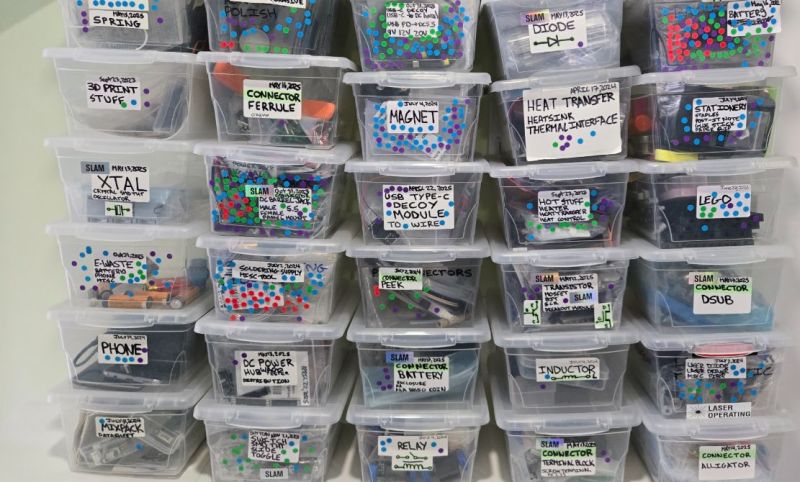
Many of us are guilty of toeing the line between having a ready supply of components at hand and simply hoarding for fear of throwing anything out. In a first admission of this problem, [Scott Lawson] decided to implement a couple of changes to assess his own position on this sliding scale.
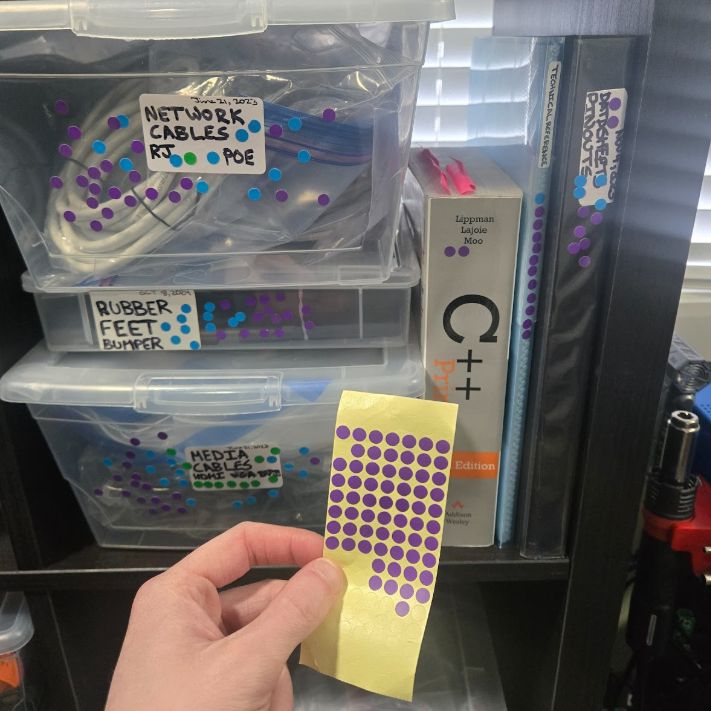
The first change was to only put parts, components, and supplies in transparent boxes. Next was to add a sticker on each box noting the contents and box creation date. This was extended to plastic bags inside the boxes when further subdivision was warranted.
Next, the question was about usage patterns, as you may think that you know how often you use something from a specific box, or how important its contents are, but it helps to add some objectivity to this. For this, [Scott] used sheets of dot stickers, with a sticker added each time he opened a box and used something from it.
By persistently doing this for a few years at his home lab, [Scott] was able to assess which boxes fell into any of three categories: hot, warm, and cold. Cold boxes are very rarely — if ever — accessed, and can thus be readily moved to the attic, shed, or even sold off if they have spent a year or longer in cold storage. Hot boxes should obviously be kept near the work areas. This way, one can make objective decisions of what boxes should go where for optimal access, and what things in your home lab are basically just there to look pretty and gather dust.
This is an effective low-tech way to get organized. Or you can go the opposite direction.












Missing the “Nothing box”.
Also missing the giant “Misc.” box!
Have to have at least 1 misc box!
“Nothing box”
https://youtu.be/SZ6mVumHY9I?si=sD1Z5XyiFqEY91_3
I also have “temp” which is basically “misc”. Everything I could sort but have no time (or will… mostly will) to sort lands there.
I have a couple dozen “nothing boxes”. They’ll eventually become something boxes.
No need to use stickers, though – if you use a box, it ends up on the top of the stack. Over time, the less used boxes end up at the bottom, and you just shift those to longterm storage.
Also, choose a box system that you know you’ll be able to get more of. If you just get whatever is cheapest at the hardware store or online that’ll be the last time you can get compatible boxes, and your storage will become a mess of badly stacked random shapes.
My opinion is the best choice is the IKEA SAMLA boxes – they might not be the best possible design or size, but they’re cheap, and Ikea is probably going to keep making them for decades.
This is great advice. After 15 years I settled on the exact IRIS boxes in this article. 4 years later, I just bought my 4th case last week.
My favorite is the Sterilite ClearView. I have mostly 6qt, and some 15qt boxes. The latch is important for me, since I sometimes take a lot of boxes on the road (BM). Things get knocked over and the latch saves me time not having to clean up a spill.
I also put the content/name stickers on both ends of the box. When things are moving fast (immediacy), putting a box back in the correct orientation doesn’t take any time.
Agree with the most used ones moving up the pile of boxes. (Same system I use)
Messes up the muscle memory though.
I like the boxes from smartstore far more and same/better price as IKEA.
Can’t rely on IKEA boxes being available long time either – i once bought 30 wooden boxes with small drawers only for them to discontinue them a year later. The wooden drawers have the advantage of the most used ones showing most finger-grease after some years.
Instead of stickers I would use a marker. Or paint with a whiteboard marker/chalk at the opening to see which ones I use most.
I simply don’t have the discipline to put on a sticker every time.
Small variation on the same idea: store the boxes on shelves N boxes wide. Pull boxes from anywhere, but always put them back on the left end of the top shelf.
When any shelf has N boxes, move N/2 boxes from the right end of that shelf to any lower shelf with free space. Put boxes you expect to use again on the left end of a lower shelf, and the rest on the right end.
It isn’t a true stack, so you don’t have to waste time on purely mechanical shuffling. Items migrate up and to the left with use though, while unused items migrate down and to the right.
I have added QR stickers to all my boxes. I can scan them, en see the content on mij stock website. I can als reverse search for parts in all the bins. I can really advise going a route like this!
You have your own stock app or use a public one?
Another experience I want to contribute, to track box contents: I have stickers with descending numbers (e.g. 50, 49, 48……1) on each box, and when I take a certain number of items out, I strike the corresponding number of numbers :-) beginning from top. So the to non-striked number shows the actual content, even with non-transparent boxes.
omg, The pic at the top of the story could be in my “home office”. :)
This is a great method for things that are easily replaced or for general use (looking at you, orphaned kitchen Tupperware, bin of generic transistors, and crate of every-kind-of-tape-known-to-Man) but the method does not include value metrics.
For example, I hope that neither the first aid kit nor the fire extinguishers ever get a sticker on them (ever), and that optical table setup may likely only acquire one or two stickers but nothing else will do, and any replacement is unlikely.
This is where the trouble begins and the method must make exceptions. I call it “the tuxedo problem” – if you own a tuxedo and use it for the rare formal occasion, should you pitch it for being unused, or keep it against the possibility that you’ll need it? The usual response is “why not rent one?”, and this works for tuxedoes, generic tools, garden equipment, and some structures (scaffolding for instance) but not for consumables or singular items (optical tables). Most people keep them in spite of their rare use.
So at the end of the day you have to consider use, turnover, replacement metrics, and storage consumption. Welcome to logistics writ small.
That honestly looks like the result of letting a four-year-old loose in my shop with a handful of stickers.
I do this all the time for my field service case. Two stickers on every tool in there. Every time I use a tool I pull a sticker. A few trips later I look at everything with a sticker still on it and think reeeeeall hard about whether it needs to be in there.
Helps keep me under airline max carriage weight :-)
does he go into boxes like once a year? out of all my storage boxes I know which I go in and out of the most without any system. I even asked a few people at the office before I posted this, all of just just know because we are in and out of them.