

Over the past years there have appeared in the media increasingly more alarming reports about micro- and nanoplastics (MNPs) and the harm that they are causing not only in the environment, but also inside our bodies. If some of the published studies were to be believed, then MNPs are everywhere inside our bodies, from our blood and reproductive organs to having deeply embedded themselves inside our brains with potentially catastrophic health implications.
Early last year we covered what we thought we knew about the harm from MNPs in our bodies, but since then more and more scientists have pushed back against these studies, calling them ‘flawed’ and questioning the used methodology and conclusions. Despite claims of health damage in mice, institutions like the German federal risk assessment institute also do not acknowledge evidence of harm to human health from MNPs.
All of which raises the question whether flawed studies have pushed us into our own Chicken Little moment, and whether it’s now time to breathe a sigh of relief that the sky isn’t falling after all.
Measuring Many Tiny Things
One of the problems with making statements about the amount of MNPs in the body pertains to the way that this is measured. Rather than sliding samples under a microscope and doing manual counting, the typical method involves a method like pyrolysis-gas chromatography-mass spectrometry (Py-GC-MS). For biological samples you first want to remove the organic components before pyrolysis, lest the subsequent mass spectrometry step produces false positives rather than an objective polymer analysis.
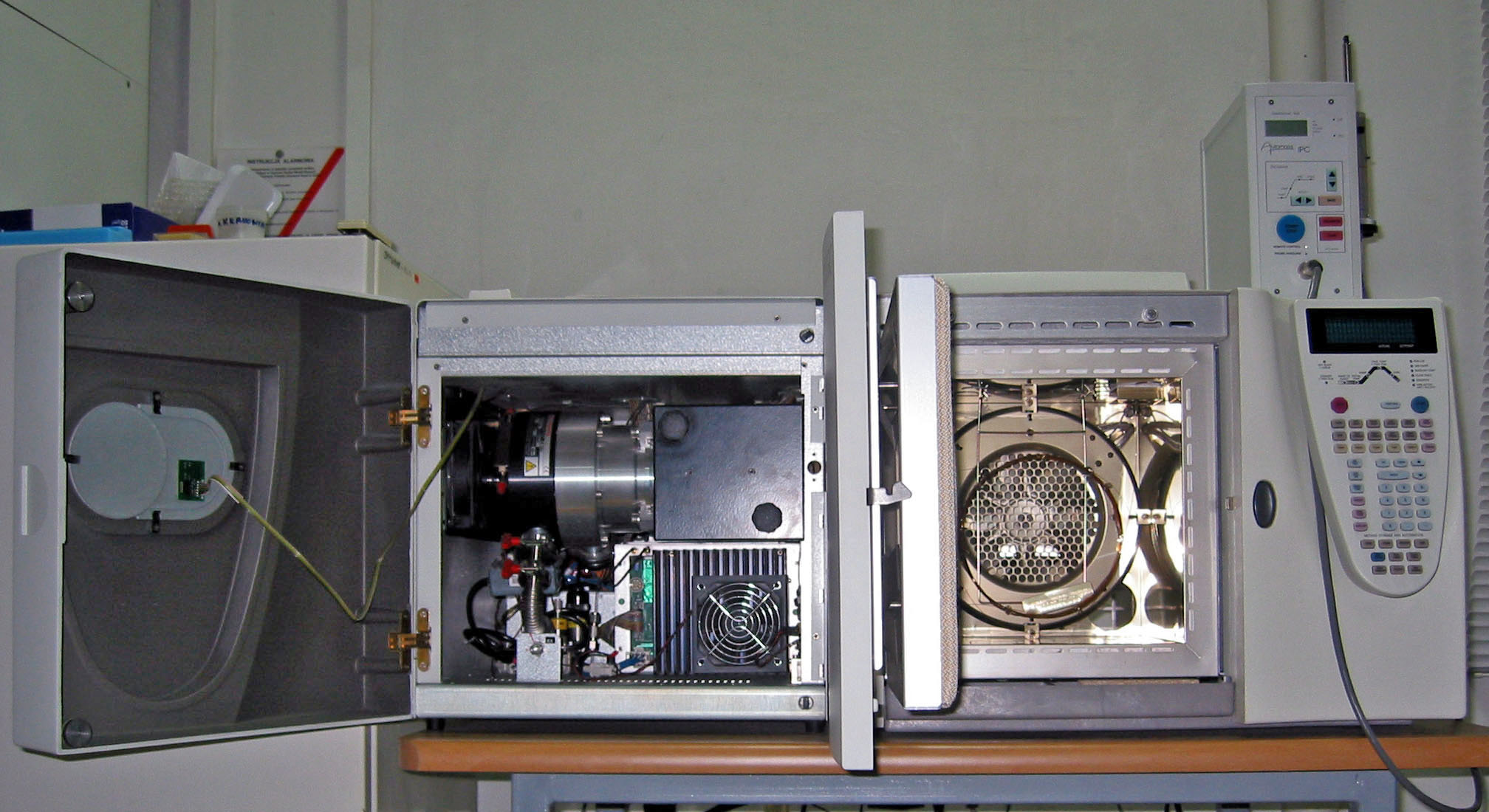
Py-GC-MS involves rapidly heating the sample in an inert atmosphere or vacuum. This cleaves large molecules into smaller fragments which can then be separated using a gas chromatography column and classified in combination with a mass spectrometer. With both results combined, the likely original materials in the sample can thus be deduced. This means that you are not literally counting MNP particles in the sample or measuring them, but quite literally vaporizing said sample and analyzing the debris cloud. Obviously this comes with some major asterisks.
A 2024 paper by Marthinus Brits et al. as published in Microplastics and Nanoplastics explored the use of Py-GC-MS for determining the amount of MNPs in human blood. Using whole blood samples they found mostly polyethylene (PE) polymer, with a mean of 268 ng/mL of MNPs across all 68 samples, with a call to investigate the health impact of this finding.
In response to this paper a correspondence by Bianca Wilhelmus et al. was submitted to the journal, in which one of the complaints was a lack of detail on the Py-GC-MS fingerprints using which the polymers were purportedly detected. It was also noted that with sub-micrometer MNP particles you’d need millions of them in a sample to really register, which is far above what had typically been found in human body fluids.
To this Brits et al. replied with among other things the admission that the quantitative analysis of MNPs using Py-GC-MS is still in early stages of development. To the issue of quantity it was noted that most of the MNPs are significantly larger than a micrometer, so they were still fairly confident of their findings.
It’s important to note more recent studies here, such as the 2025 study by Cassandra Rauert et al. in Environmental Science & Technology, in which also a study on using Py-GC-MS for detecting MNPs in blood was performed. Its conclusion was that this detection method has trouble detecting PE and PVC polymers, and the estimated exposure concentrations are testing the detection limits of this technique.
Contamination
One of the problems with trying to measure MNPs in a sample is that of environmental MNP contamination, as MNPs are being shed and distributed all around us, whether it’s from e.g. polyester clothing, plastic surfaces and tools, or carried in from outside. This makes it a real chore to make sure that in a laboratory setting such contamination does not ruin the findings, as with a recent study on MNPs in bottled water by Qian et al. in PNAS.
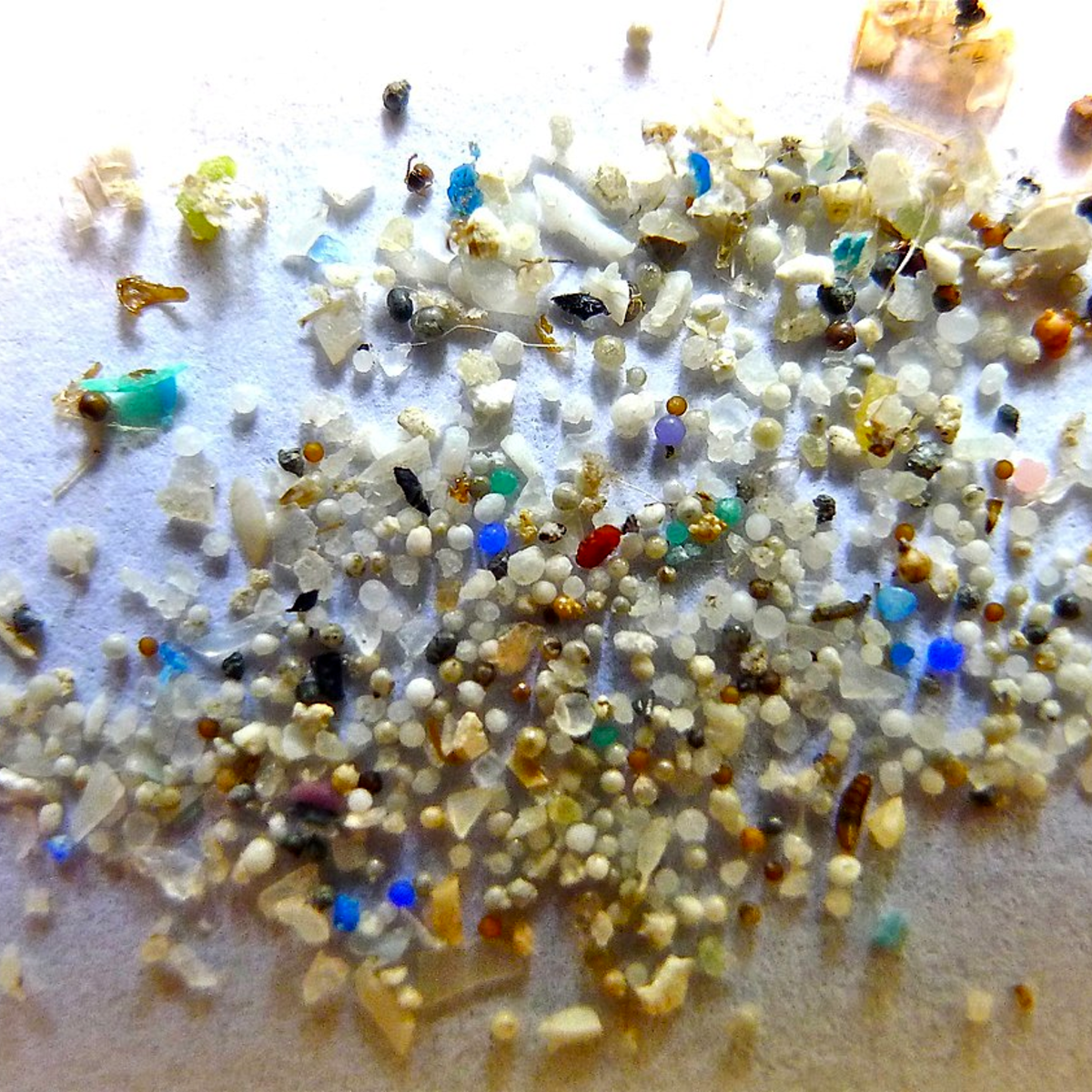
Rather than Py-GC-MS, this used stimulated Raman scattering, but also led to accusations of contamination due to improper procedures, with the finding that the ultra-pure filtered Milli-Q water that was used for a blank (i.e. control) contained as many MNPs as the bottled water. This and other issues were suggested as invalidating the findings. While Qian et al. acknowledged that using the Milli-Q water as a blank was resultingly improper, they disagreed with the premise that this invalidated the study’s findings.
Another type of contamination can come from the aforementioned biological tissue, such as in the early 2025 study on MNPs in the human brain and other organs by Nihart et al. as published in Nature Medicine. This analyzed tissue samples from human cadavers using, among other methods, Py-GC-MS, leading them to conclude that especially our brains are full of PE polymers, with major implications for Alzheimer’s and dementia research, for instance.
This assessment subsequently got challenged (full article) by Monikh et al. in a November 2025 published commentary, with the authors noting that Nihart et al.’s samples from the human liver, kidney and brain all have in common that they contain significant amounts of fatty tissue (lipids), which when subjected to pyrolysis produce fragments that are easily mistaken for PE polymer fragments.
When it comes to detecting polymers in such biological samples, it is absolutely essential to strip away the biological material, without affecting the sample that will ultimately be analyzed. In this case the processing method appears to have been flawed, leading to subsequent contamination. This was acknowledged by the team, in a reply by some of the study authors.
Empirical Correlation
Although it seems like we can at least conclude that our brains aren’t overflowing with PE polymer fragments, but that they are just filled with phospholipids in particular, this doesn’t necessarily take away all our concerns. After all, didn’t some studies find real, empirical evidence for MNPs causing actual damage? Especially since it seems harmful in mice, according to a 2025 study using starch-based plastics.
As highlighted by Baroni et al. in a September 2025 review paper on MNPs in the brain as published in Nanomaterials, the enduring problem that we are dealing with right now is one of a lack of information, a scarcity of standard detection methods and a total lack of longitudinal studies in humans.
Although we have health databases that span decades in countries with strong public healthcare systems, trying to figure out whether certain health trends are due to MNPs using their data is borderline lunacy, as you cannot realistically account for all confounding factors. Thus we are mostly stuck at this point trying to figure out how to actually effectively measure the presence of MNPs.
Methodology
The aforementioned Py-GC-MS and SRS methods are two tools available to us here, but clearly moving from measuring MNPs in water to measuring them in biological tissues is still a challenging topic. When we look at the established science of MNPs in water, we got a range of options, as illustrated by this application note by ThermoFisher Scientific:
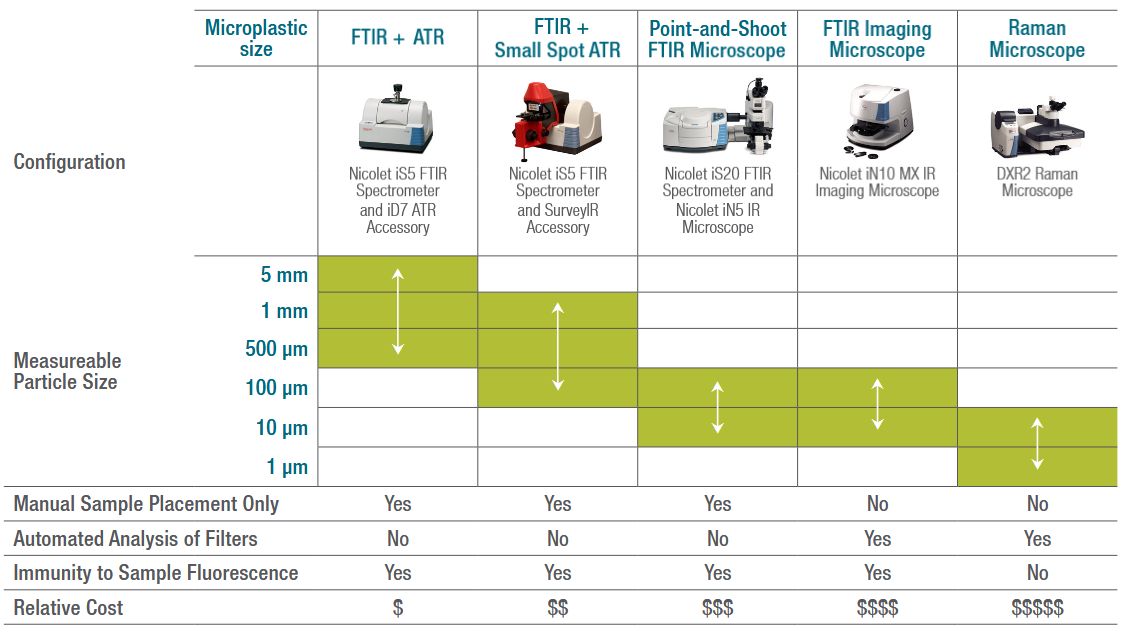
In order to measure not just the relatively large microplastic particles, but also the much smaller nanoplastics which are more likely to interact with biological systems, you are pretty limited here already. With only Raman spectroscopes applicable for such fine analysis, it’s little wonder that Py-GC-MS is being applied to biological samples.
Maybe once we have figured out the right methodology for Py-GC-MS and potentially other approaches will we be able to tell with some certainty how many of these polymer fragments are in our bodies right now, and how much of it will simply pass through rather than take up permanent residence. On the bright side, there’s no clear epidemiological evidence of MNPs being actively harmful to us, yet.
Although the sky hasn’t been confirmed to be falling, it is still looking somewhat unsteady. For that reason alone it is probably in our own best interest to use the precautionary principle here, as it’s better to have begun today to find ways to reduce and prevent the spread of MNPs, rather than to regret not having done so tomorrow.











It’s one big test, and we’re the petri dish.
The Grays are us, back from the future. They are trying to help us to not cause damage to ourselves and the environment.
So you’re saying we should burn more coal so they stop coming back to bother us?
Yes. And everyone with a brain told you this. All those “correlated” studies are most likely bogus as well. Stop accepting “science” that isn’t replicated, 3-5 times at least, by people with INCENTIVE to disprove. This is basic game theory.
After applying this filter, what science would be left?
Most science.
I hypothesise that the Earth rotates around the sun based on my observations of the solar system. You’re free to disprove this by taking your own measurements, and by doing these independent measurements (correctly) you would also see that the Earth indeed rotates around the sun. The next group trying to disprove also reaches the same conclusion. It seems at this point then that indeed the Earth rotates around the sun.
That’s how science works.
Compared to – I’ve found high levels of microplastics in samples of blood. The media latches on to this paper (confirmation bias, microplastics are bad) and run with it. Further tests by others to confirm this haven’t been done (yet), but the news is out and is treated as the truth.
Trust the science.
NEVER trust the science reporting.
Generally, reporters are innumerate twits.
They don’t even have to lie on purpose (but they often do).
They just do what their economic incentives tell them to.
Attract eyeballs at all cost.
Credibility, schmedibility, public has zero memory.
Also poll the people you know with deep knowledge of any half-technical subject that has been reported on.
What % will tell you the reporter did a ‘decent’ job (considering (s)he’s an idiot)? (0% will)
What % will tell you the reporter took 4 seconds out of context to drive their own narrative? (perhaps not 100%, but more than 50)
Also: J schools.
Journalism is the classic idiots college major.
J programs graduate enough ‘journalists’ every year to fill every journalism job.
So who succeeds?
Those that can afford to work 2 year unpaid internships while living in Manhattan!
After spending a quarter megabuck on a Journalism degree and a four+ year party.
Is it any surprise we have Vanderbilt heirs giving verbal BJs on CNN?
Everything is polymers. (except metal and glass)
It’s really difficult to build anything of substance without using polymers. Not just in man-made objects, but in nature too, from the cellulose and lignin in wood to the keratin in tissues from skin and hair to scales and exoskeletons and the collagens in tendons and bones. Even the starches in seeds like corn and tubers like potatoes are polymers, athough they aren’t usually used structurally.
Man-made polymers are sometimes built from common naturally occurring monomers, as is the case with celluloid and rayon made from cellulose, PLA made from lactic acid. Sometimes they’re built from less common naturally occurring monomers like ethylene in the PET plastic used in water bottles. Sometimes they are purely synthetic like the flexible silicone polymers that are increasingly common in the kitchen, from ice-cube trays to spatulas.
The monomers can have various chemical effects, which generally diminish as they are polymerized, and they are well worth studying in both forms. This is the case for both naturally occurring polymers and synthetic ones. Our cell walls are made out of cholesterol polymers, but cholesterol levels in blood have significant health impacts. Ethylene is used by plants to control fruit ripening. The effects of purely synthetic polymers are less well known, as they aren’t needed for us or plants or other animals to survive, which is the case with naturally occurring polymers and the monomers they are built on.
When I was a child I thought I could figure out how integrated circuits work by applying voltages to various pins and seeing what the other pins do. It had worked for a discrete transistor, but I had no clue that there was too much complexity in an integrated circuit for that to work, that a single package size could fit a huge variation of unrelated dies, nor that I could get datasheets for those integrated circuits which would tell me how to use them.
The studies were using my childhood approach to semiconductors, when there’s no technical reason they couldn’t study the individual effects of various polymers, common and uncommon, natural and synthetic, and document actual health effects. Lumping everything together in a single study on plastics, not even acknowledging the spectrum of polymers and their already known health effects and requirements, is poor scientific practice, even without the bad methodologies.
Are those “polymers” in the room with us? 🤪😂🤣😛
What’s with the emojis, grandpa?
Grandpa can’t use emojis because keyboards have no keys for them (manually copying or entering emoji-codes doesn’t count).
Yes, especially if you have carpeting.
This is a summary of an attempt to counter FUD with FUD. The science is inconclusive at this time, and that is fairly well-reported. The amount of microplastics, the spectrum of them, and the effects of them are all unknown. That’s just how it is. Pointing out that the study that claims to provide a weak answer to a small part of the question is fine and good, but doing so is also providing a weak answer to a small part of the question.
I’m not sure who to blame for the tendency to overstate these things in the popular press. The scientists themselves have a need to publish non-results so they can cite that publication in their next grant application. Universities have whole departments dedicated to creating and spreading memes out of their faculty’s publications. And newspaper/magazine writers were barely literate even before they became pure correlation engines.
But i have almost always been impressed with how straightforwardly a non-answer is portrayed as such by the people who actually write them up. Which is kind of surprising but is something i really appreciate about scientists.
Yep… The way it is. Just like other activities you can follow the money. Warming, cooling, no warming. Or ‘x’ is bad for you, no wait now it is good for you, actually you know it is neutral… so the wheels of ‘science’ turns. As we know alarm-ism really does work on the population. Moral, Just take an aspirin and stay calm.
These ‘good for you’ then ‘bad for you’ stories are mainly spin and oversimplification. The purpose of the studies they summarize, then misquote, then demonize are over the heads of the talking heads.
The media will ALWAYS report something like this as a “DISASTER!!!!”. They try to make you mad or scared so you’ll click the article. I don’t have a solution, but I’m getting really weary of the practice.
The solution is to ignore all media and create your own reality (physically as well as mentally) with people you care about and know in person. Do not cede your cognition to any so-called authority, they do not have your best interest at heart. Notice how much they scream and whine about the breakdown of any consensus, whether it’s scientific, social, or political. They hate it when individuals exercise their personal will.
I’d just like to say that your personal free will should not extend to skipping your vaccinations or firing bullets into the air. For the first time in over 30 years there is measles in my hometown.
Sorry dude, you’re just gonna have to deal. If they wanted people to remain in the consensus-reality they shouldn’t have made it so oppressive and boring. Can’t blame me for leaving the theater if the movie sucks.
We had a measles outbreak in my town. The daycare at the center of it requires vaccinations. Kids who should be immune were giving measles to other kids who should be immune.
Antivaxxers are an easy target to blame, but our local experience suggests there’s more to it. Personally I suspect a mutation but I would have hoped the powers that be consider such things.
Hey wanna be my in person friend? My reality is wild
Hell yeah, man.
How many star wars movies were made in your reality?
In here, it’s 3, and one holiday special.
I’ve met a bunch of people that share a Fn nightmare in that regard.
Humans have a working ‘people’ memory of about 1000 (size of tribe and neighboring tribes players).
This comes from ‘science’ (sociology, spit), so should be suspect.
Old results and as well confirmed as anything in that swamp.
Don’t fill your limited memory space with any ‘celebrity’ types.
Just put them all into the person bucket of ‘irrelevant, untrustworthy’ with the politicians.
Forget all details, the internet is your ‘slow memory’, beware corrupted data.
Preferable baseline for nanoplastics in the bloodstream 0 particles
The current few studies are showing us that the amount in our bloodstream is slowly increasing
Most of the nanoplastics come from folks religiously putting polyester clothing in washing machines since the invention of the thing, spreading the plastic particles around the globe all the way to the arctics
Particles in significant amounts can clog up small arteries and block bloodflow to something like a section of the brain, for example
Particles can trigger something like cancer
Studies are just showing us that the change of damage is increasing all the time if we don’t start cleaning up
AS with most things the devil is in the fine print, the biggest problem with microplastics is that they carry with them heavy metals, this alongside the additional inflammation is being seen to disrupt endocrine systems in humans. But you know WHY we are talking about it now? Its because we are in a energy transition for transport, electric cars are reducing the consumption of oil, the oil industry will have to transition to textiles, synthetic textiles are a major source of the microplastics due to wear and tear and shedding during washing.
Would it be possible to use ASMLs EUV technology for microscope purposes?
Probably not the euv itself but the instrumentation they have around it sure. Spend a million dollars an hour or something looking at garbage and possibly breaking or ruining your vacuum. Iykyk sort of thing.
I think the answer is there’s better ways
“Asbestos is fine- healthy, even! It’s good for you! Cigarettes, too, three out of five doctors recommend Camels!”
Asbestos is a wrongfully-maligned wonder-material and I would gladly risk lung cancer to have a shirt that I could clean by tossing it into a fire. Cigarettes really are garbage though, won’t argue with you there.
You’d change your tune the instant you actually got lung cancer, though.
a shirt that i could clean by tossing it into a fire.
i love it
Itchy and uncomfortable.
I’d rather have a cotton shirt so cheap I could just wear it once (I do and I don’t).
You could bury cotton cloths in the landfill for carbon sequestration.
All you have to do is convince the cool people/idiots that ‘only peasants were cloths twice’.
Best part, free, voluntary tax.
Like state lotteries.
But on the vain rather than those bad at math.
Cigarettes are broad category.
Don’t care for paper myself, but concerts make for compromises.
Joints of quality smoke are ‘too much’, even if rolled penitentiary J thin.
Another ‘great’ hack. Thanks, Maya.
If we can’t show it’s bad, and we know it isn’t “good” then we should just assume it’s bad.
There is a correct version of this, but there’s also a scare mongering version of this.
Telling the difference is difficult.
Let’s just isotope label all our plastic then we’ll be certain. Too bad ol’ _______ is having such a hard time with getting rid of the ultra processed foods – that would be a way bigger win than some hacks finding carbon in blood so they can sell more Stanley cups.
Problem: plastics ingested provably pass through the body chemically unaltered, microgram for microgram.
This total and obvious absence of traditional reactive (metabolic) interaction dramatically shrinks the space of potential physiological impact (and thus also scaremongering).
Solution: the endocrine system! Where demonstrable but clearly consequential nanogram quantity complex interactions permit all manner of vague and handwavy claims! Academic charlatanism never had it so easy!
Eh, large plastics clearly pass through unaltered but microplastics are still an unwritten story.
Likely yes. In a coincidence, this is the 20th anniversary of one of the most costly science exaggerations of all time. “An Inconvenient Truth” was released in May 2006. For a few years after that I was teaching high school AP physics and math. The biology teachers were all showing it to every class several times a year. I would occasionally substitute for them in my planning period and the assignment was invariably to show that film. It was so full of crazy exaggerations I had to bite my tongue, and I must have seen it a dozen times. The poor learners (progressive misnomer for students) had to take “movie notes” each time to show how serious it was.
BTW, “Although firmly in the top 5 of misnomers” I think is not really a misnomer. Over time “Rare Earth” became a name for a list of elements and not a description. I’m trying to think of an example. Sort of like “Velociraptor” is a name for a collection of fossils of animals no one has ever seen. No one knows if they were fast, or just silly. Not a great example. Or a razor back hog. They don’t really have razors.
‘Razorback’
During the Clinton admin, Bill was getting on AF one in Arkansas with a young hog under his arm.
The conversation was recorded.
SS agent: That sure is a nice hog you’ve got there Mr. President.
BC: Yep, except around these parts we call this a ‘razorback’.
SS agent: That sure is a nice razorback you’ve got there Mr. President.
BC: Yep, I got this razorback for Hillary.
SS agent: That was one hell of a trade Mr. President. I’m glad your on our side.
That SS agent is now a very senior presidential appointee.
What’s a fact is that polystyrene microplastics causes birth defects and aborts in mice.
What that means for human pregnancies can’t be tested for obvious reasons.
But do we really want to roll the dice?
Overestimate it’s potential harm? No. Given how large the contamination is, there is no way to overestimate the amount of potential harm it could do. That said, there isn’t enough hard data to say how much of that potential harm will become real harm. As such, we should be doing everything we can to remove it from the environment as bioaccumulation and biomagnification are real things.
Kind of like coffee?
Plastics are so ubiquitous that it would be hard to measure them in any laboratory without making sure that the entire process from end to end didn’t contain any plastics. From the water or other medium, the sample and how it’s taken, contained and transported to the lab, and the instrument itself. There are plastics everywhere from the casing of the instrument to the very parts that move the sample to wherever it’s being sampled / vaporised etc. and the gas/liquid that’s used in the instrument and what’s used to flush it too. It’s going to have to be in a clean room with a completely clean process. And in an an air filtered room as at this point as the plastics are airborne.
Besides all that, these machines aren’t magic, I myself thought naively, that you could throw things at it and it would tell you want was in a sample but it’s much more complex than that. As with any mass spec, liquid or gas chromatography or other, it has to be essentially tuned for each test down to the temperature, the medium the sample is contained in, what was used to flush the instrument, and so on, so there are no other markers that may result in a false positive or false negative and even then you get spikes that you have to interpret.
What concerns me most is the growing rate of early-onset colorectal cancer. There’s evidence suggesting a correlation with microplastics, perhaps through sustained inflammatory effects.
Thank goodness on the challenge to the brain data. I had wondered how a large plastic spoon’s mass of plastic could be present there without major negative effects of some kind and why they concentrated there far more than elsewhere in the body.