
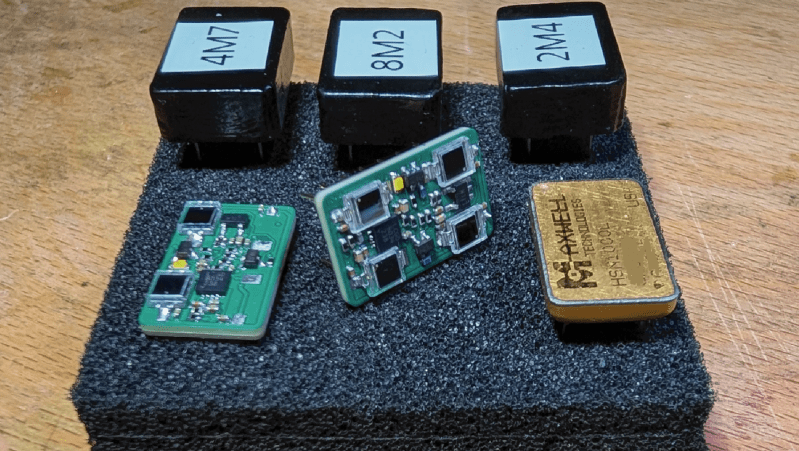
Last year, we brought you a story about the BhangmeterV2, an internet-of-things nuclear war monitor. With a cold-war-era HSN-1000 nuclear event detector at its heart, it had one job: announce to everything else on the network than an EMP was inbound, hopefully with enough time to shut down electronics. We were shocked to find out that the HSN-1000 detector was still available at the time, but that time has now passed. Fortunately [Bigcrimping] has stepped up to replicate the now-unobtainable component at the heart of his build with his BHG-2000 Nuclear Event Detector — but he needs your help to finish the job.
The HSN-1000, as reported previously, worked by listening for the characteristic prompt gamma ray pulse that is the first sign of a nuclear blast. The Vela Satellites that discovered Gamma Ray Bursts were watching for the same thing, though almost certainly not with that specific component. With the HSN-1000 unavailable, [Bigcrimping] decided he might as well make his own gamma ray detector, using four BPW34S PIN diodes coated with black paint. The paint blocks all visible light that might trigger photocurrent inside diode, but not Gamma Rays, while using four acts increases the area and may inadvertently act as a sort of coincident detector. You wouldn’t want your homemade Dead Hand to be triggered by a cosmic ray, would you?
That tiny photocurrent is then amplified by a transimpedance amplifier based on the LTC6244 op-amp, which then goes into a second-stage based on a LT1797 op amp that drives a LOW pulse to indicate an event has occurred. [Bigcrimping] fit all of this onto a four-layer PCB that is a pin-compatible replacement for the HSN-1000L event detector called for in his BhangmeterV2.
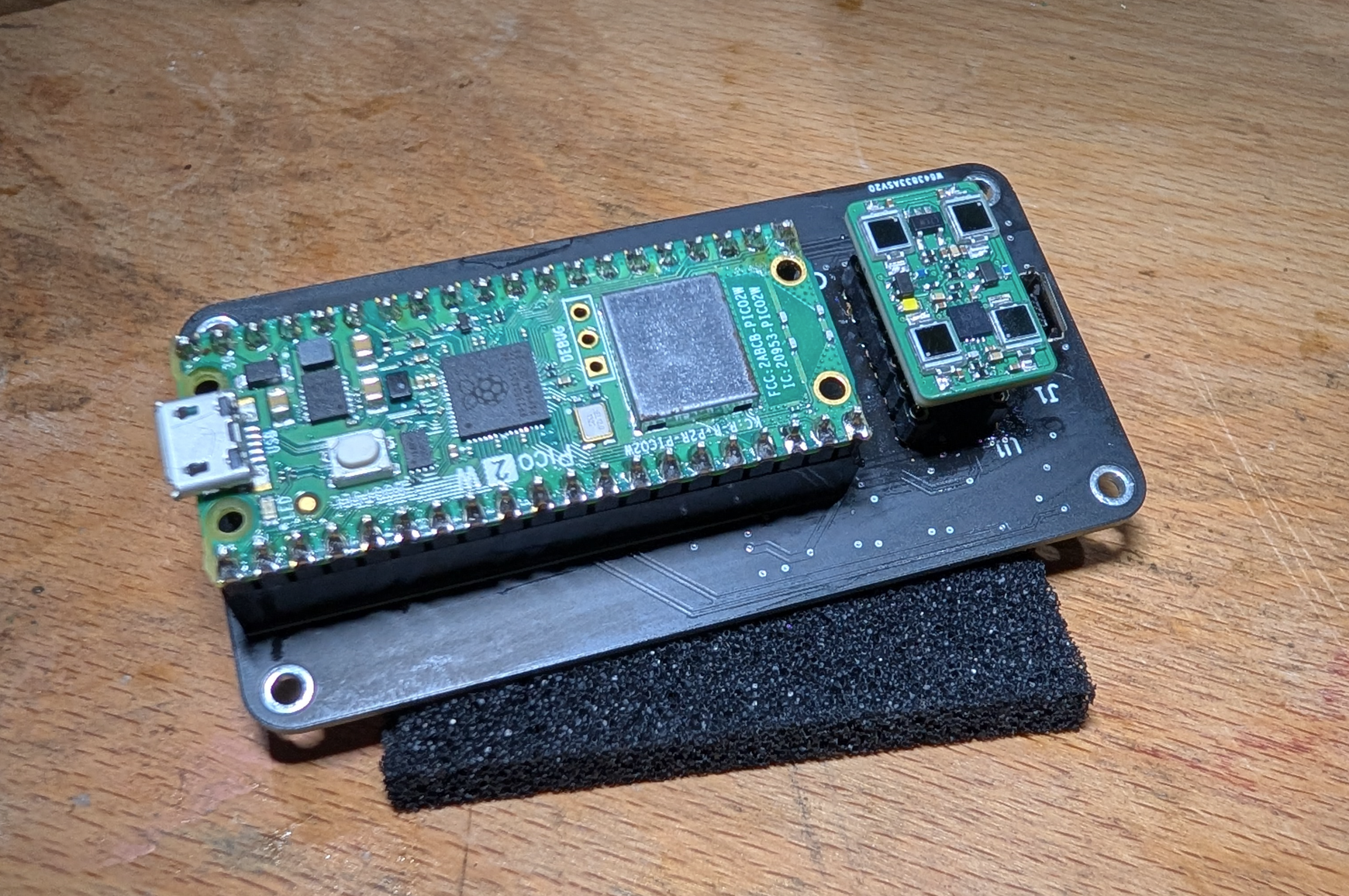
There’s only one problem: without exposing this thing to gamma rays, we really don’t know if it will work. [Bigcrimping] is looking for anyone in Europe with a Cs-137 or Co-60 source willing to help out with that. His contact info is on the GitHub page where the entire project is open sourced. Presumably a nuclear detonation would work for calibration, too, but we at Hackaday are taking the bold and perhaps controversial editorial stance that nuclear explosions are best avoided. If the Bhangmeter– which we wrote up here, if you missed it–or some equivalent does warn you of a blast, do you know where to duck and cover?












” warn you of a blast ” In this day and age where most have nukes. If there is one that goes off, everyone is going to be sending them up. Your best bet it to drive as close to the nuke site for a quick death, than to run and hide and deal with whats left over.
It seems to me that the most likely kinds of nuclear explosions are either a) accidental or b) carried out by terrorists who only have one bomb. It might be premature to commit suicide in those cases.
Over two thousand nuclear bombs have exploded on our planet in the last century.
Doesn’t seem to have had a dramatic effect on the liveability of the place.
Set off all the remaining few thousand, and you might leave a few spots you don’t want to visit, but that’s no reason to assume your days are numbered if you hear of one going off.
Most of the big ones were underground where the effects were contained. Set off the remaining ones as an actual act of war and the outcome is going to be very bad.
About 12000 nuclear warheads currently exist, about 4000 actively deployed at the moment, and many of those are much larger yields than those previously tested.
While it’s true a nuclear exchange doesn’t automatically mean we’re all screwed, setting off 4k large nukes in short succession across the globe will almost certainly have a much different effect than 2k tests spread out over decades and only in remote areas (plus, well… A couple non remote areas). Especially when many of those nukes will be employed for large scale EMPs and many others will be targeting critical national infrastructure.
I’m not advocating suicide, mind you. But life will definitely suck pretty hard for a while.
Supposedly there are no big ones now. There is treaty yield limits though I doubt if China pays any attention in real life versus what is on paper. The USA has about 1700. Who has the other 10,000?
Not sure where you’re getting your numbers, but the US has about 3700 nukes in its active inventory:
https://www.energy.gov/nnsa/us-nuclear-weapons-stockpile
Other sources give an additional 1400 or so awaiting demilling, for a total of about 5100 that count towards the 12k number.
Most are 500kt or less, but the B83-1 is 1.2MT, which is a damn sight bigger than a lot of early bombs. And as another commenter pointed out, a lot of those tests were underground, which is a totally different beast in terms of widescale effects.
Altogether, the main thing is, a full scale nuclear exchange, even without using all the available warheads, is going to be very, very impactful even to those not directly in a weapon effects area. Life will suck, for a while.
Why would you suppose all the nukes would be used? What would be the point in using them all or even half, and having none? And you are assuming all countermeasures fail and all launch systems do not fail. Also assuming all the valuable parts in Russia have not been sold and in China they are all real and the money did not wind up in Singapore with a high ranking Party member..
Most have nukes?
Man, I have never felt FOMO like I do in this moment.
Anyone up for a test? I’m sure I can rustle up a bit of Pu-238 for the project!
United Nuclear has you covered.
Chris Boden (from The Geek Group days) had from depleted U-238… it was on display in the lobby (it pegged the black meter scale high), it was next to the Farnsworth-Hirsch Fusor.
Pu-238 is an alpha emitter, this likely wont detect that very well.
Correct, I mixed up 238 (RTG fun) and 239 (actual fun)
Uh, still mistaken. Go again.
Pu-239 is just the fissile isotope, bit it is also an alpha emitter when it naturally decays. You want at least a beta emitter to test this, like Sr-90 for instance.
Would using x-rays be an “equivalent” substitute for a gamma ray pulse in testing this device?
It would be a useful test to some extent. But gamma rays are more likely to penetrate without interacting. So even if x-rays trigger your detector, you might have lingering doubt about whether gamma rays will also.
Considering x-rays have a much lower energy range than a nuke, its pretty safe to say that if it squeals from X-rays, it will scream with gammas from a nuke.
Maybe contact the high energy physics department of your nearest university? I have worked at one in the past, and know they had several small calibration sources.
Nuclear medicine will have a couple. Na22 and others. You can put a piece of indium (IIRC) in a “nuclear howitzer” which is a drum of paraffin with some plutonium and beryllium in a stainless steel slug and some ports to put samples inside. The sample will get neutron activated. These used to be in every physics department. But with the rule of Enshitification follows Feminization, they are far to dangerous for today’s physics majors. https://www.researchgate.net/figure/Pulse-height-spectrum-of-activated-indium-sample-for-shot-6303_fig5_254496338
I mean, we have sources to calibrate the meters at work but I’m on the wrong side of the pond for the guy.
Nah, you want a genuine KS-19557 Bell Telephone Nuclear Blast Detector. To be absolutely sure.
https://www.scribd.com/document/93355517/KS-19557-ATT-Bell-Telephone-Nuclear-Blast-Detector
If only we still had landlines… According to the novel/movie Fail Safe, those phones make a screeching sound when they melt in the blast. Of course those in the vicinity are unlikely to hear it, being newly vapor…
He’s a few months late so I can’t help him anymore. We used to use cesium 137 and cobalt 60. We got all our sensors replaced for safer alternatives so no more stock needed.
Smaller companies still use it for dredging operations. Cesium for the lighter contents, cobalt for the heavier contents (a bit like using woofer and a tweeter). The local river/stream dredging companies might be the best bet, especially for 137.
“announce to everything else on the network than an EMP was inbound”
Inbound? That’s one slow as molasses lazy lima bean of an EMP. Did it stop for coffee?
While at UF we had a contract with the USAF to look at survivability of various IC designs to just this event. We took a surplus Dental Xray machine and increased the voltage. It works by accelerating electrons to impact on a target inside a large glass tube. The phenomenon of a gamma ray resulting from “sudden electron impact” primarily refers to Bremsstrahlung (German for “braking radiation”). We generated X-rays equivalent to those of gamma rays from the explosions you describe. We ended up pealing the metal off the target and went through four X-ray machines. But it works.
Just were do we run a test event removing politicians not worthy our confidence? All kinds, not just local ones.
Voting … I’ve seen how it went for the last 40 years, it makes close to zero difference.
Why not use a scintillator, NaI(Tl) (Thallium-doped Sodium Iodide) or something similar, and capture the weak emission of photons with optically linked LEDs?