
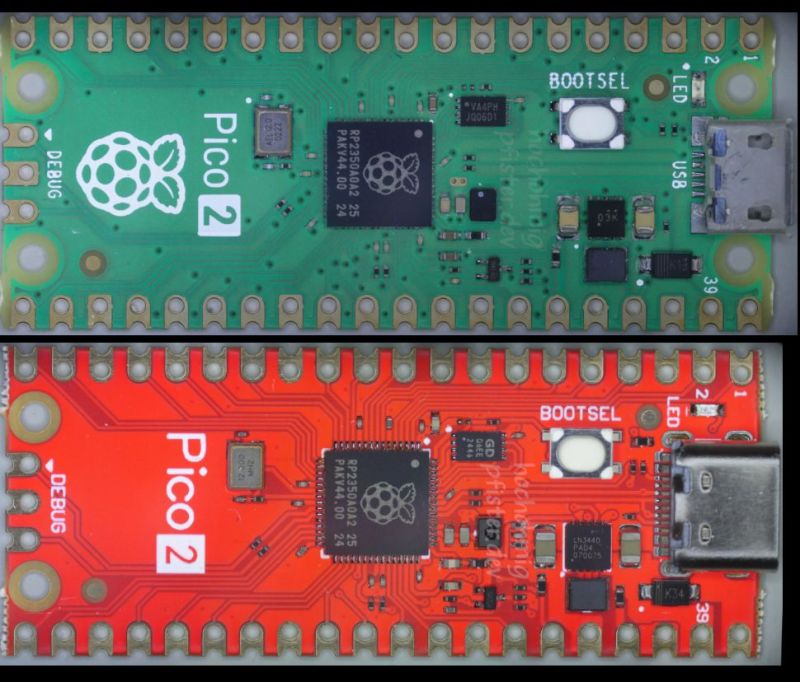
Although [Thomas] really likes the Raspberry Pi Pico 2 and the RP2350 MCU, he absolutely, totally, really doesn’t like the micro-USB connector on it. Hence he jumped on the opportunity to source a Pico 2 clone board with the same MCU but with a USB-C connector from AliExpress. After receiving the new board, he set about comparing the two to see whether the clone board was worth it after all. In the accompanying video you can get even more details on why you should avoid this particular clone board.
In the video the respective components of both boards are analyzed and compared to see how they stack up. The worst issues with the clone Pico 2 board are an improper USB trace impedance at 130 Ω with also a cut ground plane below it that won’t do signal integrity any favors.
There is also an issue with the buck converter routing for the RP2350 with an unconnected pin (VREG_FB) despite the recommended layout in the RP2350 datasheet. Power supply issues continue with the used LN3440 DC-DC converter which can source 800 mA instead of the 1A of the Pico 2 version and performed rather poorly during load tests, with one board dying at 800 mA load.











I’ve been using the Adafruit RP2350 (with the 8MB PSRAM), excellent board AND comes with the USB-C.
Same here, I’ve been happy with the Adafruit version. Pimoroni also has some nice options.
I like the Adafruit Metro, Cytron Motion, and Fruit Jam RP2350 boards as well. The Fruit Jam is what I’ve been working with lately. When I go east to visit grand kids , I usually bring a Pimoroni Tiny board (and one of my laptops) along for the ride to play with when I have down time… Although I might bring one of my Fruit Jams along this time…
As the micro connector is just weird to put on in 2026, I generally get the Waveshare boards instead. Never had issues with those, but not an expert.
No love for mini USB? I miss mini USB.. It reminds me of Firewire 800 connector a little bit, which was professional.
No idea why micro USB got so popular. The only good thing was micro USB 3.0 with that extra connector.
Because it visually made it very clear if a device made use of USB 3. :)
the mini had the (theoretical?)problem that it wasn’t rated for very many insertions and the main wear was on the socket not the plug so you couldn’t just replace the cable more often
Oh, I agree with you there. As a connector, I like mini over micro as well. It just feels sturdy compared to micro.
But C has the big advantage of one cable to rule them all, which is why I highly prefer C style boards now. No longer need to search for a (working) micro or mini cable. As I generally have one or two C cables within reach for charging or other purposes.
are any of thing really big issues? USB is only FS so impedance isn’t that critical. For the supply, can it ever use anything close to 800mA?
The power supply section on the original Picos is remarkably robust. We ran them down to ~1.8 V, and pulled easily 500 mA from them, probably more, with the SAO badge that we did.
Haven’t tested the Pico2, so can’t comment. But if I were designing a stepup/down switching supply for a small microcontroller dev board, I’d do whatever RPi did on that one.
0.5A should not be the issue even for clone. Ok it is little hotter, but it can handle it.
The USB will work fine. Full speed doesn’t care about an impedance mismatch that’s that short. The split in the ground plane is not good for RFI though.
I would be much more worried about the 1.1V power supply issue. That’s what powers the CPU. If it becomes unstable, there will probably be glitches or lockups.
I don’t understand people whose biggest complaint of something is that it has micro USB. Is it important? If there’s nothing else wrong with it then it’s perfect… And this article proves that choosing a suspicious cheap clone device just because it has USB-C makes no sense at all.
Everything is perfect if you discount the issues that it has…
If you want a Pico 2 clone with USB-C I’d say buy the Pimoroni Pico Plus 2 (or Pico Plus 2W if you want the CYW43439 wireless chip) ─ 16 MiB of QSPI flash, 8 MiB of QSPI PSRAM, and a breakout connector for many of the extra GPIO’s of the RP2350B relative to the RP2350A, while being directly compatible with either the Pico 2 or Pico 2W. I’d say the only reason not to buy it is if you are planning on soldering it flat onto another board with the castellations, as it has components on the bottom. (Yes, it does cost a bit more, but it is worth the money.)
i’m not sure these problems with the clone are really a big deal or not. but it just serves to reinforce why i love the rp2040 / pico line so well…there’s no reason to go for a cheapo clone when the officially-supported board from the most reputable vendor is only $4! never buying a ‘color-pill’ sort of stm32 product again.
it helps that i don’t care if it’s micro usb or usb-c. i have a giant pile of both kinds of cable. it’s not like i’m gonna have a pico taking up one of the precious spots on my livingroom charging octopus.
How convenient, that the good one is GREEN and the bad one is RED
Why are Raspberry Pi making products coloured like unripe raspberries?
I surmise they must be Gooseberry colored.
I’ve never had a problem with a micro-USB power connector on the RPI Pico boards. Have a ‘bunch’ of cables/power walwarts over the years so that is not an issue (as above a “pile of both kinds”). I really don’t see the ‘inconvenience’ . Nothing wrong with USB-C either of course. Have a bunch of those cables too. Both cables are ‘easy’ to find at on-line stores. So not a ‘lack’ of supply either.
I still don’t see the reasoning of buying from ali…. when you can buy the original, or Pimoroni, or Adafruit for RP2040 and RP2350 based boards. You have a bunch of quality choices in all difference form factors.
Oh, and Sparkfun has RP2040 and RP2350 based boards as well.
I have never had any issues with boards from weact studio on AliExpress. They do a rp2350b board with usb C and 16 MB of external flash and an extra footprint for more flash or psram. They have their board designs and schematics on GitHub too.
First look at PCB before watching video – ground pours with no via stitching = mini antennas everywhere.
and after watching – it does have stitching, cant see it without zooming in due to soldermask. Its $3.5 vs $5. Impedance would matter for USB 2.0 but rp only does 1.1, power only maters if your whole project uses piso as source, imo differences are meh, good enough for $1.5 discount.
In the US, the clone is actually more expensive than the genuine Pi Pico 2.
I don’t get what the obsession is with USB C connectors. The Pi Pico doesn’t do anything that requires one. It’s not worth buying a poorly designed clone just to get a different connector. The clone may also use an RP2350 with the original A2 stepping which has the GPIO glitch and some security vulnerabilities.
They could have at least added a reset button to the clone. That’s the missing feature that annoys me the most about the Picos.
I got some different clone boards recently and they had similar power problems. Broke down and ordered the genuine article to finish my project.