
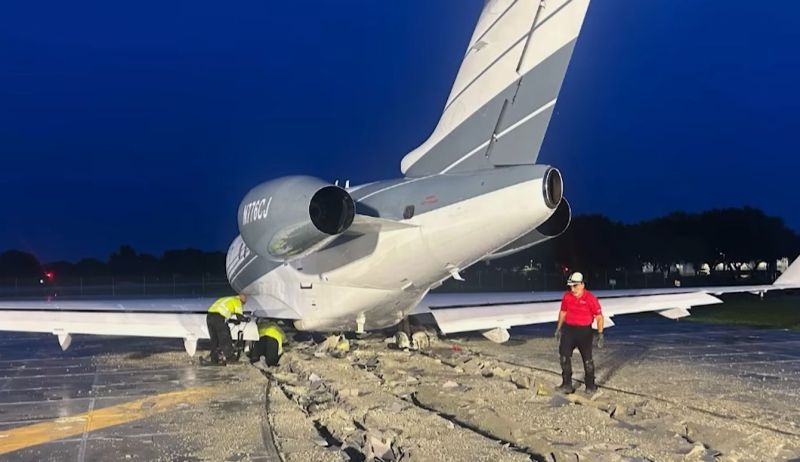
Airport runways seem pretty simple, just another strip of asphalt or concrete not unlike the roads that our cars drive upon every day. We can even use these same highways as landing strips in a pinch, so you’d assume that the engineering for either isn’t that dissimilar. Of course, you can use a highway for an occasional emergency, but a runway that sees the largest and heaviest airplanes taxi, take off and land on a constant basis is a whole other challenge, as detailed in a recent [Practical Engineering] video and its transcript.
When you consider that an Airbus A380 the take-off weight is up to 550 ton, it’s quite clear what the challenge is for larger airports. Another major issue is that of friction, or lack thereof, as the speeds and kinetic energy behind it are so much higher. One only has to look at not only runway overruns but also when one skids off sideways due issues like hydroplaning and uneven friction. Keeping the surface of a runway as high-friction as possible and intact after hundreds of take-offs, tail-strikes and other events is no small feat.
Of course, the other part of runway engineering is for when things do go wrong and an airplane enters the runway safety areas, or overrun zones. This usually provides some flat and clear space where an airplane can safely bleed off its kinetic energy, with the collapsing surface of the EMAS technology being one of the best demonstrations of how this can be safely and dramatically shortened.
Another aspect not covered here that is part of these overrun zones are frangible structures, such as any localizer antennae of ILS, lighting, etc. Frangible here means that the structure easily collapses when a heavy airplane crashes into it without causing significant damage to the airplane.
It was the failure of such a design process that doomed the crew and passengers of Jeju Air Flight 2216 in December of 2024, when the airplane during an emergency belly landing skidded over the end of the runway. Although there was a lot of open space after the ILS localizer array with just a flimsy wall and further level fields, the ILS array’s base contained a poured concrete base on which the airplane effectively pulverized.












The EMASS setup at the end of some runways offer some support for planes that are near the end of the runway. My local airport (KCRW) is on top of a mountain…yes, mountain. You have two runways, one at 50 degrees and the other at 210. We get the ocassional “touchbacks” from many of the Air Force One planes as a precautionary.
Oh, one thing about the mountain, if you can’t stop by the time you hit the EMASS area, you will have one of those moments where a bird would land on the tip of the nose and you’d go down the mountain. They say that flying is great…the takeoffs are easy…it’s the landings that make the passenger cabin clap when you land…or at least back in my day. ;)
Landing an A380 on a highway wouldn’t work well. Reasonably certain the highway would fail and become unuseable from exceeding the design standards. Not to also mention, the plane is probably permanently landed there
“Naechste halt, Frankfurt Flughafen” Lived in nearby Ruesselsheim, worked in Raunheim in the 90s for 4 years.
Responded to wrong post, sorry
I had the “pleasure” of numerous trips through Frankfurt airport (FRA) a couple of decades ago, and had the opportunity to observe parts of the runway resurfacing operations that took place then. They would pipeline a whole bunch of operations ready to go when the runway shut down for a few hours at night, and work on just a short patch (maybe 20 meters) of runway. They strip the old surface off, remediate the bed, re-pave, and match the edge of the existing runway, and have the runway ready to accept planes again, all in a few hours. And repeat the following night for the next 20 meters… and the next… a finely tuned operation.
Several times I came in on the first landing in the morning. We were never delayed due to the construction, but it was odd thinking that we were testing that patch of runway for the very first time.
And on the flights out at night you could see the line of construction equipment queued up waiting to get access to the runway once it shut down for the night.
heh my runway repair story is the opposite
small municipal airport, they closed the main runway for a whole month. I think it was more than resurfacing, i think they wanted to deal with some terrain / sinkhole sort of issues as well. One of the days where the surface was still intact but everything was closed, they invited the public for “runway day”. I got to ride my bicycle down the centerline with my arms out to the side making bbbrbr noises with my lips and pretending to take off
Call Joe Patroni.
Airports in general are not simple to build and/or operate, and runway/runways is sure the most important part, but there is a good reason why it took almost 100+ years to perfect the art.
It wasn’t really the Boeing 747 that forced worldwide airports to face jumbo airplane with jumbo requirements (and most turned out to be not good enough for the new size/weight), it was the overall inertia of the industries providing the logistics that resulted in many older airports barely compatible, and many simply run out of expansion space available. (not to mention that the overhaul of the airports had to be done with a LOT of government support, it was a truly massive effort done on a global scale).
As a side note, certain places have zero expansion left – they were originally built that way during the era when average civil airplane was no larger than the modern-day narrow body regional kind, and they were already pushing the envelope of what can be reliably done (leveling the area, etc). If you want to know more, google for the pilots’ pre-flight briefing and look for the Approach Plates – you’ll see that a lot of formerly mid-sized old airports (now upgraded to accept newer/larger airplanes) are barely large enough to accept anything larger than narrow-bodies.
As another note, the wind/weather pattern at some places are so complicated, there are plenty of stories how those change for worse right before the approach. There is official data, and then there are real stories told by pilots and flight control, this is were the two can go separate ways, while one would be taking all the resources protecting the legacy/reputation, the other one has to face the reality on its own.
Reality, as well-known, doesn’t have a pressing need to comply with the reputations nor it cares about the models based on perfect/naive bell shaped curve of distribution of favorable events with short tails.
re wind/weather patterns… my father (a former pilot and air traffic controller) used to say this about O’Hare International in Chicago — “8 runways and none of them into the wind”.
It looks like the fatal crash landing of Jeju 2216 would have been nonfatal if the landing had been on the nearby water. Not my area of expertise; just a guess.