
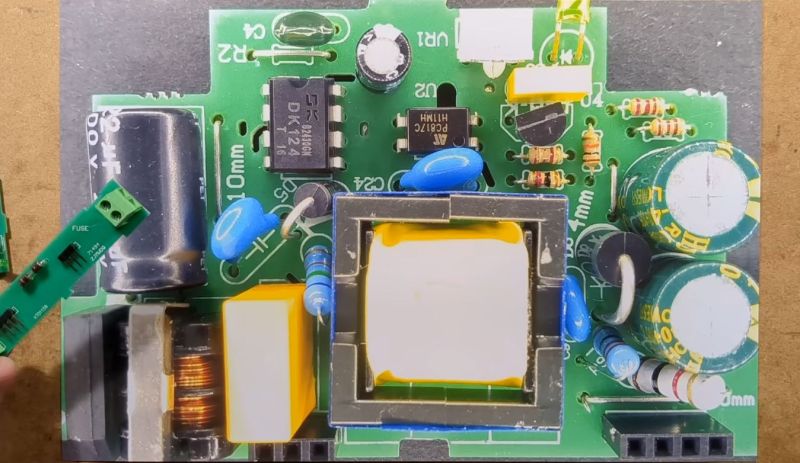
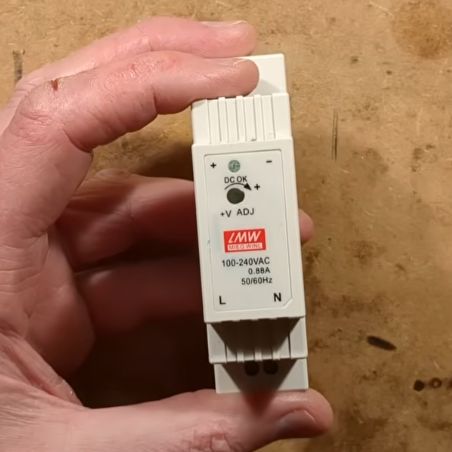
These days, you can get fakes, bootlegs, and similar for just about anything. While a fake handbag isn’t such a big deal, in the case of a DIN-rail power supply, you’d better make sure that you got the real deal. Case in point, the fake ‘Mean Well’ DIN-rail PSU that [Big Clive] got his mitts on for a detailed analysis and teardown.
Even without taking a PSU apart there are often clear clues that you might be dealing with a fake, starting with the logo and the rest of the markings. Here it’s clear that the logo is designed to only appear to be the MW one at a quick glance, with the rest of the label being poorly copied English gibberish containing copious “unnecessary” double “quotes”.
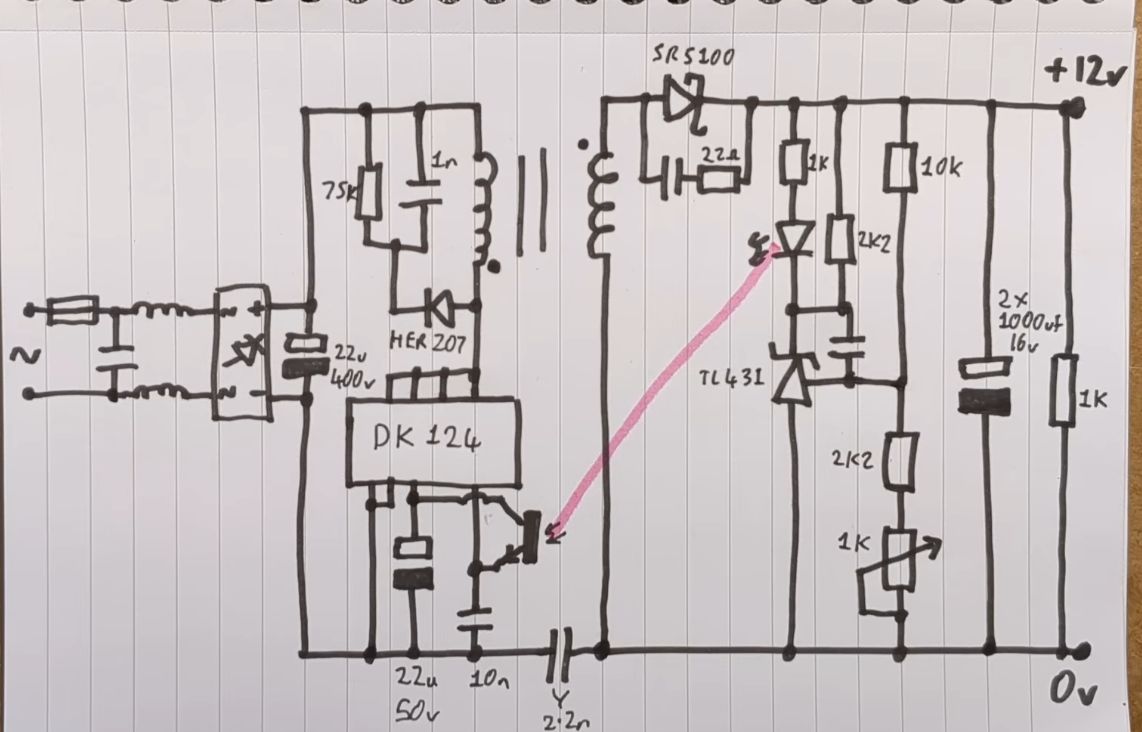
So what do you get for £3-5 in this +12VDC, 1.25A rated PSU? Shockingly, the insides are actually quite decent and probably close to the genuine MW, with basic noise filtering, proper isolation, and apparently a real class-Y safety capacitor. Similarly, the chosen DK124 control IC is more than capable of the task, with a good circuit for the adjustable voltage control.
This is possibly one of those cases where an off-the-shelf industrial design was stuffed into a case that tries to hitch a ride on the brand recognition of Mean Well rather than some national brand name. It’ll be interesting to see how close this circuitry is to the genuine MW PSU. We’ll find out once [Clive] gets the real deal in for a teardown. Perhaps it’s actually a solid clone of an older MW unit?












The DIN Rail exist outside of Germany? I am surprised.
The difference in low and high quality of this, is often the quality of the capacitors and that a manufacuter use a bigger one that is realy necessary. I mean this kind of power supply are working 24/7. Would you like to replace it every two year or every 20year. :)
They exist in all the world…
DIN rail exists everywhere. I’ve been on tons of ships from Russia to the US and anything in between, on backhoes made in the US, Taiwan, etc, on cranes made in China, Taiwan, Japan etc. For a previous job I’ve been in factories in China. You can find DIN rails everywhere. Every electrical closet of machinery has DIN rails. The computers I buy for work (mostly embedded) all come with DIN rail mounts. Even the faster devices with high speed CPU’s I buy have DIN rail mounts included.
We use DIN rails a lot in the UK and all over Europe. They are a great idea!
It’s a shame they put a fake name on it. It looks to be good quality in general. The caps may be the weak point, but if they branded it properly I’d be willing to take a look.
I work for an industrial automation company in the USA. All the panels we design, as well as almost everything in the factories, mount components of appropriate size on DIN rails.
DIN Rail commonly used in commercial/industrial/residential power distribution boxes in the EU.
And indeed, DIN rails are not commonly used in US power distribution boxes, but rather just in separate boxes for electrical control systems.
I built industrial automation machines in Detroit back in the ’70s. All the panels were DIN rails, and we repaired old machines built through the 1960s that used mostly DIN rail.
And yet, the fake handbags seem to get all the attention.
Where fake is dubious, considering the handbags that are “shameless copies” which are sold at a reasonable cost and profit, the ones that are considered “original” have ridiculous prices compared to what they really are, “a handbag”. So in essence the real value of the “original” product is the thing that’s mostly fake.
Think that handbag analogy might just fall down – look like a ridiculous price absolutely certain when you are used to the cheap stuff, but if it really is made of the quality materials and put together by real craftsmen for quality not quickest production time while looking close enough (which at least some of these ‘premium’ products are)…
Yes I could get decent materials and try to make some of these designer things vastly cheaper, but not being the master leather worker its probably not going to look nearly as good as even the cheap knockoffs, though will last vastly longer as unlike them with the faux plastic leather it won’t disintegrate inside of a year or two. And vastly cheaper though it will be that margin shrinks a great deal if it isn’t eliminated entirely if I put any value on my time – not being expert its going to take me vastly longer.
When for the real ones you are talking a day or maybe more of expert labour, and probably a day of apprentice labour preparing the easier bits, plus the premium and real material that £1000 bag doesn’t seem so crazy – its a few hundred of ‘raw’ materials (at least if you try to buy your own, maybe as larger volume customers they can get it a bit cheaper and have less wastage), probably not much different to that in labour costs, then you have the day to day workshop and inventory/distribution costs on top. Once you look at it that way you are talking £800 ballpark in basic costs, build in that margin even if its not meant to be pure profit but just to cover the next big machine repair/replacement cost etc…
Really it is mostly our perception of value has been so twisted by labour cost differences and the cheap low quality throw away knockoff.
I’m sorry to disappoint you, but these expensive designer handbags are made in the same sweatshops as the cheaper versions. The only difference is the profit, which goes directly to the shareholders. There’s no better “craftsmanship” involved here, just more expensive marketing.
See this article: “‘Made in Italy’: is the label just another luxury fashion illusion?
Investigations reveal how cashmere jackets and €2,000 handbags may be stitched in workshops paying €4 an hour, challenging luxury’s ethical image”
https://www.theguardian.com/fashion/2025/jul/24/made-in-italy-is-the-label-just-another-luxury-fashion-illusion
Wow that is a new low. Just for giggles, who do we report these fakes to?
Depends on your location. For the US it’s Aliexpress, the FTC and CBP. Not that they’ll do anything
They might. I once reported a “made in the USA” product that clearly wasn’t to the FTC via email. To my surprise they fined the company a lot of money and changed the labeling and company website advertising the product.
Even lower would be the fake Allen Bradley powers supplies we bought through a non-authorized distributor that looked just like the real thing until you checked the label information against the AB database.
I worked on a dangerous industrial process and the reputable major PLC manufacturer told us that until a product was registered with them online, it should never be connected and should be considered as fake. I know their serial number system used the date of manufacture, model number, and some cryptography to ensure fakes could not be easily generated. It also ensured that they knew where their components were being used in the event of a recall or safety bulletin. In the nuclear industry they report each and every component failure to the NRC and the component manufacturer. That allows them to track the MTBF in the real world and set up replacement schedules. It also informs the design of new plants so they know what things are problematic and which are trustworthy. Those kind of controls is why they cost more. Its the old story of the Air Force zillion dollar coffee maker….the whole story is that it was going in a zillion dollar nuclear bomber amd had to be certified safe for that use.
It’s not a fake, it has a different name and different construction.
The logo might look similar but there are endless logos that are just slanted letters on a colored background.
However I’m sure there is a Karen support group on Facebook i you feel stressed.
Well their CE and ISO9001 statuses are certainly fake.
Yes and that is the major problem. When a PLC fails in an industrial process, lives and property could be at a serious risk and the company using the fake could be on the hook for it. The truth is you have to use suppliers that are trusted and even then you have to be careful. There have been fake parts found in commercial aircraft. These video that tell you that the fake product is “pretty good” are encouraging this kind of stuff. If that stuff is good than market it under a real company brand and supply chain. A company that deceptively names a brand is not to be trusted.
Mean Well sometimes manages to make duds themselves. We had a batch of PSUs which required disassembly and milling off part of input power connector as the covers were incorrectly designed and were bending the PCBs inside, causing SMD parts to fail over time.
However, there’s one part missing – large value discharging resistor between primary and secondary. If you apply repeatedly ESD several times without discharging the injected charge between the events, it will only survive a few of the events before the PC817 reaches breakdown voltage, flashes over, the photodiode dies and then the supply happily supplies 0 V on output as it thinks it has reached the set voltage. And yes, this happens in real world. And you can never know if it will serve 30+ years without happening or die during installation.
The dielectric withstand for the PC817 is 5kV, so other stuff would fail before the opto-iso. Also, assuming test method per IEC61000-4-2, there is not enough energy to cause this failure mode as the Y-cap will bleed/equalize charge, mostly because the peak discharge current lasts for < 100nSec.
Assuming a level 4 contact test voltage of 8kV, which is seldom used for a cheap component P/S, the most likely failure would be the TL431 for the secondary side, where the test point would be the output terminals. If the TL431 fails short, then the PC817 could see Vce greater than the rated max of 80V, but that would be the root cause failure.
FWIW, I have tested PC817 optos to extermination with mininal input Z. Typical flash-over occurs at 7kV to 11kV depending on ambient conditions, not through the IC, but across the pins because of the body creepage and pin clearance.
There’s only the transformer, optocoupler and capacitor.
If the capacitor is Y1, then it can handle 8 kV for limited amount of time (or even more). The transformer may be well above this, I had trouble causing anything beyond corona discharge even on much smaller transformers.
As for the optocoupler, I was able to make 60W Meanwell series produced PSUs fail reliably when tested per IEC61000-4-2 class 4 for air discharge on plastic covered device. The plastic covers had a gap under which in a distance was a metal secondary ground and a spark was able to jump over. This way, it would get partially charged by the 15 kV jumping through air, then the spot was brushed with a conductive comb and experiment repeated. The comb could not discharge the charge on the pri-sec capacitor as it could not reach into the gap and the injected pri-sec voltage was not large enough to jump back to the brush. Rinse and repeat, after several events, the device went offline as the optocoupler got destroyed. The mode of failure was always optocoupler going short. It could be resolved by a ~200 MOhm resistor on pri-sec or by improving the plastic covers.
You may be theoretically correct, but we had the devices die during certification, during my experiments to figure out what was wrong and a few times at customer, so it was independently tested by multiple people. Also, it’s not uncommon to encounter 20+ kV ESDs in real world scenarios.
https://ieeexplore.ieee.org/document/239607
Yes, the insidious thing is when the part does not die outright but degrades a bit each time an event happens. A key to industrial components is to always fail to a safe condition or be able to detect a failure and shutdown in an orderly manner. Industrial I/O devices are sold in models specifically to fail on or off depending a what the safe condition is. Often it is also a requirement to have out of band status reporting to tell a software system that a failure has happened. At the company I worked at the software control had to have a handler for every single conponent failure to initiate the appropriate action.
Damn.. mean well is already pretty damn inexpensive . Amazing they would bother counter fitting the cheap stuff.
In quantities of thousands, every buck you shave sometimes equals your annual paycheck
Importantly, the fake most assuredly did not have to go through the expensive safety certification processes that the real one did. That manufacturer saved a lot of money right there. If your company is using fake part purposely to save a couple bucks, you are going to be sued out of existence when a plant burns down someday. Sure, the real part could fail too but using a fake part will immediately make you the scapegoat for the insurance companies.
A power supply is a commodity because the design is dictated by the semiconductors and magnetics. Quality is dictated by the use of industrial grade components instead of cheaper commercial ones and by manufacturing details like a conformal coating. That said, the difference in price shouldn’t be significant — I know its really nice to sell things at a huge markup but that windfall can’t be guaranteed for ever, you will attract competitors sooner or later.
There is a reason that good industrial products are expensive. I worked on a system for a material manufacturing plant. It involved very explosive chemicals and a touchy process with lots of safety concerns. The entire system was designed and programmed and then the PLC component manufacturer had to sign off to regulators that the system was safe to run using those components. Those documents also stated that the certification was null and void if the system was modified using any unapproved component. There is also a pretty strict registration system in case a part needs to be recalled or a repair bulletin needs to be sent out. Now, reputable plants won’t purposely buy these but the mislabeling could cause them to leak into the supply chain be accident or by a shady substitution. It has happened in nuclear plants and aircraft industry. Sure, its good enough for us experimenters but would you feel good about it leaking into your local refinery, nuclear plant, or defense contractor? If you want to buy cheap brand components for non safety use I have no problem with that but using another companies labels and certification should never be supported.