
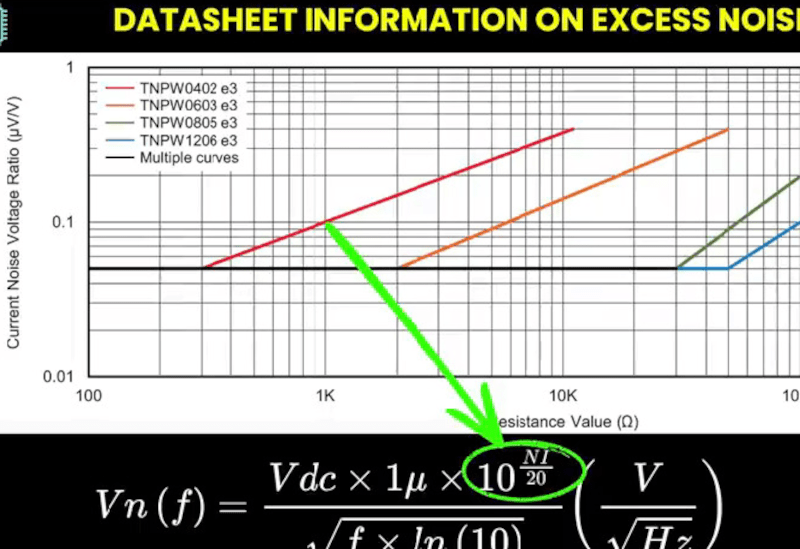
[Hans Rosenberg] has a new video talking about a nasty side effect of using resistors: noise. If you watch the video below, you’ll learn that there are two sources of resistor noise: Johnson noise, which doesn’t depend on the construction of the resistor, and 1/f noise, which does vary depending on the material and construction of the resistor.
In simple terms, some resistors use materials that cause electron flow to take different paths through the resistor. That means that different parts of the signal experience slightly different resistance values. In simple applications, it won’t matter much, but in places where noise is an important factor, the 1/f or excess noise contributes more to errors than the Johnson noise at low frequencies.
[Hans] doesn’t just talk the math. He also built a simple test rig that lets him measure the 1/f noise with some limitations. While you might pretend that all resistors are the same, the test shows that thick film resistors produce much more noise than other types.
The video shows some rule-of-thumb lists indicating which resistors have better noise figures than others. Of course, resistors are only one source of noise in circuits. But they are so common that it is easy to forget they aren’t as perfect as we pretend in our schematics.
Want to learn more about noise? We can help. On the other hand, noise isn’t always a bad thing.












One sentence starting with “Noise is” would have killed you?
Noise annoys.
It would’ve killed anyone who knows what common common electronics words mean (or how to use google)
Guess he doesn’t possess the truth. 😉
It could kill comment section to with precising what noise really is while in context of this article it’s clear.
For example @socksbot below wrote:
“Noise” is whatever signal you don’t want.
So next guy could clarify “yeah but sometimes we add noise purposefully like dither…” and I am sure someone can clarify even this comment.
“Noise” is whatever signal you don’t want. Like “weed”. Some noise is caught from the environment, some others types are generated by your device. The article is talking about the latter.
Would it kill you to google the Five W’s? This neglect is not unique to this author, it seems to be HaD style manual.
According to Google “Noise is defined as any unwanted, unpleasant, or harmful sound that disrupts daily life, typically originating from industrial, transportation, or residential sources.” Readers here are expected to know some term starting with “gr-” I think from KiCad, i2c, the list goes on. This is freshman remedial English. “Tell them what you’re going to tell them, then tell them, then tell them what you told them you were going to tell them.”
It’s what helpful people do.
So for optimal noise generation (where you actually want maximum noise to ultimately generate random numbers) would a thick film resistor be better or worse than a solid carbon rod resistor ?
Give a use case. What you really want to avoid is drift and deterioration in most cases. If you truly want random noise. Look into diodes.
I’ve heard good things about using gunn diodes as a source of wide band noise.
The use case would be generating reasonably quality random numbers at a rate of multiple terabytes per day (e.g. ~11.9MiB/second to ~119MiB/second would be useful for 100Mbit/second to 1000Mbit/second) for an extra layer of security transferring for already encrypted data traveling across networks that are close enough to use old school one time pad (post quantum secure) physically transported securely between two sites. It is still at the initial concept stage.
The initial idea was to heat a long extremely high resistance carbon rod to extreme high temperatures to maximize Johnson–Nyquist noise.
K.I.S.S.
Who knows? The article starts with that it is material independent and then goes on about various materials.
Depends. What colour would you like your noise?
You’d probably want to choose something better, like a Zener.
I think there is some decent information in this video, but I find it very difficult to comprehend. By cutting out all the breathing pauses the video turns into a wall of noise for me. I know I’m not always the quickest person. My brain needs a bit of time to catalog and comprehend incoming data, and that is lost by cutting out the breathing pauses.
And I guess I’m not the only one with that opinion.
I do appreciate condensing the material, but I agree all the jump cuts do get a bit tiring and require extra concentration that shouldn’t be necessary.
Back To audiophile “i cAn heAr 30cm difference in cable length”
Read the reviews:
AudioQuest 0.75 m Cinnamon USB-A > B High-Definition Audio Cable – $129.95
https://www.amazon.com/AudioQuest-Cinnamon-USB-Cable-Meters/dp/B0041E5F5G
Grok 3 AI:
May 1973 Stereo Review article “The Great Distortion Delusion” by Robert Carver:
The tests primarily used a modified Phase Linear 400 amplifier capable of introducing controlled amounts of notch (crossover-type) distortion, which is a harsh, odd-order form that produces significant IMD products alongside harmonic distortion. They played various program material and added distortion incrementally while the listeners (the golden ears themselves) tried to detect it.
Simpler test tones revealed lower detection thresholds (e.g., “just barely” audible at ~0.15% on a 60Hz tone alone).
With more complex two-tone mixes (e.g., 60Hz + 7kHz), distortion became obvious around 2.5%.
Adding a third tone (60Hz + 3kHz + 7kHz) pushed the audible threshold to ~4%.
On real music like solo voice, it took ~6% distortion to notice.
On percussion, thresholds reached ~12% before any effect was perceived.
With full orchestral material, distortion was essentially inaudible even at very high levels (the ear masked it effectively due to complexity).
But be sure to buy that $2,789.99 line voltage (“mains’) power conditioner for your high end audio gear that for some reason doesn’t have adequate power supply filtering.
In a blind test, audiophiles couldn’t tell the difference between audio signals sent through copper wire, a banana, or wet mud
February 14, 2026
https://www.tomshardware.com/speakers/in-a-blind-test-audiophiles-couldnt-tell-the-difference-between-audio-signals-sent-through-copper-wire-a-banana-or-wet-mud-the-mud-should-sound-perfectly-awful-but-it-doesnt-notes-the-experiment-creator
As we can see in the image above, there are only six correct answers out of 43 guesses. We put these numbers in a spreadsheet, which showed that only 13.95% of the answers were correct. Furthermore, we used the binomial distribution formula and determined there’s a 6.12% chance that we’d get the same or fewer correct answers if the listeners were randomly guessing — slightly above the 5% significance threshold many statisticians use, meaning the results are consistent with randomness. This goes in line with Pano’s conclusion that “listeners can’t reliably pick out the original from the looped versions,” suggesting that they cannot detect any changes introduced by the loop — whether it’s pro-grade copper wire or wet mud from somebody’s backyard.
Interesting. Notch distortion is going to be rich in high harmonics. That makes 7 kHz a poor choice because the 3rd harmonic is 21 kHz, already inaudible for most people. I would have been interested in knowing if clipping distortion produced different results.
Julian Hirsch, one of the test listeners, was over 50 years old when the experiment was performed.
Stereophile magazine published a sneering criticism of the Stereo Review article.
I suspect that the Stereo Review test was insufficiently careful and should have included more critically trained listeners. On the other hand, Stereophile is notorious for not performing tests that provide numerical results.