
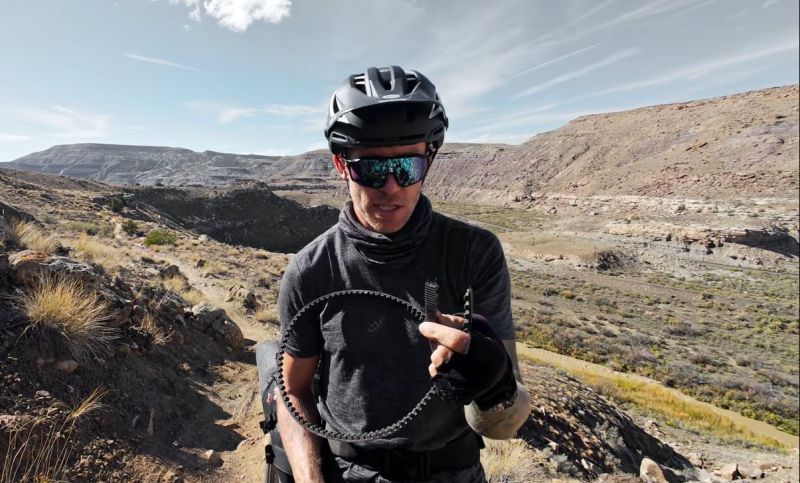
Theoretically a belt drive makes for a great upgrade to a bicycle, as it replaces the heavier, noisy and relatively maintenance-heavy roller chain with a zero-maintenance, whisper-quiet and extremely reliable belt that’s rated at an amazing 20-30,000 km before needing a replacement. Of course, that’s the glossy marketing brochure version of reality, which differed significantly from what [Tristan Ridley] experienced whilst cycling around the globe.
Although initially he was rather happy with his bike, its sealed car-like Pinion gearbox and Gates carbon belt drive system, while out in the wilds of Utah he had a breakdown when the belt snapped. When the spare belt that he had carried with him for the past months also snapped minutes later after fitting it on, it made him decide to switch back to the traditional bush roller chain.
Despite this type of chain drive tracing its roots all the way back to Leonardo da Vinci, they actually offer many advantages over the fancy carbon-fiber-reinforced polyurethane belt. Although with the Pinion gearbox the inability to use a derailleur gearing system is no big deal, [Tristan] found that the ‘zero maintenance’ part of the belt was not true for less hospitable roads
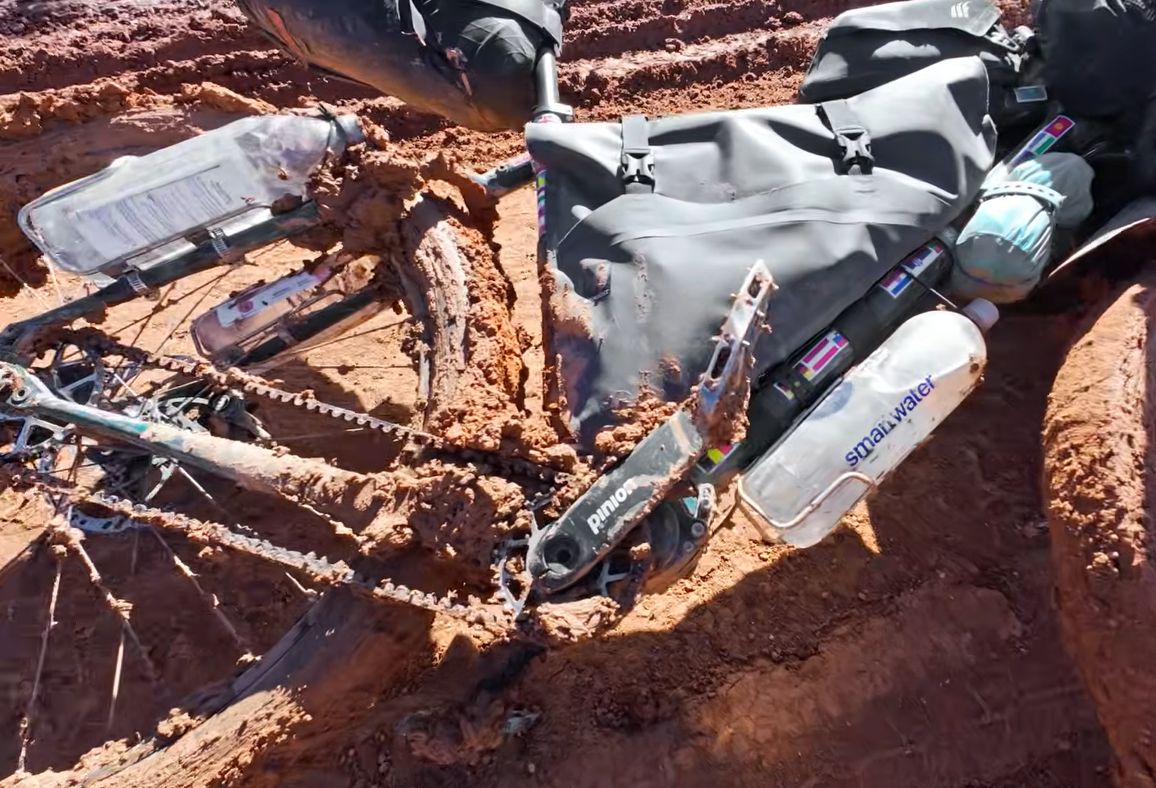
A big issue was that of abrasive dust, which created a very noisy coating on the belt that’d have to be regularly cleaned off with precious water, or by having silicone lubricant sprayed on the belt. Even with all that care he found that the belt would snap after about 8,000 km, well below the rated endurance.
When it came to super-sticky mud, called peanut butter mud for good reasons, he found that chains also cope much better with this, as the mud will just squeeze out of the chain and be forced off the sprocket, whereas the belt will happily keep compacting the mud onto the contact surfaces, increasing belt tension and requiring constant cleaning to not become hopelessly stuck.
The Utah breakdown also showed why these belts are actually very fragile: the replacement belt had been packed away folded-up for a few months at that point in the luggage, and during storage the carbon fibers had become compromised to the point where the belt just snapped after a few minutes of use. A metal chain will happily be stored away for as long as you can keep it away from corrosion, and fold up very compactly.
Another awesome feature of roller chains is that they’re super-modular, allowing you to carry spare links and such with you for in-the-field repairs, while even the most remote bicycle store in any country can help you out with maintenance and repairs, unlike the special and highly custom belts that need to be shipped in by courier.
Of all the bicycle technologies that [Tristan] has used, it seems that only this drive belt has been an outright disappointment. The sealed gearbox would seem to be a massive improvement over finicky derailleurs, and hydraulic brakes are reliable and common enough that they haven’t been an issue so far.
His conclusion is that bicycle drive belts are fine if you do city driving, where they probably will last the rated kilometers, but they rapidly fall apart in even slightly adverse conditions.











As always, simple technology is better than fancy one.
I’m not quite sure if i agree here, as I’m having great difficulty replying to your comment on my trusty typewriter.
I’m looking at my muddy bike right now after my first springtime ride. Serious bikers need serious equipment. You can make Luddite jokes all day sitting at home by your trusty typewriter. The rest of us will be out enjoying the changing seasons.
Indeed no one ever enjoyed the changing seasons before the advent of overpriced specialty hardware made for wealthy enthusiasts.
The old school chain is user repairable as is nearly every part on an old-school bicycle. As in, if it snaps you can fix it on the road. This is in in sharp contrast to goofy, overpriced stuff like belt drives which will continue to come and go as long as people with more money than experience exist, while sports professionals and people who value repairability and reliability will continue to use the stuff that’s worked for years.
That’s because you’re trying to use your typewriter to communicate across great distance. If your aim is to put legible writing on paper quickly and consistently, your typewriter is solving a different problem quite well.
It doesn’t solve it quickly and consistently. When I try to use my Remington typewriter the hammers keep hitting each other when I try to type at speed. I really have to go very very slowly to make sure it’s working right.
If you ever looked at a bicycle-chain then you would not call the chain simple compared to a belt.
And if you ever tried to make a toothed belt, you’d have the opposite experience.
My grandad’s tractor says belts don’t need to be toothed.
your grandads tractor also turns at a much higher right with a lot more power than a human pedaling a bike. Smooth belts are great at high speeds with high tension. They are NOT at all ideal for low speed low torque scenarios like pedaling a bike, for that you want a toothed belt
they do for these belt drive systems though. Smooth belts either slip under the high-torque low speed scenarios common in bicycle drivetrains or are at such tensions that the bicycle is not ride-able.
There are ones that are open on one side you know.
Plus there are closed ones that you can remove without any tools.
Combine the concepts et voilà.
FFS GDMN HaD FIX THE FCKNG RPLY system
deep breath
In this case and as a rule I’d call belts simpler than chain technologically – belts can be built of multiple parts if needed, stitched together etc but are often single part, as a rule belts will run on anything even if its only slightly round with the belt being in almost all cases the only part that wears, and if you put things like capstans in your belt drive system… It can be just as if not more flexible to your needs.
Chains on the other hand require sprockets that exactly match the chain, each additional chain link tends to add 3 or 4 parts, for hundreds if not thousands of parts per chain all of which move in relation to their mating surfaces for wear to be issue and any single failure in any of these parts tends to break the chain’s functionality if not actually breaking the chain requiring replacements…
The one thing bicycle chains have going for them is unlike so many other things they actually are something close to a universal standard globally so the spare parts you might need should be trivial to acquire and cheap.
Not really. A chain can stretch up to 3-5% without failure although it’s best to replace it before it reaches 1%. That’s a huge amount of slop for a mechanical system.
Not really. It just makes the chain a little less efficient. You can run down a chain pretty badly before it actually breaks.
Complexity isn’t a matter of having many parts, but having complicated interrelationships and dependencies between parts. A chain is many simple parts that don’t affect one another very much. A fiber reinforced belt is interconnected: if one fiber strand becomes loose it redistributes the belt tension on its neighbors, and you get a cascade failure going.
The failure mode of the chain is in parallel with respect to its parts. The failure mode of the belt is in series, making it more sensitive to small faults and deviations.
Belts are simple technology if you just want to make something turn without great requirements over power, speed, torque, or lifespan.
When you dig deeper, it starts to get complicated and belts become something that needs exact material science and manufacturing techniques, and then maintaining exact tension and geometry, or they just don’t work. Yes, you can make a belt run on “anything even if its only slightly round”, but you won’t make it run for very long.
Depends entirely on what you’re doing. As [Tristan Ridley] states in the video, it’s entirely possible that a bike with a pinion gearbox and gates belt will serve someone using it as for example a commuter bike for decades without issue (so long as it’s serviced regularly). It’s just not the right tech for his application. It doesn’t make the simple tech better overall, just better when you’re doing thousands of miles in the back country in both wet and muddy and dry and dusty conditions with little access to service facilities.
Sounds to me like crowning the belt drive unit and likewise the belt lobes would have solved most of the problem. One has to be smart about storing things so that storage doesn’t break the part as this guy learned the hard way by pulling out a broken belt. No mention of the weight differences between carrying a backup chain vs backup belt(s).
This guy might be sold on going back to chains but an improved belt design which moves debris off the gear instead of building it up and a lightweight case for the spare belt would have got him through and this article would be completely different.
Indeed, though also have to ask the question does the relatively pathetic torque a human pedalling can create really really need a toothed belt at all – I’d not be shocked to find a simple V belt with a beefy spring loaded tensioner has enough friction to not slip and transfer the forces quite efficiently even if the gear and belt has been covered in mud at this moment, and would probably have a reasonable squeeze out self cleaning effect too.
This thin toothed belt might well be in ideal conditions meaningfully more efficient as the belt is probably significantly more flexible so takes that bit less energy to bend the belt around the pulley as it moves, which would be felt on the pedals. And being more flexible you can have a smaller pulley pitch for greater gear ratios. But for durable and low maintenance rugged do everything design I’d suggest it would be fine, and in a pinch should you have broken your belt the v belt pulleys can be pushed to work with just about anything you can turn into a belt.
V-belts are unsuitable because of the high tension difference between the pulling and the slack side on a bicycle. A chain may be completely slack on the bottom side, which won’t work for a V-belt: It needs to be in quite a high tension on both sides, otherwise it will slip.
That high tension then creates high friction, and that’s not the kind of friction you want but the kind that resists you turning the pulleys because you have to squeeze the belt in the groove and then rip it out. A V-belt on a bike would be harder to turn than a totally worn rusted out chain. It also wouldn’t last very long.
V-belt drives operate best at high RPM and low torque, hence low belt tensions, which is the complete opposite of what a bicycle does.
A grown man can generate 200 Nm of torque just by standing up on the pedal, and many times more if they actually stomp down with all their weight. That puts many motorcycle engines to shame.
The point was for a rugged go anywhere machine – in which case sacrificing a little efficiency is fine. The point is you want durable, doesn’t much care about the conditions drive and that relatively tight (though it really doesn’t need to be crazy as there is so much contact area) v-belt is likely fine even ideal for that – It will care less about crap getting in, and unlike any of the other options when it fails out in the middle of nowhere in a pinch you can run basically anything in a v-belt pulley – suitable rope, fishing line, thick strip of leather, woven scraps torn from your clothing etc. Might have to wrap the pulley a few times turning the pulley into a capstan to make up for the smaller contact area and lower tension your emergency belt can take but you can always get back on the road – a bike chain that has gotten even near the point of failure has nearly always taken the sprockets with it, you are not fixing that with anything but machined replacement parts. So while you can carry some spare chain, and maybe get back on the road stuck in the gear ratio you never ever used in those harsh abrasive muck etc conditions…
Another source of V-belt inefficiency is bending around pulleys and tensioners. It gets worse when cold.
A rugged go-anywhere machine is already sacrificing efficiency for many reasons related to the external conditions. You don’t want to compound the loss with a stiff V-belt.
But please, do try. Report back how tired you got.
Perhaps I’ll give it a go, but given the bicycle is so very very efficient by its nature you’ll still be covering ground just fine with a bicycle made to survive anything that has shed some of that crazy efficiency – its so so much better than walking which is already a really efficient way to get around…
Worst case is the gear ratio has to end up biased to moving slightly slower but taking the effort out to lessen that impact of that belt, and honestly for a go anywhere machine you’d probably bias the gears that way anyway as avoiding really long sustained and steep climbs entirely while ‘going anywhere’…
Obviously just like the mountain/trail/hybrid/folding commuter bike vs a real road racer you are at least when the conditions allow going to be putting in much more effort to match the speed or the same effort and going slower, so you’ll have to work longer to reach the same destination (at least sometimes – on roads full of traffic rules its often not worth getting up to a high speed on the road bike anyway as between the lights and other traffic you’ll still end up waiting until exactly the time for that opening to go the route you wish to as if you had cruised up to the them). But doing an effortless 5mph or high effort 25 its still going to be an efficient enough way to get around.
I’m more worried about the amount of tension you have to put on the V-belt to first make it bend around the pulleys and then stop it from slipping. It puts extra pressure on the wheel and crank bearings and then those run harder and wear out faster, so you have to add heavier bearings with heavier grade grease, and that then adds resistance, especially in the cold when the grease turns into toffee.
Indeed, but I don’t think it would be a huge problem to solve, you are certainly going to lose some efficiency as V belt are just not that flexible and will need some tensions but should get a still very useable bicycle.
Between the options of putting belts on both sides to balance the forces on the bearings, which will help them last and also reduce the tension required as you just doubled the friction area (also give you redundancy as should a belt fail the other belt can still operate the bicycle, the torque transmittable might not even drop in ideal conditions as you are limited by the person power and the belts were set up to deal with being covered in greasy crap).
Or making the pulley diameter and v belt relatively large as being so much less delicate than a chain sprocket you can run that risk of a terrain strike even, though I don’t think you’d actually need to get nearly that large. As the surface area of contact is huge – assume the tensioning device means you smallest pulley is 50% (maybe even more) in contact with the belt and using a larger belt that has say 2cm deep faces on the v side – that’s 4cm x pi x radius of belt surface area so 12r cm squared at the point most likely to slip. So even just using relatively normal sprocket sizes can easily be talking 50+ cm squared – quite an area of almost certainly rubbery grippy belt material that will be hard to make slip even before you consider the tension its under and any surface texture on the pulley it might be keying into. And given that huge area likely with more pressure between the surfaces when compared to the tiny contact patch of the tyres – no point worrying your drive belt slips at x torque if the tyre was going to slip before that most of the time.
Perhaps, but again you can try other solutions than just bigger bearing and thicker grease. For instance the pedal spacing actually gives you quite a large tube at that end, and the wheel can end up as wide as you like at the hub really. So something like a thin film or even air bearing becomes quite plausible, and those last basically forever even under huge and asymmetric loadings if you do it right – more expensive to produce, needs more care in the design and assembly, almost certainly heavier, and should one of the mating surfaces take damage somehow its going to be a real pain to repair, just complete overkill for a regular bicycle when you can pop in and out cheap mass produced bearings.
But when it is meant to be a go anywhere tank of a bicycle a little extra weight doesn’t matter any more than the extra weight for the chunkier frame, and doubtless pile of spare parts and tools you’ll want to take just in case.
Plus the special storage solution for your belt, so it doesn’t get kinked, pressed or notched.
:pulls out abacus:
One can argue the belt is simpler technology.
Mature technology that has stood the test of time is nearly always better. Its these kinds of failures that prevent me from early adopting anything. With even a pretty good number of testers logging hundreds of thousands or more of road tests you would never find this failure mode but in the right conditions it seems nearly garenteed.
Saw the title and thought “that long-distance bikepacking Youtuber who loves belt drives is gonna be so triggered by this” then I see that it’s the same guy :-O
Totally valid logic though. The belt’s usual failure mode gives no warning, is unpredictable and the only fix is a whole new belt, which is relatively hard to obtain, and a spare is difficult to store in a way that’s safe from invisible damage. And then dirt negates the belt’s maintenance advantages and causes a dirt-packing problem chains never had.
Another example of the fragility of efficiency.
Inefficient systems have a wide “failure band” between perfect function and total failure. A chain for example will be 98% efficient when perfectly clean and lubed, but quickly wears in and wears out to something a little worse. It can however remain functional in this imperfect state for a long time because deviation is allowed.
When the chain stretches, you tighten it back up and keep going. It doesn’t have to fit the gears perfectly. The total failure of the system is spread over many individual parts, and each part is given enough tolerance that its deviation does not greatly affect the functioning of the whole. As the parts wear out, the system becomes inefficient, but it keeps functioning. For example, are every single one of the little rollers in your bike chain actually turning around properly? Probably not. Does it matter? Not very much.
In theory, an efficient system should last longer, because the energy lost in an inefficient system is responsible for wearing it out in the first place. Parts grinding and rattling about eventually break, so if you can reduce that rattling you reduce wear. At least to a point: an efficient system like the belt drive gains its efficiency by narrowing the tolerances and therefore narrowing the failure band. It has no give and no room for error which makes failure a ticking time bomb.
You don’t just “tighten a chain back up”. Chainstay length on most modern bikes is fixed and required chain length is thus fixed. You can get into trouble if you have a front shifter or rear derailleur and your chain length is not correct. Shifting might be flaky, you chain might pop off – all kinds of stuff.
Also the links “have to fit the gears perfectly”. You can to some extent remove a link from a chain to shorten it, but after a couple of thousand of kilometers (much less than a belt drive) the chain is so worn out that you have to replace it anyways so the rest of you drive train does not suffer. The links wear out and they will start eating away at your more expensive and harder to replace chain ring and sprockets due to slip and friction.
A belt drive on a bike is not about efficiency, but for better longevity.
With a derailleur there’s generally a +/- 1 link tolerance where shifting is basically unaffected (might get a bit tricky on highest or lowest gear combos but generally fine for anything in the middle). Shortening 2 links is just going to take away your longest and shortest gears where the derailleur would have to tighten too much, but will be fine in lower gears. You can still move, just not as fast.
On bikes without derailleur, there will be a chain tensioner on the rear dropout to adjust the wheel position slightly and take out the slack in the chain. Just like there would be for a gates belt.
Except, if the belt were to stretch the same as chains, it would no longer fit the sprockets and that would eat up the relatively soft polymer stuff that the belt is made of. That’s the problem with belts in general – if they stretch, they wear, so you can’t put a ton of force/torque through them and expect a long life.
Which is why the gates belt is carbon fiber reinforced so it won’t stretch, as in it can’t stretch because carbon fiber has this failure mode of suddenly snapping. It’s not a plastic material like steel, so it fails catastrophically when pushed past the tensile strength limits. The solution to the problem becomes the problem.
Solutions like that are over-fitted to the problem they set out to solve. They deal with some particular side of a problem really well, but fail utterly when the system parameters change even slightly.
Which as I pointed out, is the same thing. Smoother running means it lasts longer etc. which also means better efficiency. It’s surviving on the fact that the belt system runs smoothly and everything fits together nicely and rolls along without major energy losses that would get absorbed as damage on the belt. Once that is no longer the case, the belt fails rapidly.
“A belt drive on a bike is not about efficiency, but for better longevity.”
A chain gets sick. A belt dies. You’ve just been longevitied.
What?
A bike chain is not worn out at a couple of thousand km.
It’s ready to be lubricated.
Yeah, funny that it’s that same guy. I watched couple of his travel videos. So cool.
I do agree that its easier to carry replacements / chain links and about the storage problem, but chains to not give a warning before snapping in my experience.
Chains aren’t in such a big risk of snapping until they’ve become noticeably worn, so you can more or less expect it even if you can’t predict it.
Definite bathtub reliability with chains: when they’re brand new, especially with newer ones that have pressed and peened links rather than the easy to disassemble/reassemble master links, they have a fairly high tendency to fail under heavy usage. If they last the first week, then they’ll be good out until they wear out entirely. Which is why you never do maintenance the night before a race. You want tens of kilometers of strain on everything before you need reliability.
Why does it have to be “this drive belt has been an outright disappointment” and “belts rapidly fall apart in even slightly adverse conditions” instead of “bicycle expeditionist thinks that belt drives are fantastic and produces an incredibly nuanced video about why he switched to chains due to his special use case, discussing the pros and cons of belt drives” and “bicycle expeditionist experiences belt failure after 8000 km of heavy-duty use and immediate replacement belt failure due to improper storage of carbon belt caused by ignoring well-known storage requirements” and “belt failure after a third of the rated kilometers due to usage outside of the manufacturers envisaged use conditions” and “bicyclist picks drivetrain components which are appropriate for his use case”? I’m very glad about the video and article being posted here, but I’m scratching my head why the article has to be less nuanced than the video.
if only it’s the dirt… why not a casing?
This article is an obvious attempt from the big chaîne industry to prevent us from using belts
never heared of a chain cover? the combination with this type of road and belt would be king. there is a reason dutch bikes use there all rhe time as with a regular chain drive it keeps the dust an moisture out.
Dutch biker here. Bike chain covers (we call ’em “Kettingkast”, “chain locker”) keep dust and moisture out, but also in! It is a lot harder to clean chains when they’re in a kettingkast, and impossible to put a chain back on the sprockets if thwy’ve fallen off, when you don’t have the tools with you to remove said guard.
An impromptu measure was often to kick the plastic kettingkast until it broke, because as adolescents we were not going to walk 10 km with the bike next to us.
Maintnance with a kettingkast was hell, and when a bike was stored inside, the muck became a sort of sponge that made the chain rust extra-fast.
There are ones that are open on one side you know.
Plus there are closed ones that you can remove without any tools.
Combine the concepts et voilà.
if kicking your kettingcast (nieuw woord!) is your way of getting to it, i can understand your point if view. our bikes generally use the two part, bottom top style plastic covers. and if the chain got of its sprocket, your were late with maintainance. ( yes. dutchman here too)
Yeah and how do you take that two part system off without any tools? You kick it until it breaks.
I’ve done the same thing, didn’t want to walk for 4 hours through the rain.
Another Dutchy here, riding a bicycle since I was 4.
You’re party right that the fully enclosed chain covers used on many dutch bikes does keep the dirt in too, but if it’s getting and more importantly STAYING that dirty inside, you’re not doing proper maintenance. I’ve also NEVER had problems with the chain falling off and if it’s doing that, your chain tensioners are out of adjustment allowing excess slack in the chain (which is, again, a maintenance problem).
The best chain covers ever were the very old ones. I think mostly made pre ww2. It was made of some sort of rubber stretched across steel strips and it had a pool of oil inside it. The chain would go through the oil while rotating so the chain was always perfectly oiled and smooth, wouldn’t rust and the way they designed it, there wasn’t much chance of any sand coming in and even if it did, it would sink to the bottom and not mess up the chain. People did their bicycle oil changes just like a car oil change. Take out the oil, put it in a hole in the ground, cover it with dirt, clean the chain cover and put fresh oil in it.
“Up to a point, ordinary people liked the changes we made. But the more clever the praxis became, the less people understood it and the more dependent they became on us—and they didn’t like that at all.”
— Anathem, Neal Stephenson
I looked at that mud covered bottom bracket area and wondered what sort of dimwit goes riding through mud with no protection for the drivetrain.
All he had proven is that an unprotected drivetrain is vulnerable to dimwits.
If that had been a chain driven derailleur setup the derailleur would have clagged up and be wrapped aroung the rear wheel. Equal dimwittery.
It seems you have zero or less experience with such conditions. There exists no guard to protect from that stuff. It will get everywhere. In the guard, on the guard, between the guard. Best thing is to have everything out in the open and a stick to remove clogs when they build up.
And yes, no sane person with a tiny bit of experience would mount a belt drive to a bike that will do any kind of offroading. He had it coming and everyone knew.
Have you never heard of chaincases? They totally protect the drivetrain. Then the problem becomes simply a mudclolgging one, and down to the frame design, ie clearance.
Again I repeat you have to be a dimwit to get so clagged up. There is nothing that will stop it happening and the solution is to shoulder the bike if you cannot avoid it.
And what pray tell oh mighty oracle would you propose to provide “protection to the drivetrain”? Because with near certainty I’ll show you something that will clog up with mud and block the drive train from functioning properly (and it’ll be the same thing).
In those conditions, things being out in the open and unprotected is actually the BEST thing, because it allows the drivetrain to shed dirt. Any sort of protection is more likely to keep mud and dirt IN, not out.
“All he had proven is that an unprotected drivetrain is vulnerable to dimwits.”
“A common mistake that people make when trying to design something completely foolproof was to underestimate the ingenuity of complete fools.”
Douglas Adams.
Yea lack of cleaning and poor storage choices are the belts fault. facepalm
This title and article lacks context: “in extreme conditions”.
I very much like biking and tech as well, I just bike on other roads (although I’m jealous of his trips). For my roads, chains doesn’t compete belts: belts are better in every ways, even the price per km.
The video is a lot more nuanced than the article.
Chains are more efficient than belts
I don’t know about extreme conditions, but around here those belts would snap simply because of snow and ice packing in the belt. Snow gets stuck in the fenders and rubs against the tire, then sprays out in a fine powder that sticks to everything much like the peanut butter mud in the video. A polymer belt at -20 and below… also a nope.
Between the muck packing issue and cold weather, I just don’t see anyone picking belt drive for a practical commuter bike here, unless they buy two bikes – one for summer, the other for winter – but then we’re not really talking about cost savings. A basic Dutch style upright bike with 7 speed hub and chain will get you through anything, and won’t cost you a quarter of the price.
Likewise, I see there are some enthusiasts who will pay way too much money for a bicycle and pretend they’re saving money by using belts. It’s the same sort of “economy” as buying a Tesla by the argument that you save on fuel compared to some equally expensive BMW or Audi, when the alternative would be a cheap second hand Toyota which would be saving enough money to buy fuel for half a million kilometers.
The belt’s selling point was that it needs less maintenance. Of course a technology can be forgiven for needing maintenance! But in an A-B comparison, needing maintenance in this way can be the deciding factor.
My daughter has a japanese imported Maruishi shaft drive bike with a shimano 5 speed hub . It weights a bit more, costs a bit more, and is a bit less efficient. but its quiet, clean reliable and she loves it.
Can’t say I’m able to hear the chain on a well functioning bicycle with a bicycle-chain.
Neither riding it nor when near them.
Not sure what kind of weird bicycle-chains you have that you can hear and necessitate a switch to belt for noise reasons.
Now if you have a bicycle in poor state then maybe, perhaps with a slipping chain or bent cogs or something.
Chains are definitely audible on bicycles, you might not realize it because it’s just the sounds bikes make and you filter it out, but if you get on a belt drive bicycle it is so much quieter, and you realize what noises you were just putting up with before.
It’s like going from a ICE car to an EV, you didn’t even think about the noise of the engine before but suddenly when it’s gone you realize just how much noise it made.
Saying this as some one with both belt and chain drive bicycles, even a fresh out of the package chain, or a freshly waxed chain is noisy compared to a belt.
I must have super hearing then. Every chain bike Ive ever ridden including my almost $3k Trek has a continuous clickity clickity sound as the chains links interface with the sprocket, to say nothing of the thunky clunk ca ching of the derailleur. My daughters bike is nearly silent when pedaling and shifting. Not that bike noise is a big deal anyway. The real selling point for her is that she never throws a chain, and never gets grease streaks on her jeans. Her bike is her primary day to day transport. the reliability factor is what she loves about it. It might not be everybody’s ideal but it fits the bill for her. She has had it for 10 years now and hasnt had a single issue or complaint. I think the only “repair” has been her tires a couple of years ago because they were getting worn out. She runs StopAFlat closed cell EVA inserts, so while she doesnt have to worry about flats, she does wear out her tread a bit faster but thats a tradeoff thats well worth it to her.
Ultimately I was just mentioning that there are other alternatives to chains than belts that avoid the issues lamented here.
We in the US keep ignoring the rest of the world.
Not only we don’t have shaft drive bikes, we failed to notice Japan invented toilets that wash and dry … nevermind. Speed trains, too, we never heard of them.
Rhode Island’s Dynamic Bikes used to make an 8 speed shaft drive city bike but seems to have shifted their focus to building chain driven fleet bikes.
There was a kickstarter for EVO Bikes (utah) shaft drive bike that seems to have hit the COVID wall and disappeared.
Shaft drive bikes were fairly common in the US in the late 1800s/early 1900s with as many as 20 manufacturers producing at least one shaft drive variant. Ultimately, chain drive systems dominate because they are cheaper, simpler, and easier to maintain with standard interchangeable parts.
I second that (Shaft bikes were fairly common in the US in the late 19/early 20 century) with the rather well-known photo of certain rockefeller with what looks like single-speed shaft bike. Millionaires had no troubles/issues finding and riding one, and economies of scale meant spares and variants were plenty available to all. (as a side note, Wright Brothers started as a bike shop biz – meaning there was enough profit to be made to invest into R&D into something completely unrelated).
Rewind to present and find zero economies of scale allowing to find one under $1k (new, maybe $800 if I search around diligently). This is terrible.
I cannot afford $1K bike lest one falls into my backyard from one of those Amazon delivery drones. $120 is the absolute maximum I would pay for a bike of decent kind, ie, what I need it to have, easily maintainable and simple to operate, and coming with enough spares. $200 if it has all the extras, so I don’t really care if it is not what’s sold where I live. I’ll just find one in Netherlands, pay to have it airlifted, and still have it cheaper than what I see around sold new. Since only flea markets have my price range wares, I am priced out.
Since I don’t exist in the marketing plans, I reserve the right to pay in kind. I’ll just go north of the border and pick something there, and I am glad now I can.
“Point being, we in the US”
“$120 is the absolute maximum I would pay for a bike of decent kind, ie, what I need it to have, easily maintainable and simple to operate, and coming with enough spares. $200 if it has all the extras, so I don’t really care if it is not what’s sold where I live. I’ll just find one in Netherlands, pay to have it airlifted”
‘Splain to me Lucy. How can these two things both be true? I’m genuinely puzzled.
Can’t edit comments, so: “lest”?
I’d like to see a Hackaday article about the benefits of hot wax dipping a chain. I’ve read a few articles about that it will extend the life of a chain several more thousand KM than the worst performing lubes on the market.
“Lest” is a formal conjunction meaning “for fear that,” “so that… not,” or “in order to avoid,” used to introduce a clause indicating that an action is taken to prevent a negative outcome. It often follows expressions of fear or apprehension. Common synonyms include “in case,” “in order to avoid,” and “for fear that”.
Meaning, if an amazon drone delivering a direct shaft bike flies overhead, suffers malfunction and drops dead into my backyard, I may have a chance of owning one for under $120 in total. Free to be exact. Whether it is will be that exact kind is a lottery, so it was dials up as a whimsical scenario.
Nothing to explain, my monthly budget financial tolerance cannot exceed $200 per. If it goes more than that I am accumulating 30% APR credit thingie I’d rather avoid.
Point being, we in the US now have close to zero competition for almost anything I NEED on daily basis. If chain bikes were truly competing with shaft bikes, we’d have BOTH equally sold on the market and prices going down as the direct result of true liberal capitalism making sure there is better product sold for lower prices.
As a separate note, after some research on them internets I found other simpler routes of getting what I need for the price I can afford, and I am kind of glad I am invisible to the marketing departments.
At $120-200 your simpler route must be buying stolen bikes from junkies, or settling for the crap they sell at walmart.
There’s that, and a lot of people who buy fancy expensive bikes by “expert recommendation” and then realize they don’t like maintaining an expensive bike with weird expensive parts, or cycling in general.
Impounded bikes are unheard of, and those may go for less. Close to me there is weekend flea market that feeds itself on those – the impound auction used to be literally across the street, now moved to a larger area.
Since I am forced to scrape the bottom of the barrel, it means I am not included in the for-profit schema of the Big Bad Corporations, which pretty much makes me invisible.
Not really. I remember asking someone in the US why they had two toilets. As for the dry, I’m not that lazy.
There is a difference between literal dry cleaning of, say, peanut butter smudged on a carpet and washing it off with a cleaner.
While I respect different points of view, I don’t want to continue living in the late iron age when watercloset was invented, and add-ons connecting to the cold-/hot water exist, so there, I will be upgrading soon. There is another invention, reverse fan that removes things from the air not far from the source, so there is no longer a pressing need for them to travel all the way through the room towards the ceiling fan.
Unrelated, things exist, just not sold locally to me, and I am glad there are ways around.
Most originally the chain was made of cow hide. I have seen it in motorcycle museum of Stockholm. Most mainteneable in wilderness. All you need to do is kill de cow.
This is all about extreme conditions under which the vast majority of riders don’t/won’t ride. I wouldn’t consider riding through peanut-butter mud, and I wouldn’t ride at -20F, and neither would anyone I know or have ever met.
Under nonextreme conditions, belts are better, period. They really are zero maintenance, and that’s a huge plus because chain maintenance is so messy that the majority of bike riders don’t bother to do it. For off-road riding, belts don’t require a delicate derailleur hanging off the rear wheel, waiting to get bashed on a stump or a rock, and pushed into the rear spokes. Belt drive pulleys are typically smaller than chain rings, so they too, are less likely to get slammed and bent or broken.
I’m on the fence about hydraulic brakes. I’ve had them on two belt drive bikes. They are really great until there’s a leak. The first bike had problems that way. The second bike hasn’t had any issues… yet.
The Pinion gearbox is awesome- huge gear range (mine has 600%), nearly zero maintenance (change 60cc oil once per year to maintain warranty), fully enclosed and sealed.
It’s actually easier to ride at -20F provided you have suitably oiled chains and cables that don’t turn all sticky and stiff. Your biggest concern will be keeping the wind off your face to avoid frostbite, otherwise it’s perfectly normal.
When the weather alternates between wet and freezing, that’s when you get into most trouble. One day you’ve got muddy gritty slush spraying around, the next day it freezes solid, then it melts again…
When it’s cold, tires get stiff and less efficient.
Dunno. The harder the tire, the less the rolling resistance. What really happens is the tire pressure tends to go down and you run a bit flat.
Not disputing it can be done, but dressed remotely properly for the conditions and still cycling ‘perfectly normally’ I really can’t see being remotely true. Outside of maybe some of those enclosed velo cycle on a really well managed major road. Well below freezing might well get you there cleaner than that black ice and muddy puddle routine of around freezing, that certainly is very unpleasant, but I’d doubt it really makes the roads even close to ‘perfectly normal’ either…
So yeah I’m with @mrehorst I really can’t see folks choosing to ride in that weather as a rule, in those conditions unless you are right on a major well treated road wanting to get to somewhere also on the same network of major well treated roads and it hasn’t rained recently to make the road just an ice rink trying to cycle just seems like a bad idea – walking would be preferable, at least you have less distance to fall and won’t be going as fast…
I wear the same clothes as usual. Jeans, goretex jacket with a hood, thinsulate gloves. The only difference is that I put on long johns and a long sleeved undershirt, and wrap my face with a scarf up to my nose so I don’t breathe the cold air directly. Reasonably managed roads are of course required for any winter cycling.
The trick is that the human body generates heat when working. Our metabolic efficiency is about 25% so when you’re cycling around at 100 Watts you’re making 300 Watts of heat under your clothes. If you push it, you may even overheat. On longer trips you do need better gloves and to cover your legs in something windproof, but for distances under 5-6 kilometers it’s fine.
The trouble for people from warmer climates is that their body hasn’t acclimatized to cold, so if they suddenly drop to -20 F it will cause their body to go into panic shutdown and loss of blood circulation in the hands and legs, which is incredibly painful and feels like you’re freezing to death no matter what you wear. You have to ease into it gradually.
Also, ice stops being slippery when it’s well below freezing. Go figure. It gets a layer of rough frost on top, and gets rougher when people walk and cycle on it. It’s only a problem at melting, which is when they throw grit and sand on it, which is the source of all the muck that gets stuck everywhere.
Personally, the coldest I have cycled was -32C/-25F when the car refused to start. It was surprisingly comfortable, aside for the fact that my gear hub was running like toffee so it was basically stuck at 1:1.
Absolutely, but when you are moving at a reasonable cycling speed into air that cold the windchill factor is huge. I do agree you can still overheat if you can exert yourself enough, and that would actually be a really bad idea as sweating into your clothes in those conditions… But being able to sustain that serious enough cycling effort in those light enough clothes to cycle seemed rather less plausible on tricky roads to me, but while ice getting grippy isn’t entirely a new one on me, I wasn’t aware it happened at those temperatures as a rule the way you are implying, rather than just under the right and rather rarer conditions.
Lost me there those things tend to be so uncomfortable as to be impossible to really move in, at least before you rip a heap of holes in them, which would not be wise when you want some insulation… (Might just be me on that one – I am a rather unusual size/shape and really should try making some trousers so I have some that are more comfortable one day, just never made the top of my list as I basically never wear anything but shorts and T-Shirt – assuming windchill/rain is sane I’m comfortable in that for hours even sitting pretty idle at the coldest it ever really gets here, add a coat for the weather proofing as needed (but that is only into that just below freezing range).
Exactly, which is why I pointed out that you need to cover your legs if you intend to ride further. For a short 15-30 minute ride though, a good windproof jacket and long underdoos is just fine.
A “reasonable cycling speed” for a casual cyclist is about 18 kph (5m/s, 11 mph). As it tends to be dead calm when it’s that cold, that’s all the wind you get. It’s not a huge wind chill factor, but it does make it very painful if you’re riding without any face cover. A hood pulled up is also effective at deflecting the wind because it forms an air cushion around your face.
Not immediately. Once you stop it would become a problem if you keep hanging around, but why would you? Go inside. Or if you’ve broken down, start walking.
If I was going for “tricky roads”, as in forest trails in the winter, I would actually wear even thinner clothing because the effort and the heat load would be greater. Just casually cycling down the road, you need a bit more insulation to keep comfortable.
I would also pack a long parka, so if you have to stop you would immediately throw it on.
See olympic level cross-country skiers sometimes. The stuff they wear is basically a plastic sausage skin. The trick they use in very cold conditions is to stuff newspaper down their pants over their thighs and shins to block the wind. As long as you can manage to block wind, you greatly reduce the wind chill factor.
It takes some time, but if the weather stays below freezing then the ice will become more and more grippy as time goes and snow falls.
Of course if you’re used to shorts and shirts, then wearing two layers of pants would be “constricting”, but it’s still normal for millions of people. It’s the same stuff you’d wear anyways whether you’re cycling or not.
No I mean if I even try to sit down they will generally tear at the knees, or arse, or whatever stitching is weakest very quickly. Sometimes won’t fail quickly being tough enough but for being that tough do not actually allow that relatively small degree of movement freely enough to even reach the seat with the feet still on the floor… The biggest baggiest trousers I’ve ever had still tend to bind up over my knees enough they don’t last unless they are quite stretchy fabric wise.
All in all, the typical National Geographics drama about cold weather is just not true. People live in places where it gets down to -54 C.
Like the “rule of threes”,
While -20F is arguably extreme, you don’t actually die of hypothermia in three hours unless you’re ill or exhausted to the point of collapsing. All you need is normal winter clothing. It’s going to suck and you may get frostbites if you don’t wear enough, but you’ll live.
And as far as comfort goes, damp cold is worse than dry cold.
You’ll feel much colder close to freezing than far below freezing, because of higher humidity. When it is -20F the absolute humidity will be close to zero and air becomes a very good heat insulator.
If you want to see “extreme” winter cycling, there’s a an NDR documentary:
https://www.youtube.com/watch?v=sBnvyshIpsE
Looking at the weather data:
https://www.timeanddate.com/weather/finland/oulu/historic?month=1&year=2026
They’re getting weeks of -20C weather and several days with high -26 C and low -28 C which is -15…-18F and they just keep rolling along. Even the little kids just ride to school on bikes like it was nothing.
Bike maintenance is about building habits. I realized that changing the wearing parts on a regular schedule saves money and trouble. I own a simple road bike which I bought in 2011 for $400 and had virtually all parts except the frame exchanged at least once. It has served me now for over 100,000 km (62,00 miles) in all sorts of environments. Here’s my exchange schedule: chain 3,000 km, sprocket 7,500 km, chainrings 50,000 km. Cleaning and lubricating the chain every few weeks keeps the drivetrain happy.
So how I read this is, they need to alter the design to press out the mud, similar to a chain. And offer a way to store a replacement belt reliably over time in a convenient way for travellers.
I love my Pinion/ Gates/ Viral MTB. Chains and derailleurs are fragile and fussy, although I must admit in extremely nasty environments, they have an edge. What I like most about the belt is how clean the wheels and sprockets stay. So I can pull my wheels and toss my bike in the back seat without making a mess of it. The Pinion is pretty cool although they should have a USA repair facility. I hate the sort of Anti DYI that many german companies preach as if time and money are never a concern.
The primary purpose of a roller chain among bicycle enthusiasts is to give them something to do when they can’t ride (clean and lube the chain), something to argue over when they’re in a group, and something to buy when they’ve loaded up their bike with every conceivable “improvement”, color-matched to their Spandex. /S
More pragmatically the bicycle design as most of us know is a prisoner of decisions by Union Cycliste Internationale (UCI) race eligibility (and other) decisions in the early part of the last century to keep things as they are, though peripheral markets have developed since. This has resulted in this design being globally ubiquitous, relatively inexpensive, and reasonably easy to integrate into many types of urban environments. It has given Humankind wheels.
Unfortunately, the price for this has been the death of large-scale improvements in efficiency and more generally, this kind of thinking would keep us forever staring at vacuum tubes, flying in biplanes, driving cars that you crank by hand to start, and racing sailboats looking like something from the 1800s – the rest is paltry incrementalism and marketing.
https://daily.jstor.org/who-killed-the-recumbent-bicycle/
Coil belts the way you do bandsaw blades with 3 loops. No stress with bends or folds, store in a round cookie tin of the right diameter. In the center there’s room for other stuff if you’re packing.
When the words “carbon fiber” and “folded” appear in the same sentence, you’re almost always gonna have a bad time.
The belt may be designed so that fibers can’t be destroyed just by folding the belt too sharply… but long-term storage is another thing entirely.
the belt drive didnt fail, carrying squished fancy overpriced CF belt failed
My journey as a cyclist has been one long slog of slowly coming to accept that it needs maintenance. I used to not do the maintenance, and then I resented doing maintenance, then i started looking for shortcuts to do less maintenance. Now i just look for ways to make the maintenance more efficient so i can do it more often.
One day I decided to go down the rabbit hole of investigating new age chain lubes…wax, carbon, teflon, etc, the whole spectrum. And i found myself reading a review from a guy who said with this magical long-lasting lube he could go 100 miles between lubings, when he used to only go 50 miles. And at first i was like…i will go 500 miles (4 months) without lube, this guy is crazy. But then it clicked in my mind. Now i lube more than once a month, and i replace my chain less often, and hopefully my sprockets/chainrings less often too. And for my summer bike, i got a lube that is almost worthless as a lube but is a 2-in-1 cleaner, so lubing is now very quick…just squirt, wipe.
Perhaps someday the chain will be supplanted but for now i just appreciate that i know how to maintain it, i know how to repair it on the side of the road, it’s not very expensive, and it’s compatible with all my existing hardware (a big deal since i only ride 20th century steel frames). No one is going to sell me some “doesn’t need maintenance” product ever again — i won’t fall for it!
“i got a lube that is almost worthless as a lube but is a 2-in-1 cleaner, so lubing is now very quick…just squirt, wipe.”
Considering the rate at which you go through chains and chainrings(!) is this really the royal road to success?
Keeping a chain clean is worth more than having fancy lubes on it, and dirt sticks less to light oils, and it’s easier to clean off. Even WD-40 will be fine if frequently applied.
For winter cycling, any sort of grease or wet & dry lube etc. heavier stuff that’s supposed to stay on the chain will simply make the chain run like molasses when the temperature goes below freezing, and all the grit and salt on the road cakes onto the chain. The muck then retains water, and causes the whole system to freeze up, which is worst in the between seasons when it’s flipping plus to minus and back every other day.
In those conditions, if you want to service the bike properly you’d need to bring it indoors and mess up your bathroom or wherever you put your dirty greasy dripping bike. Then you have to dry it completely before putting it back out again, or it’ll freeze up. That’s not a practical proposition when you have to do it every couple days. The alternative is to keep the bike outside, in a shed if possible, and simply spray the chains and gears regularly with alcohol mixed with a light oil. It’s basically the same idea as WD-40 except the alcohol is bio-degradable.
Well, i used to think no, but now i think yes.
I don’t ride a large amount by sporting standards but i don’t have a car so i use my bike every day, all weather. It sees a lot of wear. I find that if i oil the chain with a heavy oil (“wet lube”) about every 3 months, i get a satisfactory result but the chain stretches quickly. It really should be replaced at least annually, but if i’m only oiling it every 3 months i’m also not replacing it like i should. The worn chain will skip or fall off (I’ve even had one snap), and it will wear out your gears…worn gears wear the chain faster and skip more and so on too.
Cleaning is a big deal too.
If i clean/lube the chain more frequently, the chain lasts longer, more like 2+ years. And during that life span it is working better. Not wearing the gears means they’re working better too. IMO it’s a big win but it took me a long time to accept that fact. I understand your skepticism :)
Motorcycle chains have been getting lubricated with a few drops of regular old engine oil since forever. They last many thousands of miles and manage very high speeds. Got one on a 1960 Harley that still run just fine and I know it has not been replaced since the 1970s. A bike chain should not be too maintenance intensive. The lubes for bike chains are being way overthought.
I think that’s largely because of scale effects and also becuase motorcycles have a “real” transmission (for changing gears). The bike chain is much lighter and it has to be narrow to fit in the derailleur. The teeth are smaller and narrower too. I’m not sure but i think it’s often more exposed too. Another huge factor is i absolutely destroy my bike chain every winter but most motorcycles spend the winter in a garage (ymmv). Bike chains wear much faster than motorcycle chains do. I do kind of wish there was a slightly-larger bike chain that doesn’t wear as quick, like i do buy the slightly wider chain for my single speeds when i can.
What does not make a lot of sense to me is that the vast majority of UTVs, snowmobiles, and many motorcycles up to large Harleys use belt drives. Tree chipper that can eat 8 inch logs, 60 inch bandsaw mill, 20 HP engine lathe, all belt drives. Belts typically have covers to keep water and dirt out. Seems like other engineering problems here.
How many of those things are operated in deep mud though?
Belts are more fragile than a chain, that’s not really a debate as much as an engineering fact for a given spec of belt / chain. Chains have many drawbacks over belts (noise, cost, lubrication, weight) but robustness is not one of them, they are much more tolerant of bad operating conditions.
They are all unconcerned with efficiency. Most run at high speed, low torque.
Bicycles have very low drive speed, and very high torque for the low power transferred. Users are very sensitive to power loss.
There is no other comparable belt application.
Well, it has been several decades since I’ve ridden a bike. I’m old and gray and do like to see people try to invent new things. The Schwinn bike I had as a kid (when dinosaurs ruled the earth) would seem like outdated technology compared to the lightweight frames, hydraulic brakes, electric motors etc. that are commonplace today. I’ve been looking at the Atomic Zombie StreetFox, a three wheeled recumbent trike that anyone with the right tools etc. can build. Even that wasn’t available in my day. Search Youtube and you see electrics that can go a lot faster than I could ever pedal as a kid. The technology has changed, but overall, the basics are still the same.
I see the point of this article as confirming my thoughts about the superiority of closed-gear systems. I think belts are better than chains in most cycling situations, but I won’t die on that hill. And this youtuber is telling a story about taking the wrong kit into a very specific situation, and also storing his spares badly…it’s not saying anything else.
However the story does confirm something. You will never convince me that derailleurs serve any other purpose than to employ bicycle mechanics. A derailleur would have died in the situation above and should probably only seen today in elite cycling, where the marginal in crease in efficiency is needed. How can most of us still be using a system that boils down to shoving the chain off of one gear until it jumps in the air and then (hopefully) lands on the next gear? Derailleurs require constant maintenance. Sorry, just no, derailleurs are the RS-25 engines of the cycling world, we need to move on.
I’ve ridden a bike with a chain in exactly the same place he’s riding, and the tires jammed against the frame with mud build-up while the chain was still kinda working. Not shifting anymore because of so much mud in the derailleur and packed into the cassette, but in the gear it was already in, it was better at self-cleaning than the tire/frame interface was.
My frustration with derailleurs is in heavy brush or rocky sections where you hit the derailleur and it gets bent. That’s somewhere belts would be great.
Keep your chain. Ditch the derailleur. Switch to an internally geared shifter hub. Shimano’s nexus and alfine hubs are really good values for their price.
I rode a single speed for about 20 years because of how much i hate derailleurs, so i more than halfway agree with you. But a few years ago, i WD40ed the heck out of the derailleur on my winter bike, which i had been using as a single-speed, and i was surprised that worked pretty well. So that taught me that they’re not as bad a maintenance problem as i had come to think they are. And then on the other side, after breaking a couple bikes, i had to buy a used bike and by total coincidence it has a perfectly working index shifter. And just for the novelty (i’ll try anything once) i learned how to use it and .. i like it! The funny thing is, i’ve put about 300 miles on it and haven’t had even one problem with it. I’m nice to my equipment in terms of maintenance and mean in terms of riding habits. Looking forward to seeing how much longer it “works perfectly” for.
Choice of cost, weight, easy maintenance, durability, and actually having gears so its nice to ride, pick 1 maybe if you are a little lucky pick 2, but really you never get to really have them all convincingly.
Fixed gears are cheap to build and maintain, light, reliable and darn nearly indestructible compared to most anything else, but only one gear really sucks if you have to deal with say a few steep hills AND long flat stretches – so great choice for some folks, but generally not ideal.
The fancy in hub/frame gearboxes that then go to a fixed gear or perhaps a shaft are heavier, not cheap to build or maintain (at least once you get to the parts need replacing rather than religious oil changes phase), and being rather hidden and usually bespoke to the frame (or so it seems to me) more of a pain to work on. But they are also hidden away from the dangers on the trail and do seem like a really nice choice if you can have them and the only sane way to have gears if you intend to cycle in really tough conditions.
The derailleur systems big flaw really is only that it is exposed to getting knocked about, otherwise its a relatively simple mechanism you can see and bend back into place if you do smack it into something. Which 99% of riders never will, as most folks don’t really ride offroad trails and downhills which is just about the only situation you are likely to smash it on something. Plus the cleanliness, lubrication and wear on the gears you can just see making it rather easy to know if you should do something that isn’t on the schedule… If you want gears it is just the simple and easy way, that really doesn’t need much maintenance – seriously my last bike went through multiple chains, more than a few tyres and tubes, think that was the one I ended up bending the forks on a hidden pothole with the riding in all weathers, on pretty crap roads covered in lots of road salt and outside storage at the train station and the derailleur never once put up a fight, I think I had to tighten the stretched cable once… Yes it needs some TLC, but when you are doing that for your chain as often as you can (if not as often as you really should) its a trivial thing to check over.
And the fact that the chain has to run offset on most gears, so it must be narrower and lighter, and it wears out faster.
Single speed chains are much stronger.
I suppose, but that chain replacement is still normal maintenance – slightly more frequent, or even much more frequent if you don’t put any effort into the preventative looking after your chain it still isn’t really a flaw of the system. It is still going to last pretty well, is still cheap, and lightweight, and unlike single speed you actually have some gear ratios…
Single speed chains are just called single speed because they fit single speed bikes. It doesn’t mean you can’t have gears (hub or pinion).
Shimano Alfine hubs fit any bike with 135mm rear spacing. That size is standard for most 1990s-2010s quick-release (QR) mountain bikes, hybrids, and touring frames. So no bespoke frame requirement.
As for weight a Shimano Deore FH-M6000 hub weighs in at 372g Then you add a Shimano 105 CS-HG700 11-speed cassette (11-34T) has an average weight of 379 grams, then add on a Shimano 105 RD-R7000 deraileurs 232g youre sitting at 983g
The Shimano Alfine 11-speed internal gear hub (SG-S7001-11 / SG-S7051-11) typically weighs approximately 1,665 grams add another ~76 grams for the sprocket and youre sitting 675g over a “normal” 11 speed rear setup.
More expensive, yes definitely. The deraileur setups under $200 and the Alfine is around $4-500. Parts arent that expensive, and are pretty long life. Youre looking at 20-50,000 km between clutch replacements depending on how diligent you are with your maintenance , Keeping it reasonably clean, and changing the oil every 2000km or once a year whichever comes first. And at $15 youre not breaking the bank if you do have need to replace the clutch.
The 8-speed is better because the fifth gear is 1:1 while on the 11-speed the closest you get is 0.995:1 which means it’s ever so slightly crunchy as it’s rolling along. The 11-speed is also a touch more sensitive on the cable adjustment, which tends to go off faster than with the 7 or 8 speed hubs.
For casual touring and daily errands, you tend to stay in the middle gears to keep an easy cadence and about 20+ kph speed which won’t get you tired or sweaty. It’s enough speed to cover distance but not too much to become a workout. That matches the common gearing ratio of a single speed bike – guess why it was chosen?
I’ll be watching the video, possibly for the second time. I can only say riding in that level of mud without a sealed belt was unwise. Also that the spare belt should be stored with the appropriate curve in it, too tight or too aged it will no doubt fail. Maybe rotate the belts? No idea.
I would argue Gates should have an extreme duty version, and a way to store the spare belt that it can’t be pinched. Also a ‘belt repair’ option to emergency stitch the belt back together wouldn’t be a bad idea.
My commuting bike is almost 12 years old and still on the original gates carbon belt drive (CDX) and it has done perhaps 60,000 KMs with an Alfine 11 hub now maybe more. I have recently bought a new one (118t) simply because it’s probably past it’s life. However my bikepacking bike is a 1 X drivetrain with chain and derailleur and mechanical brakes and has done over 20,000kms with all sorts of loads. Pinions, belts, internal gear hubs and hydro brakes are fine for commuting and light bikepacking but if your going into the remote back country of developing nations on multi month expeditions than simplicity, durability and reliability is king (ask me how I know lol). Astonishing that this so called “bikepacking influencer” Tristan is only just figuring this out now, after so many of his videos telling you what an expert he is and how he has the perfect bikepacking setup and we should all be following his lead. Dunning Kruger at work – what you don’t know is always infinitely more than what you know so don’t let confidence keep you blind. I like Tristan but it’s good to see him waking up and eating humble pie.