
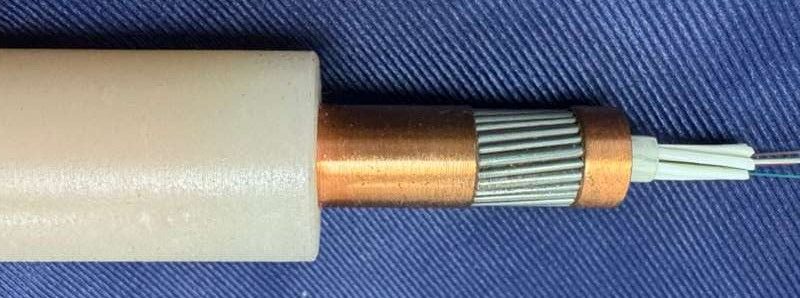
While you may have never heard of TAT-8, there is a good chance you sent some data through it. TAT-8 was the 8th transatlantic communications cable and the first transatlantic fiber-optic cable, carrying 560 Mbit/s on two fibers between Tuckerton, New Jersey, and, thanks to an underwater splitting device, Widemouth Bay, England, and Penmarch, France. Construction of the cable began in 1998. Later that year, the first call, made by [Issac Asimov] took place. The cable was retired in 2002. Now, Subsea Environmental Services is recovering the cable for recycling.
The 6,000 km cable was built by a consortium of companies including AT&T, France Télécom, and British Telecom. The 1.3 micron fiber used special optical repeaters about 40 km apart and cost about $335 million (just shy of a billion dollars today). Designers were optimistic, with some claiming the cable would end the need for future cables or, at least, that the cable would not reach capacity for ten years or more. In reality, the cable was saturated within 18 months. Turns out, the equivalent of 40,000 phone lines wasn’t enough.
In all fairness, the saturation might have been difficult to predict, but it may also have been hastened by the cable itself. In 1989, IBM funded a dedicated T1 link between CERN and Cornell University. Ten months later, [Tim Berners Lee] would use this link to demonstrate his new development: The World Wide Web.
According to Subsea Environmental Services, the cable still looked new after lying on the seabed for four decades. We’ve looked at the tech behind these undersea cables before. Not to mention the history behind the TAT cables.












Wait…how could Isaac Asimov have made the first call in 1988 when he died in 1992?
I meant 1998.
Because it was built in 1988. These editors are almost as bad as Slashdot. I will be demanding a refund soon.
You are both incorrect, it was (the cover band?) Issac Asimov that made the call. /s
Looking it up, it’s cause construction started in 1988 and not 1998, which makes your typo serendipitous?
Yeah because 560mbits make absolutely no sense to build for inter continental infrastructure in 1998…
Wow, the lengths meth heads will go to get a bit of copper…
But seriously, how can the recovery of a bit of scrap cable be worth the effort? Mostly polyethylene and steel, a bit of copper, and some threads of glass.
It’s probably around 10 000 tons of material, which is admittedly a bit mind-boggling. But even at premium scrap prices of $1000/t that’s only $10M.
That will need roughly ten one-month sorties of the MV Maasvliet that’s being used, recovering a thousand tons per trip. I have no idea what the operating cost of that boat is (but 7 crew members and 700 kW of diesel – do your own arithmetic), but it’s easy to imagine how you can eat up that amount of cash pretty quick on-water.
Doesn’t even occur to you that they never intended to abandon it, littering the sea floor, does it.
But how much pollution does the retreival process put into the environment (burning fuel, etc) compared to just leaving the cable there?
I’m no environmental expert, but I’d think there’d be more environmental impact from removing something that’s been lying there for 40 years than just abandoning it there. It’s the argument of people saying they knock over piles or rocks hiking citing how moving rocks kills microfauna, the “damage” has been done, you’re just causing more damage by moving it again.
I don’t even know what it’s like down there under the ocean, are these cables all silted over by now, or still lying on top of a harder surface?
The company has or is recovering TAT-14 and SMW-3 in the recent search of information I read. Just SMW-3 is over 39,000 KM. Interesting that AT&T Bell Labs in New Jersey worked in many of the undersea projects. Also, Lucent Technologies, Alcatel, Alcatel-Lucent, and Nokia.
I found an article about the environmental impact of submarine cables and their recovery, open access, it’s an interesting read https://doi.org/10.1016/j.jenvman.2025.127962
Another article suggested value of recovered submarine cables may be surprisingly high, if sections of the cable can be reused as-is, or if long sections can be recovered with the very long high-quality copper strands intact.
Very thorough study and interesting read. Thanks for sharing.
How does cable recovery work in practice? Thousands of other cables have been installed since 1988 and I would assume that some of them may be crossing the TAT-8. Just pulling on the older (lower) cable would therefore bring a risk of damaging newer (and still active) cables.
Yeah this would be a good article, what is the exact process used? How do they handle overlying cables? What is the process leaving the cable end and coming back to continue, etc?
My guess is that they use an rov to cut the cable where another cable overlies it and either leave a short section in place or pull the cut end under the other cable but IDK.
I was so confused with this article. Until you realise the mistake. Not 1998 it’s 1988!
More than a day later and still not fixed.
Unfortunately, these factual mistakes often don’t get corrected even when they are pointed out in the comments.
The retrieval date in the article must be wrong also than if the cable was down 4 decades it couldn’t have been pulled up in 2002 if laid down, sunk, in 1988.
Not the retrieval date, it was de-commissioned in place in 2002. It is being pulled up now, the article linked is from late 2025 and they had completed their 3rd voyage to recover it.
The picture shown is of an armoured part of the cable, used for a very, very small percentage of the cable lay. The normal cable is about 1cm in diameter and quite flexible.
I SS ac Asimov should be I S aac Asimov. Also 1988, not 1998.
The picture is oddly of a terminated inner core? Here is a picture with the sheath:
https://collection.sciencemuseumgroup.org.uk/objects/co34077/section-of-tat-8-transatlantic-optical-fibre-cable-1989
Sadly this picture also leaves a lot to be desired with showing the inner stackup without termination hardware.
Imagining a world where CERN was shelling out the big bucks for a 1.5MBps line on the only 282MBps line connecting continents is a trip. Although in 1988 I was running DOS off a 5″ floppy and my game off another floppy, it would be years until I got an 80MB HDD
Not sure how big the cross section of this one is, but if it’s reasonable it would be cool if they sold chunks as souvenirs. I’m kind of a telecom nerd, and it would be fun to have a piece of this cable.
Conspiracy theory… they’ll trying to look at how the cable was tapped… or they’re doing something else and this is just the excuse, like searching for the Titanic…
All I can think of is the 1970’s Murder on the Orient Express, with a true Brit expected to say she would wish to make a trunk call to her solicitor, as opposed to a long distance call to her lawyer.