
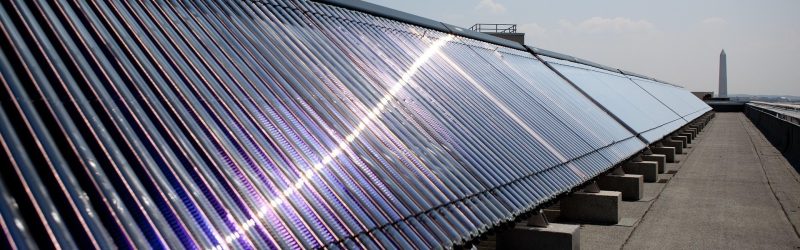
Way, way back in the days when men wore beards and wide-lapelled suits in exotic colors, only NASA had access to photovoltaics and ‘solar’ meant solar thermal. In those days of appropriate technology, it was thought that the ultimate in thermal mass was a phase-change material– a salt or wax that in melting and re-freezing could hold far more heat than plain rock or water, which were more often used. Well, now that it’s the 21st century, we’ve got something even better. As Ars Technica reports about a recent paper in Science Magazine, Molecular Solar Thermal (MOST) energy storage can blow that old stuff right out of the water.
Molecular energy storage? That’s where the sunburn comes in. A sunburn occurs because proteins in your skin are denatured– kinked, twisted, and knocked out of shape– by ultraviolet light. The researchers realized that those kinky proteins are pretty energetic: like a spring, they’re storing energy in their distorted structure. Even better, certain chemicals, like the pyrimidone in the study, don’t ‘relax’ the way a phase change material does. It’s not a matter of warming up and giving up the energy stored in the molecular structure when cooling down– the energy needs coaxed out, in this case by an acidic solution.
That poses problems for a closed-loop system, since you’d be continuously diluting the pyrimidone with heat-releasing acid and neutralizing base. On the other hand, 1.65 MJ/kg of energy storage is nothing to sneeze at, especially when you’re collecting it with nothing more technically advanced than a fluid running through clear tubing. Conveniently enough, researchers found a way to make this stuff liquid at room temperature.
Comparing the heat in this MOST storage material to electrical potential in a battery is a case of apples and oranges, but in terms of pure energy density the pyrimidone cooked up for the paper is in the same range as Li-Ion batteries. There is some self-discharge, in that the altered “dewar” state of the pyrimidone decays naturally, but with a half-life of upto 481 days, you could imagine storing up a tankful UV-altered pyrimidone all year round to provide your winter’s heat.
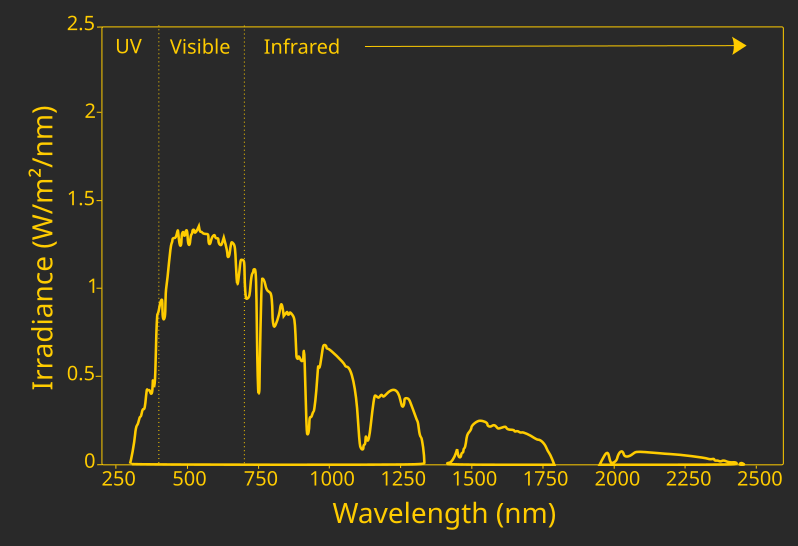
It’s not perfect. Right now you get about 20 “charge cycles” before the molecules break down, but then, if you’re using this for seasonal load-spreading, a two-decade service life is nothing to shake a stick at. It’s only collecting energy from the UV range of the spectrum, which is a tiny fraction of the energy from our sun. The quantum efficiency of the molecule is rather poor as well– it takes a lot of photons to get a dewar transition.
With solar photovaltaics being as cheap as they are, thermal builds are few and far between– even solar water heaters are powered by PV these days. Of course if you’re somewhere that doesn’t get much sun, you could always go for wind power instead.
Thanks to [zit] for the tip! If you’ve seen a bright idea in the wild, or have one yourself, our tips line is open rain or shine.












Because of the awful energetics (requires UV photons), I mean, you’re probably better off efficiency-wise to use PV-generated electricity to synthesize liquid fuel (like a flow battery) and store that, but this is pretty neat.
The energy stored is about 5 times the heat of fusion of water, so pretty significant.
Unfortunately, if they can get it to work with lower energy photons so to capture a greater fraction of the spectrum, it probably will be easier for random thermal motion to flip the stored stuff back to the low energy state, reducing its “half life”.
Also they have a financial incentive to increase the ozone hole and allow more UV through the atmosphere. Ouch.
1.65 MJ/kg of energy! Great Scott!!
= 458 Wh/kg
3450 btu/pound
FREEDOM!
Didn’t you guys dump the British part out with the tea in the Boston harbor a while back?
But you got the conversion incorrect for BTUs, so who knows what unit you’re talking about.
Wide-lapelled suits in exotic colors are out??
Not for you Ian, you keep on trucking.
Dwayne Dibbley is my fashion guru!
I was more curious about when men wore beards in exotic colors.
My powder blue brushed denim leisure suit has turned pink in random places!
Diluting the pyrimidone with acid may not be necessary as there is a technology, bipolar-membrane electrodialysis, which can temporarily adjust pH in a continuous flow without any net change.
This bipolar membrane electrodialysis is currently used on apple juice to shift the pH enough to denature (inactivate) the enzyme that causes browning. Nothing is added or removed from the final juice in this process.
Big issue here is the efficiency – reacting only to 5% of the spectrum, and then only 5-ish per cent of those photon having an effect? Solar panels operate around 20% efficiency, or 80 times more. Sure, Li-ion batteries may be more expensive per kg, but if I need multiple acres to gather enough sun, it’s hard to justify this over solar panels.
The efficacy of this prescription seems dependent on how much water you use for storage. I mean if you have enough water, you don’t need phase change material. And water is pretty cheap.