
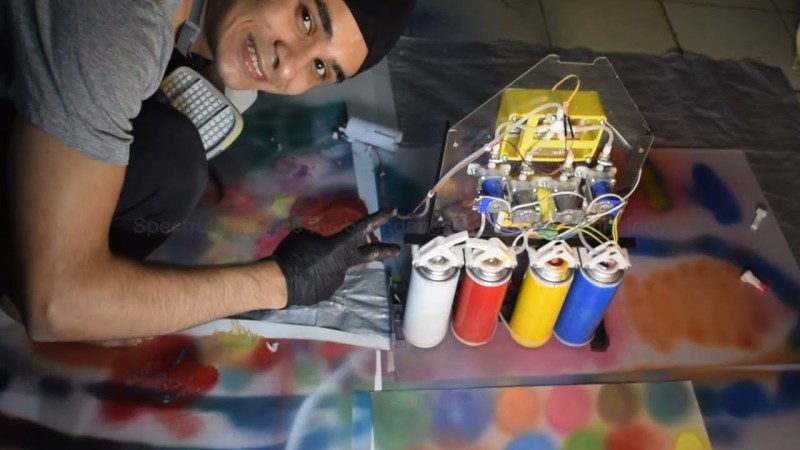
One of the problems with being a graffiti artist is that you have to carry around a different spray can for each color you intend to use. [Sandesh Manik] decided to solve this problem by building a rig that can produce a wider range of colors by mixing the paint from several cans at once.
The project is called Spectrum. It uses four off-the-shelf spray paint cans—colored red, blue, yellow, and white—and mixes them to create a wider range of colors. All four cans are hooked up to a single output nozzle via a nest of tubing and a four-to-one tube manifold. Key to controlling the flow of paint is a custom device which [Sandesh] calls the “rotary pinch valve,” with one fitted to the feed line coming from each spray can. These valves use a motor-driven lever to pinch a plastic tube shut, allowing them to control the paint flow. This design keeps the mechanism and paint completely separate, which was important to stop paint from fouling the valves in short order. It also prevents backflow, which keeps the paint going towards the outlet and prevents ugly messes. By quickly actuating the valve, the paint flow from each can is modulated to mix various colors as desired.
The mixing valves are under the command of an Arduino Nano. The microcontroller reads a series of knobs to select the amount of each component color to mix, and displays relevant information on a screen. Then, when a push button is pressed, the valves are actuated to spit out the right amount of each paint from the atomizer nozzle. [Sandesh] went so far as to include an advanced “gradient” mode, where a force-sensitive button allows the device to transition smoothly from one color to another depending on how hard the button is pushed.
It’s a neat concept which we’d love to see explored further, perhaps with a more traditional selection of CMYK paints rather than the more unusual red, yellow, blue, and white. We’ve also seen some fun spray paint projects before, like this neat wall-mount plotter.












Simple and effective. Very nice.
Very cool. Technically its not hard at all, I wonder why no one has made a machine which can do this till now
It is legal if the owner agrees.
And you have to distinguish vandals who merely spray their tag from artists who make beautiful pictures.
This was supposed to be a reply to Menno
I’ve had some decnt results with a can in each hand, mixing in the air. For a car fender, not somebody’s wall.
I think this method actually detracts from the spontaneous and rushed look of graffiti, which is inherent in what little appeal it has. but good for mural painters.
that is wrong on all accounts.
No.
The CMYK color model is a transparent-media (usually dye-based) subtractive process that works by subtracting colors from the reflected light in the substrate and is not well suited to opaque media, particularly if it’s on a random surface. Misunderstanding how the color system works and how it interacts with the substrate color has led to any number of hilarious failures in commercial use and would likely be a mess here as well.
This device is effectively an RGB+W system that mixes opaque colors on the fly (rather than in overlays) and will work much better with opaque off-the-shelf spray paint, though if you were to digitally map a project from a standard RGB file you’d do better with explicit green rather than mixing blue and yellow to get there.
Nope, graffiti is art; but art can be vandalism if you don’t ask for It.
Forgot to add that the project is working from fundamental primary colors (Red, Blue, Yellow) + white that can be combined to yield any opaque color required and wouldn’t map exactly to RGB either.
Before watching I understood the concept, but I loved the video. It is clear, complete, and heartfelt. And the claymation is brilliant :) Its cool to build a working solution, its beautiful to explain and share that solution well.
it is hard to find a fly big enough to mix spray paint on it without killing it
My gas is art.
Tomorrow at ‘work’, I’ll be performing ‘extra hot kimchi, oldish hard boiled eggs and beer.’
Enjoy fellow slackers.
Just like in HS, I’ll make an effort.
At letting most of it fly in one of the offices.
Standup should be fun.
If this helps keep it short, I might do this every day.
You/I don’t get to decide what’s art, the critics do.
GD critics wouldn’t know an original smell if it hit them in the face.
-Not always
-Not always
-Yes, you are
-Not always
The city of Charleroi, Belgium is known for its industrial decline, but also a lot of city of corporate sponsored graffiti murals of outstanding quality!
-Not always
-Not always
-Yes, you are
-Not always
The city of Charleroi, Belgium is known for its industrial decline, but also a lot of city of corporate sponsored graffiti murals of outstanding quality!
That’s pretty cool. You can do some mixing by hand, but it’s very difficult. This is beautifully simple.
I do think a hue / brightness control setup would be easier though. And I’d add a black can.
The only other thing is you need to switch nozzles a lot when spraying; I remember having two cans of the same colour out with different nozzles. But you can probably switch nozzles on this.
This is super cool. Wonder if it’d work for fragrances?
only if you weren’t invited
that’s subjective
that’s subjective
not if you were invited (see point 1)
Graffiti isn’t tagging.
This was a reply to Menno but Hackaday commenting is broken.
Look up “Gamma Acosta” and tell me that isn’t art. Beautiful work on walls he has permission to work on. And his work in Colorado actually improves many of the property values.
Gamma fan here as well :)
get off my lawn!!!!!
If all three were the case, then why do some people pay them to do their work on their properties?
A point-by-point retort
–it’s not illegal if you do it on your property, or with consent of the owner, or on canvases
–art is subjective
–I’d like to see your art
–see first bullet point
Pretty cool execution of the valving, easy hose replacement if fouled by dry paint.
I’m still hung up on the whole ugly comment, ’cause everything we build here is considered ugly to the unwashed masses of muggles who never once wonder how anything works, and never care to make anything or learn more than they have to.
I wonder if this system would be better served by using systolic pumps that are driven by servo motors?
I think it would offer much more control over the mixture, and an additional benefit would be total control over nozzle pressure. I’d imagine programming it to be automatic would be kinda tough, but maybe keep it simple and have a simple servo driver for each that is just controlled by a knob.
With the systolic pumps they’d probably want to incorporate some sort of high pressure limit/cutoff though.
But yeah, this idea is pretty cool. At a customer job site I watched a contracted artist paint a 20ft x 9ft mural with aerosol rattle-cans. It was a cool process to watch. Took several days and many many spray cans! I’d image a system like this would greatly reduce the amount of inventory he’d need to stock for jobs.
Whoops, I ment a peristaltic pump, not systolic.
The type of pump that uses rollers to pinch a hose and meter fluids. Can’t edit my comment for some reason…
If a famous graffiti artist “damages” your ugly fence, it would be valued x times its initial price.
Tagging absolutely sucks and ticks all those boxes, but not everyone using spraypaint on a wall is tagging.
“The city of Charleroi, Belgium is known for its industrial decline, but also a lot of city of corporate sponsored graffiti murals of outstanding quality!”
Here in North Central Indiana, several cities have very well done murals on various buildings. They are definitely art, some of them are amazing. Kokomo, IN has a lot of very good commisioned murals.
you are probably thinking of the “tags” and yes that is ugly. but allot of people make great portraits aswell. In the netherlands they put this art on buildings that will be demolished later, and its nice to see.
The problem with your comment is :
– Graffiti isn’t illegal, only illegal graffiti is
– It’s paint so as any artistic movement its esthetics qualities varies and what you may find ugly is beautiful in someone else eye
– Graffiti makers are artist
– Only illegal graffiti woule be able to damage other people’s properties and even then the “damage” verb is strong as covering a surface like wall with multiple layers of paint, protect it from the weather (see what they’re doing to boats hull)
I know your comment was a bait but please think before posting wrong statements publicly.
+1
What an absolutely not insightful and hateful thing to say.
Did you know there are countries where graffiti artist are not only a thing, but sponsored by the government to beautiful boring walls and public infrastructure?
Let’s look at what Wikipedia has to say about graffiti:
“Graffiti (singular graffiti, or graffito only in graffiti archeology) is writing or drawings made on a wall or other surface, usually without permission … In most countries, marking or painting property without permission is considered vandalism.”
So yes, usually illegal.
“Graffiti is distinguished from murals, an often permitted form of street art.”
So if it’s art, it’s a mural, not graffiti.
OK, let me clarify: about 99% percent of graffiti is ugly, illegal, damaging and artistic.
The cost for companies to clean it up is immense.
Just the railway company in this tiny country spends ten million euro per year in cleaning graffiti of their rolling stock and infrastructure. Acid in paint damages the lacquer on trains, causing scratches.
And of course someone is going to claim paint does not do that, so check for yourself:
https://www.treinreiziger.nl/ns-gaat-schade-graffiti-4-ton-verhalen-op-daders/
There maybe some exceptions, but as a whole, graffiti sucks.
As do most of our commenters (although the threading got horribly broken because of back-end BS), I disagree on all four counts. As does most of the art world, these days — your world view is dated.
Anyway, talk about this project. It’s fantastic! That bit where he has the trigger control the setpoint along a color-mix gradient? That’s brilliant, and enables artistic effects that are otherwise impossible.
100% awesome hack. And that’s what we’re here for anyway, no?
All right, it is a pretty good hack. And the 2 examples of the artwork produced with it that I see in the original article are indeed comparable to some the best work I’ve seen done the old fashioned way. I’d like to see this tool in the hands of other top-end street artists to see what they think.
Having to deal with sprayed train cars all day for about 10 years now, there are very few kinds of people I hate more than sprayers. In all that time I have seen (and photographed) 2 (in words: two) graffitis that were not utter garbage. On the other hand I have to deal daily with tarps which originally could be opened and closed single-handed, but due to paint now require two people pulling with full force. I have to sort out the cars, where the tarp snapped out of the guide rail due to this, and where markings became unreadable. I have to do the paperwork to get them cleaned up, and I have to put them back into the train after they were cleaned with oftentimes very aggressive detergents (let’s not talk about environment, cost and work safety here).
One time after sorting out a freshly sprayed car someone snuck up behind my back while shunting, changed a switch just in front of the locomotive and destroyed a railway crossing.
Another time freshly painted museum cars were sprayed the second night before a tour, and we had to grind off and reapply the paint within the 36 hours left. The time was too short for the paint to dry, so we coud not apply all the legal markings on the cars — in the end we just taped the stencils in place.
You appear to have it mixed up – paints are a subtractive color system. You already commented that mixing blue and yellow makes green – which confirms its not an RGB color system.
Light is an additive color system, so it can be represented by RGB pixels. This obviously makes sense, because paint doesn’t emit any light so it can only subtract color, where as light cannot remove colors it can only combine, so it is additive.
This was meant as a reply to thinkerer, sorry
I saw a guy painting an interior wall by using virtual image and spraying exactly where needed. He had to change colors a lot. This would be the perfect tool for that – RGB (as described below) would be better.