
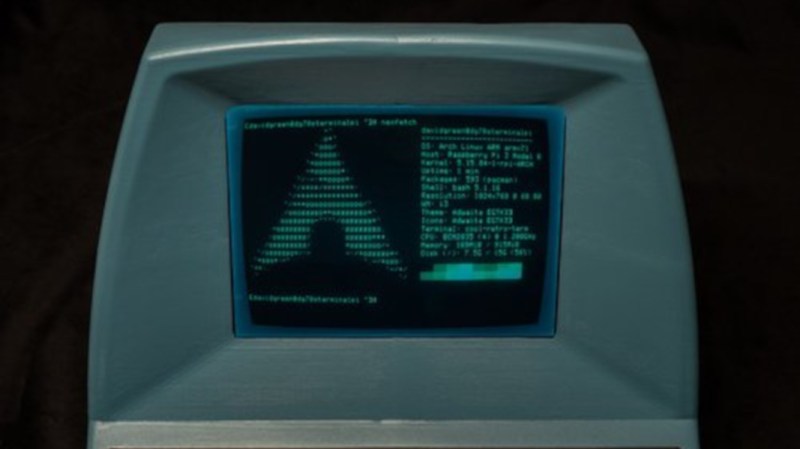
Not so long ago, most computer users didn’t own their own machines. Instead, they shared time on mainframes or servers, interacting with this new technology through remote terminals. While the rise of cloud computing and AI might feel like a modern, more dystopian echo of that era, some look back on those early days with genuine fondness. If you agree, check out this 70s-era terminal replica from [David Green].
The inspiration for this build was a Lear Siegler ADM-3A terminal seen at a local computer festival. These machines had no local computing resources and were only connected to their host computer via a serial connection. The new enclosure, modeled on this design, was 3D-printed and then assembled and finished for the classic 70s look. There are a few deviations from a 70s terminal, though: notably, a flat LCD panel and a Raspberry Pi 3, which, despite being a bit limited by today’s standards, still offers orders of magnitude more computing power than the average user in the 70s would have had access to.
On the software side, there are a few modifications to allow the Pi 3 to emulate a CRT-style display. It also runs the i3 windows manager, which was the easiest way to replicate the feel of an old terminal without going command-line-only. With the Pi’s computing power available, though, it’s easier to run emulators for older computer systems, and there’s perhaps no better way to get a sense of how these systems behaved than to use a replica from the era. Another excellent way is to completely reimagine what these computers could have been like in an alternate past.












Read/Write error…I/O…que….yep
“Mom said to never post while drinking.”
Isn’t it past your bedtime, Billy?
Cool build. The ADM-3a was my second choice when I went to do something like this. Instead I did a reinterpreted DEC VT05 (https://tinkerfarm.net/reinterpreting-a-vintage-computer-terminal/). It runs a host of redone text games from the era from the console.
If I recall correctly, the “magic cookies” for changing text types (bold, underline, reverse) took up a space on the display screen for ADM-3A – so you always had a space before and after a change in any of those characteristics.
I remember using the line editor for the Cyber 7600 and stringing a bunch of commands on a single line – then entering the display command to see that I had messed up 20 lines of my program.
What a world we live in where a four-processor, 1GB, wirelessly-connected computing platform the size of a credit card is considered “limited”.
Zawinski’s Law is alive and well, it seems.
IIRC that was common to most terminals of the day. Reasonably sure it was the case for the Televideo 925’s that I used (and compatibles like the TeleVideo 950, Wyse 50, 75, etc.)
Oops, mistakenly reported your comment
I do it all the time, because there’s two links starting with R. My ADHD has reduced my attention span such that it’s now just “A”.
I have a few in the garage now along with a TRS80 and a Super Pet. I’ve found some notes on interfacing with the original keyboards.
That’s a pretty sweet one as well. I see you got the chair too!
These days that’s not even a good mobile telephone. Modern technology is insane.
For me it’s the amount of storage on a micro SD card that boggles my mind, even our wildest sci-fi didn’t imagine we could fit gigabytes or even terabytes into something that you could hide under a postage stamp.
Ah I see comments are broken again… I was replying to SBRK.